International trade generates enormous volumes of shipment records, customs transactions, product classifications, buyer and supplier information, trade values, quantities, countries, ports, and historical market movements. Finding the right information from this volume of data can be difficult when conventional database searches require users to know exactly what product, HS code, country, company, or trade parameter they need. This is where TradeImeX AI Search changes the way businesses explore trade intelligence and global trade data.
Instead of relying only on multiple filters and individual database queries, users can describe a complete business question in natural language and use AI-assisted analysis to discover relevant import export data, market patterns, companies, products, and trade opportunities. For companies involved in sourcing, exporting, importing, market research, business development, and competitive intelligence, understanding how to use an AI-powered trade data search tool effectively can make research faster and more focused.
What Is TradeImeX AI Search?
AI Search is an AI-powered search capability within the global trade intelligence ecosystem of TradeImeX. It allows users to ask business and market-related questions in natural language rather than depending entirely on conventional search fields. For example, instead of separately selecting a country, product category, HS code, year, and trade direction, a user can ask:
“Who are the major exporters of Mongolia under HS code 27?”
Or:
“Give me HS code 85 import data of the Philippines”
The objective is not simply to retrieve a number. The AI-assisted approach helps users move from a basic trade data search toward a broader understanding of what the underlying data means.
The platform covers extensive global trade data, including customs, statistical, and bill-of-lading datasets across more than 100 markets. Depending on the dataset and query, users can research products, HS codes, countries, trade flows, shipment activity, buyers, suppliers, and market trends. Global trade data powered by AI-driven market research is becoming increasingly popular, according to the International Trade Council.
How to Use TradeImeX AI Search
1. Start With a Specific Business Question
The quality of an AI-assisted search depends heavily on the question being asked.
A vague query such as:
“Tell me about electronics.”
can produce a broad result.
A more useful query would be:
“Analyze the top electronics importers in the Philippines from 2022 to 2025 and identify the major product categories.”
The second question provides a product area, country, trade direction, destination, and time period. When conducting an AI trade data search and AI-powered market research, try to include at least three or four relevant parameters:
Product or commodity
Importing or exporting country
Trade direction
Time period
HS code, if known
Buyer or supplier requirement
Port, where relevant
Value, quantity, or growth requirement
This gives the system clearer context and makes the resulting analysis more commercially useful.
2. Ask Questions Using Natural Language
One of the biggest advantages of AI is that users do not necessarily need to remember every database field.
For example, a traditional import export data search may require users to know exactly where to enter a country, product, HS code, and date range.
With AI Search, a business user can instead ask:
“Show me Sri Lanka's major tea export markets and explain how exports have changed in recent years.”
or:
“What is the fish export data of the Maldives under HS code 03?”
The system can interpret the intent behind the query and connect relevant trade parameters.
This makes AI particularly useful for researchers who understand the business question but may not know the exact database terminology required to retrieve the answer.
3. Use HS Codes When Precision Matters
Natural-language searches are useful for exploration, but HS codes can significantly improve precision. Products may have different names across countries and industries. For example, the term “smartphone” may correspond to a specific HS classification, while a broad search for “mobile electronics” can cover several categories. If the HS code is known, include it in the query. For example:
“Analyze HS code 85 export data of the Philippines.”
This combines AI-driven interpretation with structured classification. For more advanced research, users can also ask questions that combine HS codes with countries, companies, years, or trade values.
4. Add a Time Period to Identify Trends
A single year's trade value provides a snapshot. A multi-year search can reveal the direction of a market. Instead of asking:
“What is the latest banana export data of Philippines under HS code 08?”
Ask:
“Give me banana export data of the Philippines?”
This allows users to investigate changes in trade value, market share, demand, and product composition. Time-based queries are especially useful for identifying:
Growing markets
Declining markets
Emerging destinations
Product demand changes
Shifts in sourcing countries
Changes in export concentration
5. Ask Follow-Up Questions
AI Search becomes more useful when research is treated as a conversation rather than a single query. For example, a user could begin with:
“Show fish exporters in the Maldives under HS code 03.”
Then continue:
“Which destination grew fastest?”
Then:
“What were the Maldives’ leading fish products shipped to that market?”
And finally:
“Identify major buyers associated with those shipments.”
This approach can turn one broad research requirement into several connected investigations. Instead of repeatedly starting a new trade data search, users can progressively narrow their research around the information that matters most.
6. Combine Product and Country Intelligence
A common mistake in trade research is looking at a product without examining the markets connected to it. For example, an exporter researching rubber could ask:
“Which countries imported the most electronics from the Philippines in 2025?”
This product-country combination can help businesses understand where demand exists and which markets deserve deeper research. It is particularly useful for exporters looking for potential destinations and importers evaluating alternative sourcing countries.
7. Use AI to Move From Data to Insights
The most important difference between basic database retrieval and AI for import export data is the ability to ask analytical questions around the data. Users can ask questions such as:
Which markets are growing fastest?
Which countries are becoming major suppliers?
Which products account for the largest share of exports?
Which markets have experienced declining imports?
What are the major sourcing countries for a particular product?
Which HS codes dominate a country's imports?
What trade patterns have changed over the last five years?
This addresses the broader question: How can AI help with trade data?
AI can help simplify complex trade research by interpreting natural-language questions, organizing relevant information, identifying patterns, and helping users investigate follow-up questions without manually constructing every individual search.
8. Use the Right Dataset for the Question
Not every trade question requires the same type of data. TradeImeX provides different forms of trade intelligence, including:
Customs Data: Useful for detailed shipment-level research, including companies, products, quantities, ports, and other transaction-level information where available.
Statistical Data: Useful for studying country-level import and export values, product categories, trade partners, historical trends, and market-level patterns.
B/L Data: Useful for bill-of-lading & shipment-related research, particularly when investigating shipment movements and associated trade participants where available.
Understanding the difference between datasets helps users formulate more precise questions. For example, a market-size or country-level trade trend question may be more appropriate for statistical data, while a company-focused shipment investigation may require customs or B/L information.
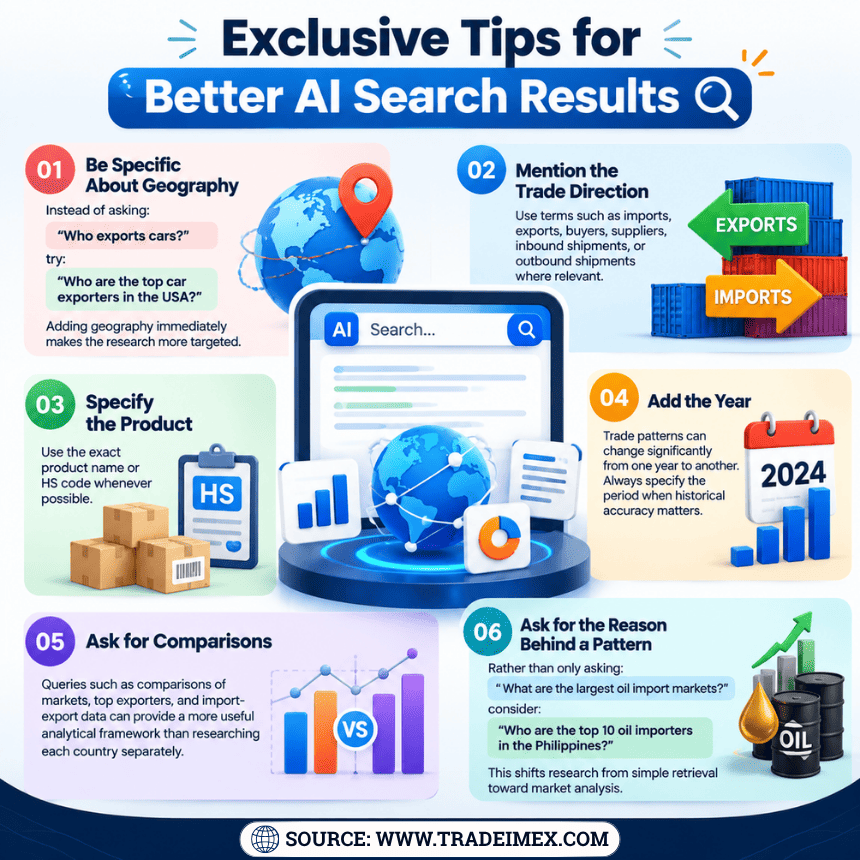
Exclusive Tips for Better AI Search Results
1. Be Specific About Geography
Instead of asking:
“Who exports cars?”
try:
“Who are the top car exporters in the USA?”
Adding geography immediately makes the research more targeted.
2. Mention the Trade Direction
Use terms such as imports, exports, buyers, suppliers, inbound shipments, or outbound shipments where relevant.
3. Specify the Product
Use the exact product name or HS code whenever possible.
4. Add the Year
Trade patterns can change significantly from one year to another. Always specify the period when historical accuracy matters.
5. Ask for Comparisons
Queries such as comparisons of markets, top exporters, and import-export data can provide a more useful analytical framework than researching each country separately.
6. Ask for the Reason Behind a Pattern
Rather than only asking:
“What are the largest oil import markets?”
consider:
“Who are the top 10 oil importers in the Philippines?”
This shifts research from simple retrieval toward market analysis.
TradeImeX AI Search vs. Conventional Trade Data Search
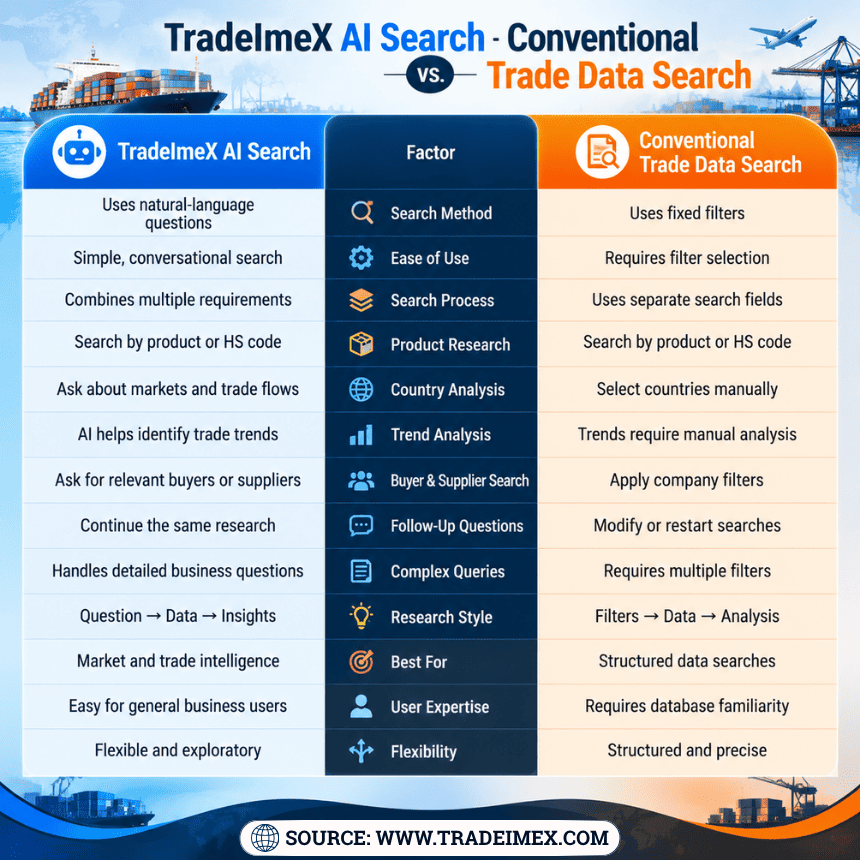
A conventional trade data search is highly effective when users already know the exact filters they want. Structured filters can provide precise results for products, HS codes, countries, companies, ports, and dates.
AI Search adds another layer by allowing users to describe the business problem in natural language. The two approaches can therefore work together. TradeImeX users can use precise filters through Live Search when they know exactly what they need, while AI Search can help when the research question is broader, analytical, or difficult to translate into individual database filters.
This combination makes the platform more than a conventional database. It functions as a trade intelligence platform designed to support both structured data discovery and AI-assisted research.
Factor | TradeImeX AI Search | Conventional Data Search |
Search Method | Uses natural-language questions | Uses fixed filters |
Ease of Use | Simple, conversational search | Requires filter selection |
Search Process | Combines multiple requirements | Uses separate search fields |
Product Research | Search by product or HS code | Search by product or HS code |
Country Analysis | Ask about markets and trade flows | Select countries manually |
Trend Analysis | AI helps identify trade trends | Trends require manual analysis |
Buyer & Supplier Search | Ask for relevant buyers or suppliers | Apply company filters |
Follow-Up Questions | Continue the same research | Modify or restart searches |
Complex Queries | Handles detailed business questions | Requires multiple filters |
Research Style | Question → Data → Insights | Filters → Data → Analysis |
Best For | Market and trade intelligence | Structured data searches |
User Expertise | Easy for general business users | Requires database familiarity |
Flexibility | Flexible and exploratory | Structured and precise |
Why AI Search Matters for Import-Export Research
International trade research increasingly requires more than identifying a single shipment or annual trade value. Businesses need to understand markets, competitors, sourcing patterns, product demand, and changes in international trade flows. An AI search for import export data can reduce the friction between a business question and the underlying trade information. For example, an exporter may want to know:
“Which countries imported the most products under my HS code, and which markets have shown sustained growth?”
An importer may ask:
“Which countries are the largest suppliers of this product to the Philippines?”
A market researcher may ask:
“How has global trade in this product changed over the past five years?”
These questions can become starting points for deeper research using trade data.
From Search to Trade Intelligence
The real value of AI-assisted research is not simply getting an answer faster. It is being able to ask better questions & investigate the information from multiple angles. A typical workflow could be:
Business Question → AI Search → Relevant Trade Data → Trend Analysis → Company/Product Research → Market Intelligence → Business Strategy
This approach can help transform raw import export data into actionable research. Whether the objective is identifying potential markets, studying competitors, researching suppliers, analyzing buyers, monitoring product demand, or understanding international trade trends, effective prompting is an important part of extracting value from an AI-powered trade data platform.
Conclusion and Final Takeaway
Trade data contains valuable information, but finding the right information traditionally requires time, database knowledge, and carefully structured searches. Our AI Search brings natural-language interaction into this process, allowing users to explore complex trade questions more intuitively. The best results come from combining specific products, countries, HS codes, trade directions, and time periods with clear business questions. Users can then follow up with deeper questions to uncover market trends, company information, sourcing patterns, and product opportunities.
As AI for import/export data continues to evolve, the ability to move seamlessly between natural-language questions and structured trade intelligence can become an important part of modern market research. TradeImeX brings these capabilities together across its global trade database, helping businesses move from simple trade-record searches to deeper, data-driven trade intelligence. Contact info@tradeimex.in for more information on AI-powered trade research, or to search live data by country or HS code and get customized trade reports & market insights for your business.
Frequently Asked Questions
1. What is TradeImeX AI Search?
TradeImeX AI Search is an AI-powered search tool that allows users to explore global trade data using natural-language questions. Users can search for products, countries, HS codes, buyers, suppliers, trade trends, and other import-export information without relying entirely on traditional database filters.
2. How can AI help with trade data?
AI can simplify trade research by interpreting natural-language questions, connecting multiple search parameters, identifying relevant trade information, and helping users analyze trends. It can make complex trade data search more intuitive and help users move from raw data toward meaningful trade intelligence.
3. What type of questions can I ask AI Search?
Users can ask questions about imports, exports, products, HS codes, countries, buyers, suppliers, trade values, historical trends, and market opportunities. For example, users can ask which countries import a particular product, how trade has changed over several years, or who the major buyers or suppliers are in a specific market.
4. How can I get better results from the AI Search Tool?
For more precise results, include specific details such as the product name, HS code, importing or exporting country, trade direction, and time period. Instead of asking a broad question, provide a complete business requirement. You can also use follow-up questions to investigate specific trends or companies identified in the initial search.
5. How is TradeImeX AI Search different from a traditional trade data search?
Traditional searches generally require users to select individual filters and database parameters. AI Search allows users to describe their research requirement in natural language and then explore relevant import-export data and trade insights. Users can also combine AI Search with structured Live Search for more detailed and precise research.
Explore the latest global trade trends, market insights, import-export analysis, and industry updates with TradeImeX blogs.
Request a Data Sample →
Tradeimex
TradeImeX’s content team brings together expertise in global trade data, import-export trends, market intelligence, and international business. Our writers turn complex trade data into clear, actionable insights to help businesses understand markets, identify opportunities, and make informed decisions. From emerging trade trends to country and product-level analysis, we focus on delivering timely insights backed by reliable data.