
The global fruit industry is a major component of international agricultural trade, supplying fresh produce, processed foods, and raw materials to markets worldwide. From bananas & mangoes to apples, citrus fruits, grapes, & avocados, fruit production supports millions of farmers, exporters, importers, wholesalers, and food-processing businesses. In 2025-26, global fruit trade continues to be influenced by changing consumer preferences, weather conditions, agricultural productivity, and demand for year-round fruit supplies. According to the latest global trade data and fruit export data under HS code 08, the total value of global fruit exports reached $180.02 billion in 2025, a 10.6% increase from the previous year.
These statistics demonstrate the enormous scale of the global fruit economy. However, the largest fruit producers are not necessarily the largest exporters because domestic consumption, processing requirements, product varieties, and international market access influence export performance. This article examines the latest available fruit production statistics, leading producing countries, major fruit-exporting markets, HS codes, and international trade opportunities for 2025-26.
World Fruit Export Data 2025-26: Global Market Overview
The global fruit market includes fresh, dried, frozen, and processed fruit products. International trade connects major agricultural producers with countries where climatic conditions, seasonal availability, or local production cannot meet consumer demand. For consistent international comparisons, HS Code 08 is an important starting point. It covers edible fruit and nuts, as well as peel of citrus fruit and melons. However, this category includes nuts and certain other products, so its total export value should not be described as the value of fruit alone.
Key global fruit trade statistics:
Global exports under HS Code 08: around $180.02 billion in 2025.
Global imports under HS Code 08: around $192.67 billion in 2025.
Leading exporter by value: United States, with around $18.02 billion.
Second-largest exporter: Spain, with around $13.20 billion.
Third-largest exporter: Netherlands, with around $10.52 billion.
Other leading exporters: Chile and Mexico.
Fruit Exports by Country: Who Are the Top 10 Fruit Exporting Countries?
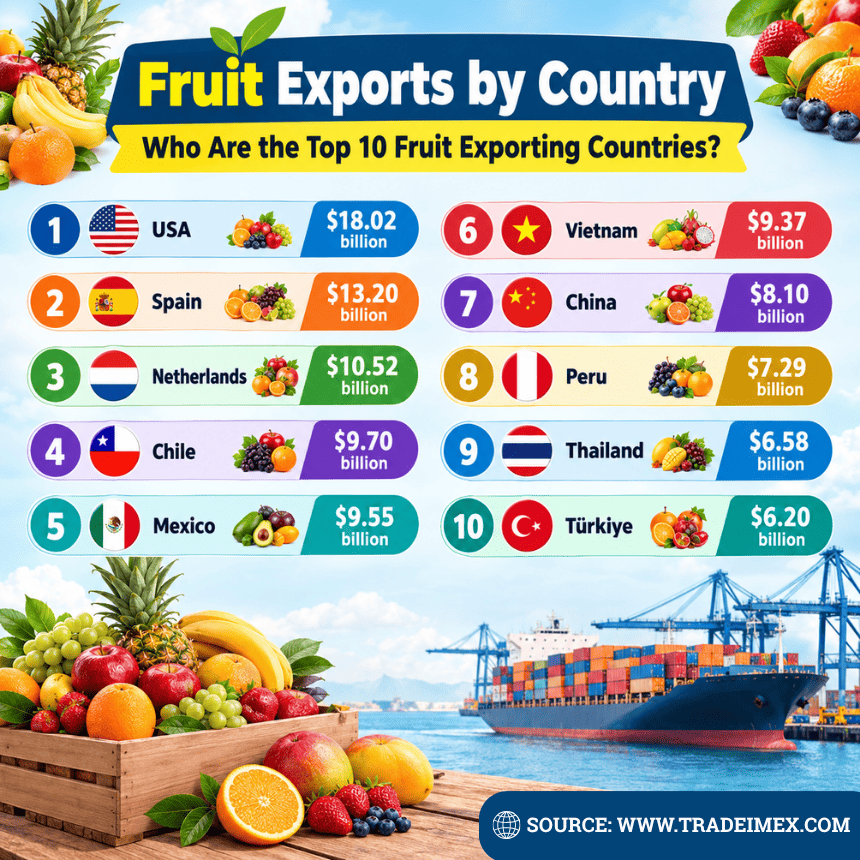
When it comes to fruit exports by country, the top 10 fruit exporting countries play a significant role in the global market. These countries showcase impressive agricultural outputs and trade contributions, making them key players in the fruit export industry. With diverse fruit offerings and sustainable farming practices, countries like the United States, Spain & the Netherlands consistently top the list of fruit-exporting nations. The USA is the largest fruit exporter in the world, according to the US fruit export data with several companies driving its export growth, as per the US fruit exporters & suppliers database. The top 10 fruit exporters in the world, according to the fruit shipment data for 2025, include:
1. USA: $18.02 billion (10%)
2. Spain: $13.20 billion (7.3%)
3. Netherlands: $10.52 billion (5.8%)
4. Chile: $9.70 billion (5.4%)
5. Mexico: $9.55 billion (5.3%)
6. Vietnam: $9.37 billion (5.2%)
7. China: $8.10 billion (4.5%)
8. Peru: $7.29 billion (4.1%)
9. Thailand: $6.58 billion (3.7%)
10. Türkiye: $6.20 billion (3.4%)
Top 10 Fruit-Producing Countries in the World
Fruit production statistics help identify countries with substantial agricultural capacity and the potential to supply domestic and international markets. The following ranking uses the latest comparable country-level production figures available in the cited FAOSTAT-based dataset, covering 2025. The figures measure total fruit production in metric tons. They do not represent export quantities, export values, or the amount of fruit available for international sale.
According to FAOSTAT-based production statistics, China produced around 274.01 million tons of fruit in 2025, followed by India at 112.91 million tons and Brazil at 41.57 million tons. Meanwhile, international trade data recorded around $145.86 billion in global exports under HS Code 08, covering edible fruit and nuts, in 2025. The United States, Spain, Mexico, the Netherlands, and Vietnam were among the leading exporters by value.
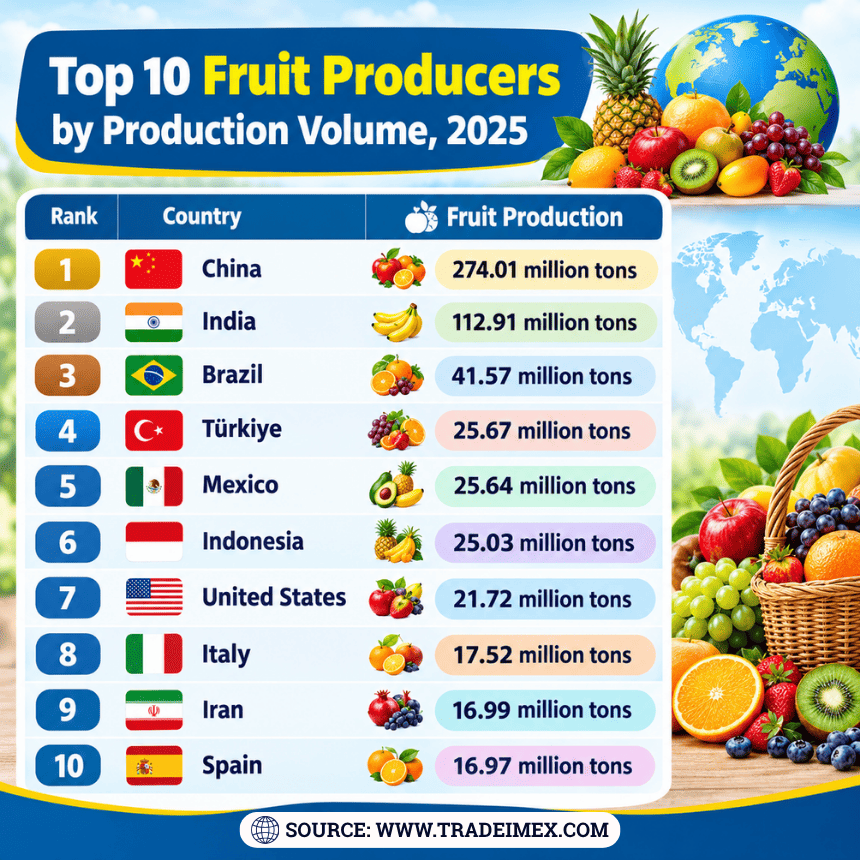
Top 10 Fruit Producers by Production Volume, 2025
Rank | Country | Fruit Production |
1 | China | 274.01 million tons |
2 | India | 112.91 million tons |
3 | Brazil | 41.57 million tons |
4 | Türkiye | 25.67 million tons |
5 | Mexico | 25.64 million tons |
6 | Indonesia | 25.03 million tons |
7 | United States | 21.72 million tons |
8 | Italy | 17.52 million tons |
9 | Iran | 16.99 million tons |
10 | Spain | 16.97 million tons |
1. China: The World's Largest Fruit Producer
China ranked first in global fruit production in 2025, recording around 274.01 million tons, according to China export data. Its production increased by around 1.42% compared with 2024, when output reached around 270.18 million tons. The country's extensive agricultural sector produces apples, citrus fruits, pears, grapes, peaches, and numerous other fruit varieties. Large domestic markets absorb a substantial portion of this production, while international sales depend on specific commodities, quality standards, prices, and destination-country requirements.
China's production scale makes it an important country for fruit market research. Businesses examining Chinese fruit trade should distinguish between domestic production, fresh fruit exports, processed fruit exports, and imports of varieties that are unavailable or seasonally limited locally.
2. India: A Major Producer of Tropical Fruits
India produced around 112.91 million tons of fruit in 2025, placing it second in the global ranking. Its agricultural output includes bananas, mangoes, guavas, citrus fruits, grapes, papayas, pomegranates, and other commercially important crops. Different climatic zones allow fruit cultivation across multiple seasons, although individual crops remain sensitive to rainfall, temperature, and regional harvesting cycles.
India also participates in international trade through fresh fruit exports and processed products such as pulp, juice, and dried fruit. Export opportunities depend on consistent quality, appropriate packaging, phytosanitary compliance, and access to refrigerated transport where required. For international buyers, India offers a broad range of potential fruit suppliers. Nevertheless, production volume alone is insufficient to determine export availability or supplier reliability.
3. Brazil: A Leading Latin American Fruit Producer
Brazil recorded around 41.57 million tons of fruit production in 2025. The country is well known for citrus fruits, oranges, bananas, mangoes, papayas, & other tropical produce, according to Brazil export data. Its citrus industry also supplies raw materials to juice and food-processing businesses, connecting agricultural production with value-added exports.
Brazil's fruit trade opportunities vary according to the commodity. Fresh fruit exporters must manage transport times and product quality, while processed fruit businesses face different packaging, processing, and market-access requirements.
4. Türkiye: A Diverse Fruit-Producing Economy
Türkiye produced around 25.67 million tons of fruit in 2025. Its agricultural sector supplies apples, grapes, citrus fruits, cherries, apricots, & other products. Geographic proximity to European, Middle Eastern, & regional Asian markets provides opportunities for international distribution.
Seasonal supply, weather conditions, grading standards, and trade costs influence export performance. Businesses sourcing Turkish fruit should compare individual commodity statistics rather than treating the country's entire fruit production as exportable supply.
5. Mexico: An Important Fruit Exporting Country
Mexico recorded around 25.64 million tons of fruit production in 2025. Its commercial fruit sector includes avocados, mangoes, berries, limes, and other tropical and subtropical produce. Mexico also benefits from established trade links with the United States, providing access to a large consumer market.
Its export performance is supported by specialized growing regions and established supply chains. However, demand, harvest timing, phytosanitary rules, and competition from alternative origins affect the performance of individual fruit categories. Mexico's position in the global fruit industry demonstrates how agricultural production can translate into substantial international trade when supported by market access and distribution infrastructure.
6. Indonesia: A Major Southeast Asian Producer
Indonesia produced around 25.03 million tons of fruit in 2025. Its tropical climate supports bananas, pineapples, mangoes, papayas, and numerous other varieties. Domestic demand accounts for a significant share of production, creating a different relationship between output and export availability than in countries with more export-oriented agricultural sectors.
International opportunities include regional Asian markets and selected tropical fruit categories. Island geography, transportation costs, post-harvest handling, and quality consistency remain important considerations for businesses evaluating Indonesian suppliers.
7. United States: A Major Producer and Exporter
The United States produced around 21.72 million tons of fruit in 2025. Its commercial agriculture includes apples, grapes, berries, citrus fruits, peaches, and other products. The country is also a major participant in international trade under HS Code 08, with reported exports of around $16.42 billion in 2025.
This export total includes edible nuts and other products within the HS category, so it should not be interpreted as fresh fruit exports alone. The United States is simultaneously a major importer of fruit. Seasonal gaps, consumer demand, and the need for year-round availability create opportunities for overseas suppliers.
8. Italy: A Major European Fruit Producer
Italy produced around 17.52 million tons of fruit in 2025. Its agricultural regions support grapes, apples, pears, citrus fruits, peaches, and other crops. Italy's production base serves fresh-produce markets, food processors, and international customers.
The country also benefits from access to established European distribution networks. Export competitiveness depends on fruit variety, product quality, seasonal availability, and compliance with retailer and destination-market requirements.
9. Iran: A Significant Regional Fruit Producer
Iran recorded around 16.99 million tons of fruit production in 2025. Its agricultural output includes apples, grapes, dates, citrus fruits, & other products cultivated across different climatic regions. Regional demand can provide opportunities for fruit trading and distribution.
However, international transactions involving Iran can be affected by trade restrictions, applicable sanctions, payment arrangements, and transport constraints. Businesses should conduct appropriate legal and commercial due diligence before evaluating specific trade opportunities.
10. Spain: A Leading European Fruit Supplier
Spain produced around 16.97 million tons of fruit in 2025. Its Mediterranean climate supports citrus fruits, grapes, peaches, nectarines, berries, and other produce. Spain is also an important exporter, particularly in categories such as citrus fruit.
Spain exports under HS 0805, covering fresh or dried citrus fruits, reached around $3.66 billion in 2025. Spain's position illustrates the importance of analyzing individual export categories. A country's total fruit production may provide a useful overview, but product-level trade data offers more direct insight into its international competitiveness.
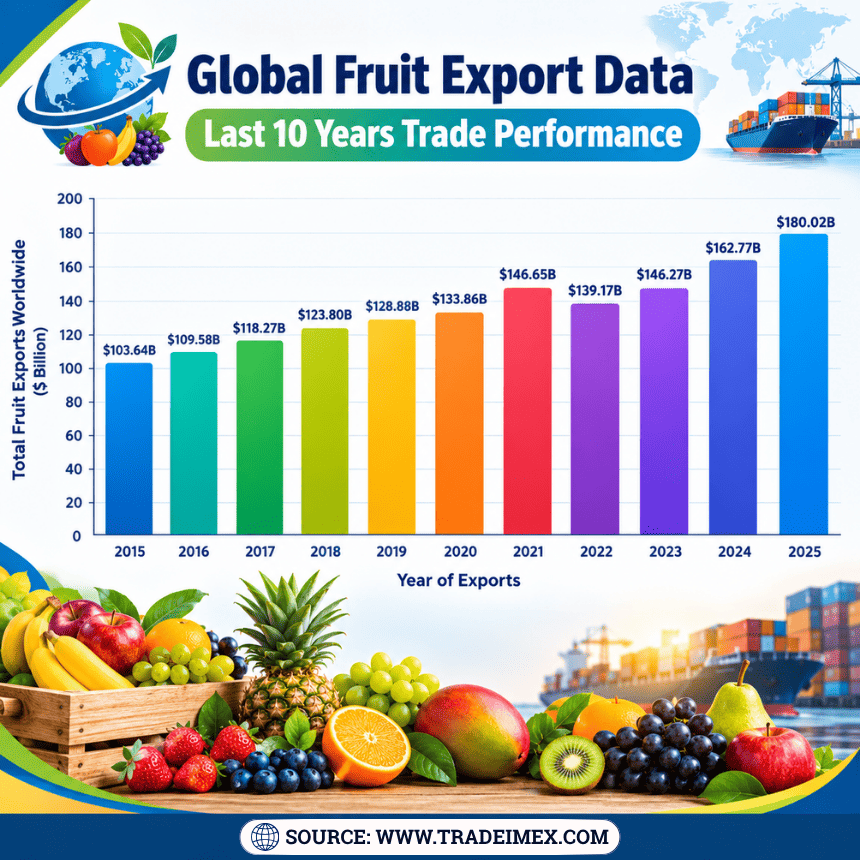
Global Fruit Export Data: Last 10 Years Trade Performance
Year of Exports | Total Fruit Exports Worldwide ($) |
2015 | $103.64 billion |
2016 | $109.58 billion |
2017 | $118.27 billion |
2018 | $123.80 billion |
2019 | $128.88 billion |
2020 | $133.86 billion |
2021 | $146.65 billion |
2022 | $139.17 billion |
2023 | $146.27 billion |
2024 | $162.77 billion |
2025 | $180.02 billion |
Major Fruit Export Categories Under HS Code 08
HS codes allow importers, exporters, and market researchers to analyze trade by individual product rather than relying on broad agricultural categories. The following codes are particularly relevant to the global fruit industry:
HS 0803 — Bananas: Covers bananas, including plantains, fresh or dried.
HS 0804 — Dates, figs, pineapples, avocados, guavas, mangoes, and mangosteens: Covers important tropical fruit categories.
HS 0805 — Citrus fruits: Includes oranges, mandarins, lemons, limes, and other citrus fruit, fresh or dried.
HS 0806 — Grapes: Covers fresh or dried grapes.
HS 0807 — Melons and papayas: Covers melons and watermelons, as well as papayas.
HS 0808 — Apples, pears, and quinces: Covers important temperate fruit categories.
HS 0809 — Apricots, cherries, peaches, plums, and similar fruit: Covers several commercially important stone fruits.
HS 0810 — Other fresh fruit: Includes strawberries, raspberries, blueberries, kiwifruit, and other fresh fruits not classified elsewhere in Chapter 08.
Top 10 Fruits Exported Under HS Code 08 (2025-26)
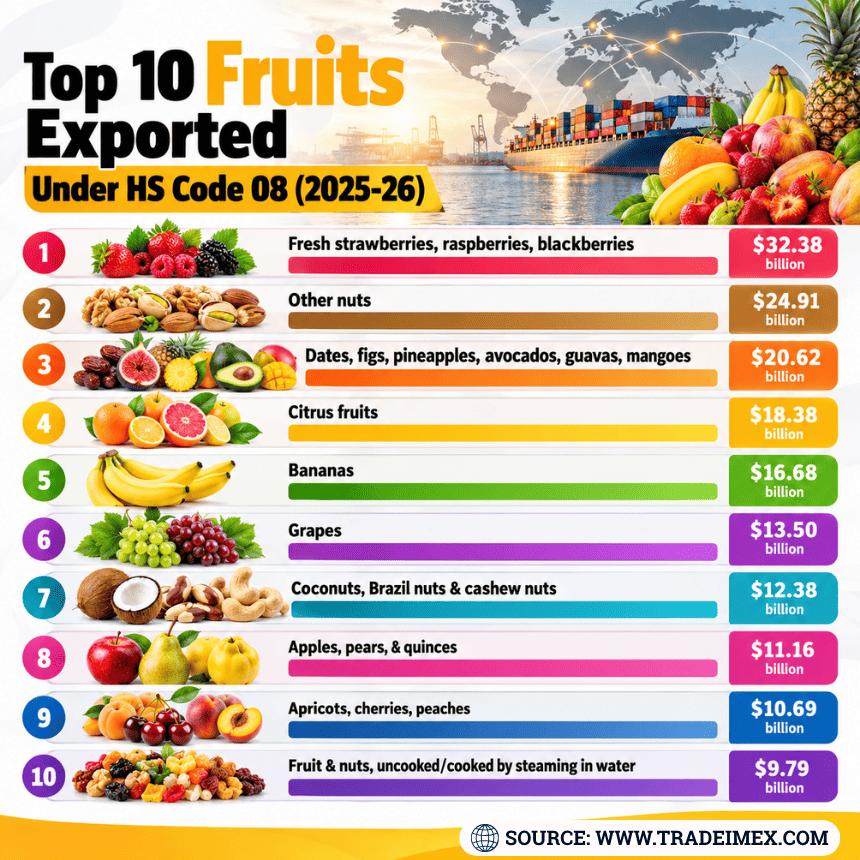
HS Code 08 governs the international trade of fruits; the top 10 fruits exported include bananas, apples, oranges, grapes, pineapples, pears, avocados, lemons, blueberries, and strawberries. These fruits are in high demand worldwide for their quality, taste, and nutritional benefits. The top 10 fruits exported globally under HS code 08 in 2025-26, include:
Fresh strawberries, raspberries, blackberries: $32.38 billion
Other nuts: $24.91 billion
Dates, figs, pineapples, avocados, guavas, mangoes: $20.62 billion
Citrus fruits: $18.38 billion
Bananas: $16.68 billion
Grapes: $13.50 billion
Coconuts, Brazil nuts & cashew nuts: $12.38 billion
Apples, pears, & quinces: $11.16 billion
Apricots, cherries, peaches: $10.69 billion
Fruit & nuts, uncooked/cooked by steaming in water: $9.79 billion
Dried fruit, frozen fruit, juices, jams, and other prepared products may be classified under different HS headings. Accurate classification is therefore essential when comparing international trade statistics.
Key Trends Shaping the Global Fruit Export Market in 2026
1. Growing demand for tropical fruits
Mangoes, avocados, bananas, pineapples, and other tropical fruits have established consumer markets across Asia, Europe, and North America. Importers are looking for dependable supplies, consistent quality, competitive prices, and year-round availability. Exporters that can coordinate harvesting, grading, packaging, and refrigerated transport are better positioned to serve demanding international markets.
2. Cold-chain infrastructure and post-harvest management
Fruit is a perishable commodity, and its quality can deteriorate during harvesting, storage, and transportation. Refrigerated containers, temperature monitoring, appropriate packaging, and efficient port handling are essential for many fresh-fruit categories. Countries with established trade infrastructure can reach distant markets more effectively, even when their production volumes are smaller than those of major agricultural economies.
3. Climate change and seasonal supply risks
Heatwaves, droughts, floods, and irregular rainfall can affect fruit yields and harvesting schedules. These changes may influence prices, export availability, and international sourcing decisions. Importers can reduce risk by identifying alternative origins, monitoring historical shipment patterns, and diversifying their supplier base.
4. Food safety and phytosanitary compliance
International fruit shipments must meet the applicable food-safety, plant-health, pesticide-residue, traceability, and packaging requirements of destination markets. Compliance is especially important when supplying supermarkets, large distributors, and markets with strict agricultural import controls.
5. Growth in processed fruit trade
Frozen fruit, dried fruit, fruit pulp, juice concentrates, and other processed products offer additional opportunities for agricultural exporters. Processing can extend shelf life and help producers access different customer segments. However, these products may use different HS classifications and should not automatically be combined with fresh-fruit exports when analyzing market performance.
Conclusion: Global Fruit Export Data 2025-26
The global fruit industry offers substantial opportunities for agricultural producers, exporters, importers, and food-processing companies. China and India lead the latest comparable fruit production ranking, while Brazil, Türkiye, Mexico, Indonesia, the United States, Italy, Iran, & Spain also feature among the world's largest producers. Global trade presents a different picture. The United States, Spain, Mexico, the Netherlands, and Vietnam ranked among the leading exporters under HS Code 08 in the cited 2025 data. These values include edible nuts and related products, making product-specific analysis essential for businesses focused exclusively on fruit.
Note For Our Readers
For 2025-26, the most effective way to assess the market is to combine the latest available production statistics with verified export and import records, commodity-level HS codes, destination-market demand, and seasonal supply information. By examining these indicators together, fruit traders can identify potential suppliers, compare markets, evaluate competitive positioning, and make better-informed decisions in the global agricultural trade industry. For the latest fruit trade records by country, company, or HS code, or AI-powered trade research, contact TradeimeX at info@tradeimex.in and get customized trade reports & fruit market insights for your business.
Frequently Asked Questions
1. Which country produces the most fruit in the world?
China ranked first in the 2025 fruit production dataset, with around 274.01 million tons, followed by India with 112.91 million tons and Brazil with 41.57 million tons.
2. What are the top 10 fruit-producing countries in the world?
The top 10 fruit producers in the cited 2025 dataset are China, India, Brazil, Türkiye, Mexico, Indonesia, the United States, Italy, Iran, and Spain.
3. Which countries are the leading fruit exporters?
In the cited 2025 data for HS Code 08, which covers edible fruit and nuts, the United States ranked first followed by Spain and the Netherlands.
4. What HS codes are used for fruit export data?
Important codes include HS 0803 for bananas, HS 0804 for several tropical fruits, HS 0805 for citrus fruits, HS 0806 for grapes, HS 0808 for apples and pears, and HS 0810 for other fresh fruit.
5. How can businesses use world fruit export data?
Businesses can use fruit export data to identify international buyers and suppliers, compare sourcing countries, examine seasonal demand, evaluate export performance, and identify potential market-expansion opportunities.
Explore the latest global trade trends, market insights, import-export analysis, and industry updates with TradeImeX blogs.
Request a Data Sample →
Tradeimex
TradeImeX’s content team brings together expertise in global trade data, import-export trends, market intelligence, and international business. Our writers turn complex trade data into clear, actionable insights to help businesses understand markets, identify opportunities, and make informed decisions. From emerging trade trends to country and product-level analysis, we focus on delivering timely insights backed by reliable data.