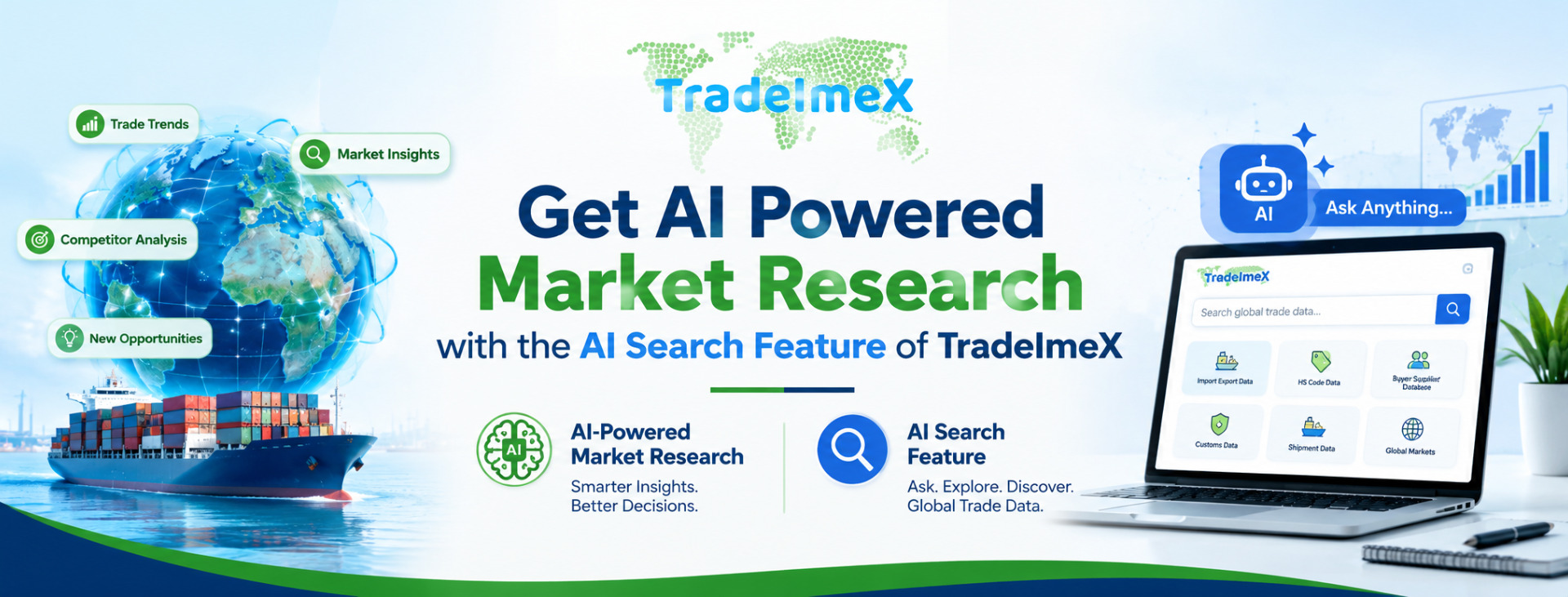
International trade is becoming increasingly data-driven. Businesses entering new markets, evaluating products, identifying trade opportunities, monitoring competitors, or finding potential buyers and suppliers need access to reliable information and the ability to turn that information into actionable insights. However, having access to large volumes of trade data is only the beginning. The real challenge is finding the right information quickly and understanding what it means for a business. This is where the AI search feature of TradeImeX brings a smarter approach to trade research.
Instead of relying only on conventional filters, users can ask business-related questions in natural language and explore relevant trade insights more efficiently & instantly. By combining AI capabilities with extensive import-export trade data, the platform helps transform complex trade information into research that is easier to explore, interpret, and use. For companies looking for faster AI-powered market research, this approach can simplify everything from initial market exploration to detailed trade analysis.
What Is the AI Search Feature?
Traditional trade-data research often requires users to select multiple filters, identify HS codes, choose countries, define periods, and refine search parameters before reaching the required information. The AI search approach provides another way. With the AI search feature, users can enter a complete business question rather than constructing every search manually. The system is designed to understand the intent behind a query and help users discover relevant trade information. For example, instead of searching separately for a product, destination country, trade period, and relevant trade indicators, a user can ask a question such as:
“What are the major export markets for US pharmaceutical products?”
“Analyze Vietnam exports of HS Code 85 products and identify important destination markets.”
This makes trade research more conversational and accessible while reducing the effort involved in navigating large datasets. The feature is particularly useful for businesses that want to move from search to strategy more efficiently.
From Trade Data to AI-Powered Market Research

Trade databases contain enormous amounts of information. Import shipments, export transactions, product classifications, countries, ports, HS codes, trade values, and historical records can provide valuable clues about market behavior. But manually examining these datasets can take significant time.
AI can help bridge this gap. TradeImeX’s approach to AI-powered market research combines trade-data discovery with intelligent analysis. Instead of simply locating records, users can explore questions around products, countries, markets, trade movements, and opportunities. This can support research activities such as:
Exploring international demand for a product
Identifying major importing and exporting markets
Studying historical trade trends
Understanding product-level trade movements
Researching HS codes and product categories
Discovering potential buyers and suppliers
Comparing markets and trade destinations
Evaluating market-entry opportunities
Supporting competitor and industry research
Building customized trade intelligence reports
The objective is straightforward: make extensive trade information easier to access and understand.
Why AI-Powered Trade Data Matters for Modern Businesses
Businesses today do not simply need more data. They need relevant data at the right time. AI-Powered Trade Data can help businesses approach international trade research with greater efficiency by connecting data discovery with intelligent search and analysis. Consider a company planning to expand into a new country. Its research may involve several questions:
Which countries currently import this product?
How has demand changed over time?
Which markets have significant trade activity?
What HS codes are associated with the product?
Who are the relevant importers or exporters?
Which suppliers are active in the market?
What are the major trade routes?
Which markets deserve deeper investigation?
Instead of treating each question as a completely separate research exercise, an AI-powered interface can help users explore connected questions through a more natural workflow. This makes trade intelligence more accessible not only to data specialists but also to sales teams, sourcing professionals, market researchers, exporters, importers, consultants, and business-development teams.
Search Import Export Data Using Natural-Language Questions
One of the biggest advantages of AI-driven search is simplicity. Businesses often know what they want to investigate but may not know exactly which database filters or technical terminology to use. For example, a user may understand the business requirement:
“I want to find markets importing automotive components.”
But they may not know the precise combination of product keywords, HS codes, countries, and filters required for traditional database research. An AI interface can help translate the business question into a trade-data search. This makes it easier to search import export data without requiring users to manually construct every part of the query. The result is a more intuitive research experience where business questions become the starting point.
Explore Global Trade Data Search More Efficiently
International businesses rarely operate within a single market. A company may source products from China, sell to Europe, evaluate demand in the Middle East, and simultaneously monitor competitors in North America. Consequently, research needs to extend beyond individual countries.
A comprehensive global trade data search can help businesses explore trade activity across markets and product categories from a broader perspective. With access to global trade information, users can investigate:
Countries: Import and export activity across international markets.
Products: Trade movements across product categories and HS codes.
Markets: Potential destination and sourcing markets.
Companies: Relevant importer-exporter information in the underlying data.
Trade activity: Historical and current patterns that can support market research.
This broader perspective can be particularly valuable when businesses are looking beyond their existing markets.
Discover Opportunities Through an Importer-Exporter Database
Finding the right business connections is a major part of international trade development. An Importer-exporter database can help businesses research companies involved in international trade and identify organizations relevant to their products or markets. For exporters, this can support buyer discovery and market expansion research. For importers and sourcing teams, it can support supplier research.
For sales and business-development teams, it can provide a starting point for identifying companies active in specific product categories and markets. When combined with AI-powered search, company and trade-data research can become more streamlined. Users can begin with a business question and progressively narrow their research according to their objectives.
A Smarter Trade Intelligence Platform for Business Research
A modern Trade Intelligence Platform needs to do more than store large datasets. It should help businesses navigate those datasets efficiently. The AI Search capability is designed as part of a broader data-driven research environment that brings together trade information, search capabilities, product intelligence, HS Code Intelligence, buyer and supplier discovery, and reporting tools. This creates a workflow where users can move through different stages of research:
Discover → Analyze → Validate → Research → Act
First, discover relevant markets or products.
Next, analyze the available trade information.
Then, validate the findings through underlying trade records & relevant data.
After that, conduct deeper market or company research.
Finally, use the insights to support business decisions.
This makes TradeImeX useful for organizations that want trade research to become an integrated part of their business-intelligence workflow.
Supporting Business Intelligence With Trade Data
International trade data can contribute significantly to business intelligence. When analyzed effectively, trade records can help reveal patterns that may not be immediately visible through general market information. Businesses can use trade intelligence to investigate:
Market demand
Product movement
Import and export trends
Country-level trade relationships
Buyer and supplier activity
Emerging markets
Product opportunities
Sourcing patterns
Competitive activity
Historical trade performance
For example, an exporter researching a new destination market can combine product-level trade information with country-level analysis to understand where its products are already being imported and where additional research may be worthwhile. Similarly, procurement teams can investigate sourcing markets and companies before developing a supplier strategy.
AI-Powered Trade Intelligence Platform for Multiple Use Cases
The platform is designed to support different business functions rather than a single type of trade professional.
1. Exporters
Exporters can research international demand, identify potential destination markets, explore buyer information, and understand product-level trade movements.
2. Importers
Importers can investigate sourcing markets, suppliers, product categories, and international trade activity.
3. Market Researchers
Research teams can use AI-driven queries to accelerate the initial stages of market discovery and develop deeper trade-market analysis.
4. Sales & Business Development Teams
Sales teams can research companies, products, countries, and trade activity to support international prospecting.
5. Sourcing Professionals
Procurement teams can explore supplier markets and international sourcing patterns.
6. Consultants
Consultants can use trade intelligence to support client research, market studies, industry analysis, and strategic reports.
This flexibility makes the platform relevant across multiple stages of international business research.
From Import Data Search to Deeper Market Intelligence
Conventional import data search is useful when users already know exactly what they want to find. But business research often begins with broader questions. A user might ask:
“Which countries are importing this product?”
“Who are the major importers?”
“Which markets have growing demand?”
“Which suppliers are exporting this product?”
“What are the main HS codes associated with this category?”
These questions require more than a simple keyword search. AI Search provides an additional layer that helps users begin with the business question itself and explore the underlying trade information.
For users who prefer precision, traditional search and filtering remain valuable. For users who want a more conversational research experience, AI Search provides another path to discovery.
One Platform for Global Export Import Trade Data
International commerce is highly interconnected, and market opportunities can emerge across different regions and industries. Access to global export import trade data can help businesses understand these international connections. Trade research may involve products moving between multiple countries, changing sourcing patterns, shifting demand, and evolving market relationships.
Historical trade data can provide context for understanding how these patterns have developed. Combining this information with AI-driven discovery can help businesses conduct research more efficiently and identify areas that deserve further investigation.
Why Choose an AI-Driven Approach to Trade Research?
The key advantage is not simply automation. It is the ability to make complex information easier to explore. An AI-powered approach can help reduce the distance between a business question and the relevant trade information. Instead of asking users to think like database operators, the experience allows them to begin more naturally, as business researchers.
The result can be:
Faster initial research
Simpler data discovery
More intuitive searches
Easier exploration of complex questions
Better access to product and market intelligence
More efficient trade-data workflows
Greater integration between data and business research
AI does not replace the need for human judgment. Rather, it can help researchers reach relevant information faster so they can spend more time interpreting findings and developing strategies.
TradeImeX: Your Global Trade Intelligence Platform
TradeImeX brings together extensive international trade information with modern search and intelligence capabilities to help businesses research global markets more effectively. As an import-export data provider, the platform supports access to trade information across more than 100 markets, covering product, country, shipment, HS code, buyer, supplier, and other trade-related intelligence depending on the available data source.
Its AI-driven capabilities add another layer to this ecosystem by allowing users to ask complete business questions and explore relevant insights through a conversational search experience. This positions the platform as a global trade intelligence platform for businesses looking to combine trade-data discovery with market research and business intelligence.
Turn Your Business Questions Into Trade Insights
The future of trade research is not simply about having larger databases. It is about making those databases more useful. Businesses need to move quickly from questions to information, from information to insights, and from insights to informed action. The AI Search capability provides a new way to approach that process.
Whether you are researching a new export market, exploring import activity, identifying potential buyers, studying suppliers, analyzing HS codes, or investigating international product trends, AI-driven search can make the research process more intuitive. With AI-powered capabilities, extensive import-export trade data, and tools designed for modern trade intelligence, businesses can explore international markets through a more intelligent research experience.
Start Exploring AI-Powered Trade Intelligence
Ready to transform the way you research international markets? Explore the AI search feature and discover how natural-language questions can help you navigate trade information, conduct market research, and uncover relevant global trade insights. From search to strategy, turn your trade-data questions into actionable intelligence. Contact TradeImeX at info@tradeimex.in and get customized trade reports and advanced market insights for your business with a new revolution in import-export intelligence.
Explore the latest global trade trends, market insights, import-export analysis, and industry updates with TradeImeX blogs.
Request a Data Sample →
Tradeimex
TradeImeX’s content team brings together expertise in global trade data, import-export trends, market intelligence, and international business. Our writers turn complex trade data into clear, actionable insights to help businesses understand markets, identify opportunities, and make informed decisions. From emerging trade trends to country and product-level analysis, we focus on delivering timely insights backed by reliable data.