

Introduction
The global smartphone industry continues to play a significant role in international trade, driven by technological innovation, rising consumer demand, expanding manufacturing capacity, and increasing competition among international brands. Smartphone exports connect major production hubs such as China, India, & Vietnam with consumer markets across the United States, Europe, the Middle East, & other regions. According to the latest smartphone export data & global trade data, the total value of smartphone exports under HS code 851713 reached $291.98 billion in 2025, a 4% decline from the previous year. Global smartphone exports reached around 1.26 billion units in 2025, representing annual growth of around 1.9%.
Apple and Samsung remained the leading smartphone vendors, while Xiaomi, Vivo, & OPPO continued to compete across different price segments. Country-level trade statistics also highlight China's dominance in mobile phone exports, alongside the growing importance of India and Vietnam as manufacturing and export destinations. Businesses with a smartphone export database can use these trends to identify international markets & understand the changing structure of the global electronics industry & supply chain. This article explores smartphone exports by country, the top 10 mobile exporting countries in 2025, the smartphone HS code, major smartphone manufacturing countries, and the top 10 smartphone manufacturers.
Global Smartphone Export Data 2025-26: Key Highlights
Key statistics and industry insights
Global smartphone shipments: around 1.26 billion units in 2025.
China: Exported around $120.5 billion worth of wireless phone devices in 2025.
Vietnam: Recorded $32.1 billion in smartphone exports in 2025.
India: Exported around $30.1 billion worth of wireless phone devices in 2025.
Leading smartphone manufacturers: Apple, Samsung, Xiaomi, Vivo, & OPPO were among the leading global vendors.
Major manufacturing countries: China, India, and Vietnam remain important production and export hubs.
Smartphone HS code: HS 851713 identifies smartphones under the international Harmonized System classification.
Smartphone HS Code: Understanding HS Code 8517
The Harmonized System (HS) is an internationally recognised product classification used by customs authorities to record imports and exports. Businesses researching mobile phone exports should understand the distinction between HS 8517 and the more specific smartphone classification.
Important smartphone HS codes
HS 8517: Covers telephone sets and other apparatus for transmitting or receiving voice, images, or other data, including various telecommunications devices.
HS 851713: The international HS subheading specifically used for smartphones.
National tariff extensions: Countries may use additional digits, such as eight- or ten-digit codes, for more detailed customs classification.
Using the correct smartphone HS code is essential when comparing export values across countries. Data recorded under the broader HS 8517 heading may include communication equipment other than smartphones, so its total value should not automatically be treated as smartphone-only trade.
Smartphone Exports by Country: Who Are the Top Smartphone Exporting Countries?
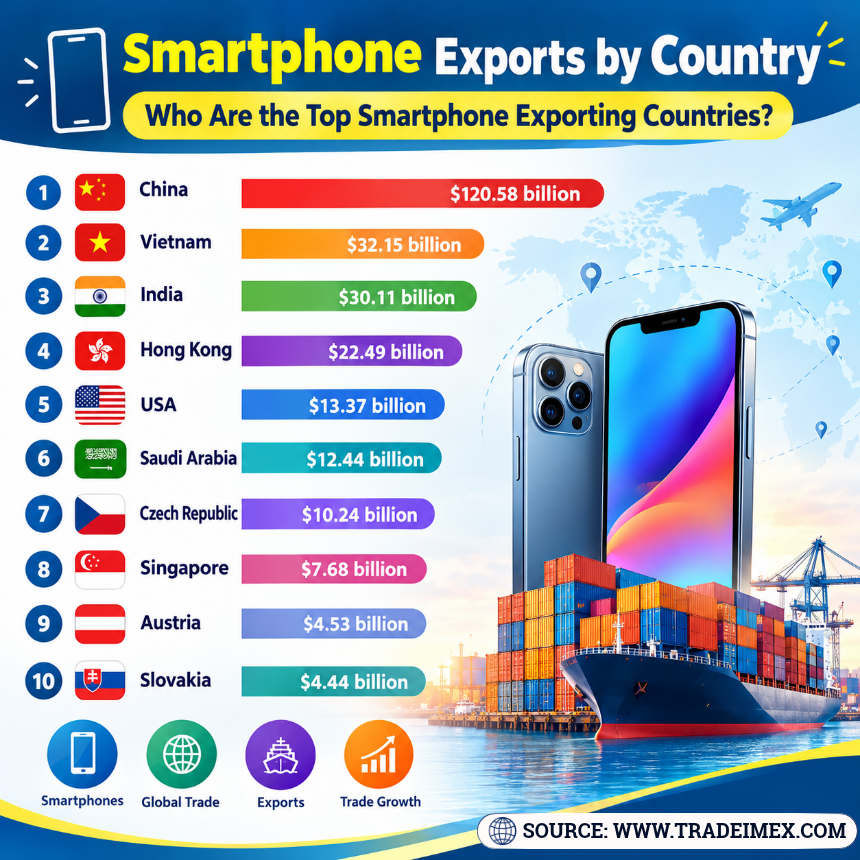
Smartphone exports are an important part of the global economy, and some countries are better at it than others. The top smartphone exporting countries include China, South Korea, and Vietnam. China leads the way, making many of the world’s smartphones, while South Korea is known for popular brands like Samsung. Vietnam has also become a major player as companies move their factories there. Together, these countries help supply smartphones to people everywhere, making them key players in this industry. The top 10 smartphone-exporting countries, as per the smartphone shipment data & global smartphone exports for 2025-26, include:
1. China: $120.58 billion (41.3%)
2. Vietnam: $32.15 billion (11%)
3. India: $30.11 billion (10.3%)
4. Hong Kong: $22.49 billion (7.7%)
5. USA: $13.37 billion (4.6%)
6. Saudi Arabia: $12.44 billion (4.3%)
7. Czech Republic: $10.24 billion (3.5%)
8. Singapore: $7.68 billion (2.6%)
9. Austria: $4.53 billion (1.6%)
10. Slovakia: $4.44 billion (1.5%)
1. China: The Largest Mobile Exporter
China remained the world's largest mobile exporter in 2025, with around $120.5 billion in wireless phone device exports, according to China export data. Its extensive electronics manufacturing ecosystem, established component supply chains, and large-scale assembly facilities support its leading position. The country manufactures and assembles devices for domestic brands as well as international companies. Its suppliers also produce essential components, including circuit boards, displays, batteries, & electronic parts. Although companies are increasingly diversifying their production locations, China remains central to global smartphone manufacturing and international electronics trade.
2. Vietnam: A Major Smartphone Export Hub
Vietnam ranked among the world's largest mobile phone exporters, recording around $32.1 billion in wireless phone device exports in 2025, as per Vietnam customs export data for smartphones. Its electronics industry benefits from international investment, established manufacturing facilities, and access to regional component suppliers. Vietnam's role in global smartphone supply chains has expanded as manufacturers establish production facilities to serve overseas markets, as per the Vietnam export data.
3. India: Rapid Growth in Smartphone Exports
India has become an increasingly important smartphone manufacturing and export destination. Its wireless phone device exports reached around $30.1 billion in 2025, according to the cited ranking. Expanding assembly capacity, investment in electronics manufacturing, and government support for domestic production have contributed to this growth. India also serves a large domestic consumer market, giving manufacturers opportunities to develop production capabilities for both domestic sales & international shipments. The country's growing export capacity makes it an important market for businesses researching mobile export opportunities and smartphone suppliers.
4. Hong Kong: An International Electronics Trading Centre
Hong Kong recorded around $22.4 billion in wireless phone device exports in 2025. Its position reflects its importance as a trading and distribution centre for electronics moving between mainland China and international markets. Export statistics for trading hubs can include re-exported goods, meaning the reported value does not necessarily represent products manufactured locally.
5. United States: A Major High-Value Electronics Market
The United States recorded around $13.3 billion in wireless phone device exports in 2025, according to the US smartphone export data. Its position reflects international electronics distribution, trade in high-value devices, and the movement of goods through established commercial networks. The country is also a major smartphone consumer market, making import and export comparisons useful for understanding its broader electronics trade, according to the USA smartphone exporters database.
6. Saudi Arabia: A Growing Export Presence
Saudi Arabia recorded around $12.4 billion in wireless phone device exports in 2025 in the cited dataset. This figure includes trade activity that may reflect re-exports and distribution arrangements rather than domestic smartphone manufacturing alone. Businesses should therefore evaluate the origin of goods and the applicable product classification before interpreting the country's export performance as evidence of manufacturing growth.
7. Czech Republic, Singapore, Austria, and Slovakia
The Czech Republic exported around $10.4 billion in wireless phone devices in 2025, followed by Singapore at $7.6 billion, Austria at $4.5 billion, and Slovakia at $4.4 billion. These markets demonstrate how international electronics trade depends on both manufacturing and distribution. Singapore and Austria, in particular, have established roles in international trading networks, while European electronics supply chains support cross-border trade in finished devices and related products.
Top 10 Smartphone Exporting Companies: Smartphone Exporters Database
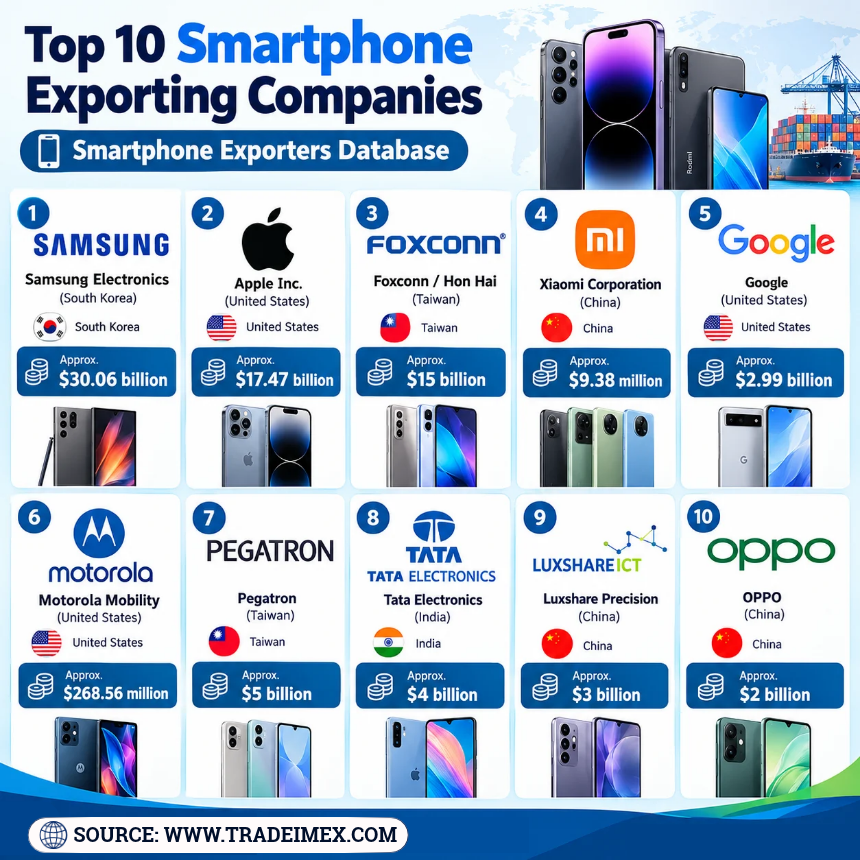
The global smartphone export market is led by major technology brands and electronics manufacturers, including Samsung, Apple, Foxconn, Xiaomi, and other international companies. These businesses support global mobile phone supply chains through manufacturing, assembly, and international distribution. The following list provides approximate 2025 export values for leading smartphone exporters. Company-level figures are indicative estimates and may reflect different reporting periods or regional operations. The leading smartphone manufacturers & exporters in the world, as per the smartphone exporters & suppliers database for 2025-26, include:
1. Samsung Electronics (South Korea): Approx. $30.06 billion
2. Apple Inc. (United States): Approx. $17.47 billion
3. Foxconn / Hon Hai (Taiwan): Approx. $15 billion
4. Xiaomi Corporation (China): Approx. $9.38 million
5. Google (United States): Approx. $2.99 billion
6. Motorola Mobility (United States): Approx. $268.56 million
7. Pegatron (Taiwan): Approx. $5 billion
8. Tata Electronics (India): Approx. $4 billion
9. Luxshare Precision (China): Approx. $3 billion
10. OPPO (China): Approx. $2 billion
Smartphone Export Data: Last 10 Years Global Trade Performance
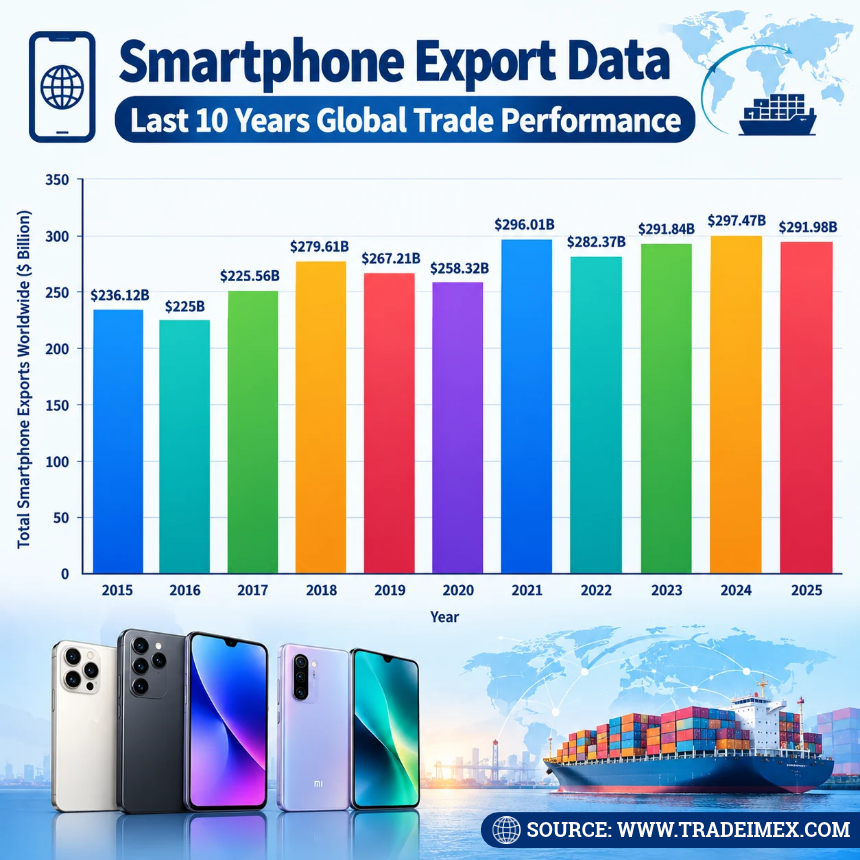
Year of Exports | Total Smartphone Exports Worldwide ($) |
2015 | $236.12 billion |
2016 | $225 billion |
2017 | $252.56 billion |
2018 | $279.61 billion |
2019 | $267.21 billion |
2020 | $258.32 billion |
2021 | $296.01 billion |
2022 | $282.37 billion |
2023 | $291.84 billion |
2024 | $297.47 billion |
2025 | $291.98 billion |
Smartphone Exports in 2026: Emerging Trends
The 2026 outlook for smartphone exports is influenced by consumer demand, production investment, component availability, trade policies, and the expansion of manufacturing facilities outside traditional production centres. China continues to benefit from its extensive electronics supply chain, while India and Vietnam are attracting manufacturing investment and strengthening their positions as export hubs. Several trends are particularly important for international smartphone trade:
1. Supply-chain diversification: Manufacturers are spreading production across multiple countries to manage costs, reduce concentration risks, and improve access to export markets.
2. Expansion of Indian manufacturing: India's growing assembly capacity is strengthening its position in the international smartphone supply chain.
3. Vietnam's electronics industry: Vietnam remains an important production centre for internationally traded mobile phones and electronic components.
4. Premium smartphone demand: Higher-value devices can increase export revenue even when unit volumes do not rise at the same rate.
5. Competition and production costs: Component prices, labour costs, tariffs, & export expenses influence manufacturing decisions and export competitiveness.
Global Smartphone Chipset Shipments Decline 15% in H1 2026
According to the latest statistics, global smartphone system-on-chip (SoC) shipments fell 15% year over year in the first half of 2026, driven by rising memory costs, cautious inventory management, and longer smartphone replacement cycles. Chipset shipments from MediaTek and Qualcomm declined by more than 25%, while Apple, Samsung, Google, and UNISOC recorded growth. Despite the market slowdown, shipments of AI-capable smartphone chipsets increased by 24%, highlighting continued demand for premium devices and on-device AI features. Projections expect global smartphone SoC shipments to decline by 14% in 2026, with the memory supply shortage potentially continuing into the second half of 2027.
Global shipments: Smartphone SoC shipments fell 15% YoY in H1 2026.
MediaTek and Qualcomm: Both recorded shipment declines of more than 25%, losing market share.
Apple: Its SoC market share increased by 4 percentage points year over year, supported by strong demand for the iPhone 17 series.
Samsung: Gained ground as its Galaxy S26 series adopted both Snapdragon and its own Exynos chipsets.
Google: Recorded growth in SoC shipments as its proprietary Tensor chipsets gained traction.
UNISOC: Benefited from smartphone manufacturers shifting some entry-level devices towards its more affordable 4G chipsets. It also made progress in 5G through partnerships involving POCO and Redmi.
Memory prices: Smartphone memory prices surged by more than 300% YoY in Q2 2026, pushing memory costs above SoC costs across all smartphone price segments.
AI smartphone chips: Shipments of SoCs for generative AI-capable smartphones grew by 24% YoY in H1 2026, driven by demand for AI features and premium devices.
2026 outlook: Counterpoint forecasts a 14% annual decline in global smartphone SoC shipments, with entry-level shipments expected to fall by more than 30%.
Supply-chain outlook: The memory shortage is expected to persist until H2 2027, potentially creating further pressure on smartphone production and pricing.
Global Smartphone Export Share in H1 2026
Samsung: 22% share (+9% YoY)
Apple: 21% share (supported by the iPhone 17 series)
Xiaomi: 11.4%
OPPO: 10.3%
Vivo: 8%
Top Smartphone Manufacturers in the World
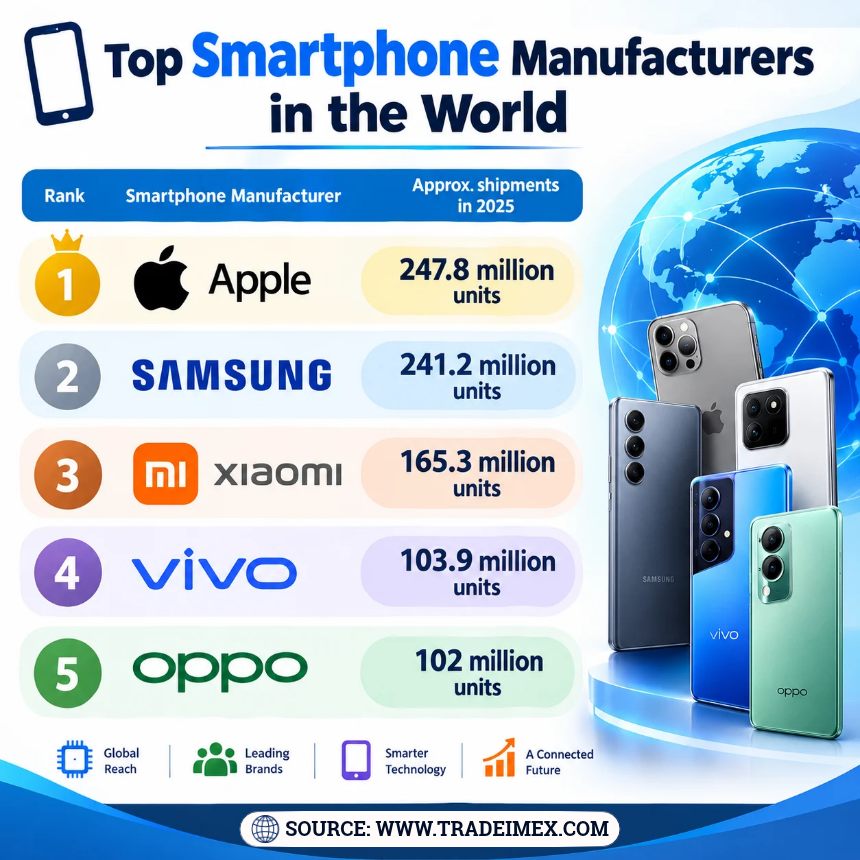
Smartphone manufacturers are different from smartphone exporting countries. A brand may be headquartered in one country, manufacture devices in another, and export finished products from a third.
Rank | Smartphone manufacturer | Approx. shipments in 2025 |
1 | Apple | 247.8 million units |
2 | Samsung | 241.2 million units |
3 | Xiaomi | 165.3 million units |
4 | vivo | 103.9 million units |
5 | OPPO | 102 million units |
Other significant smartphone manufacturers include HONOR, Lenovo/Motorola, Huawei, realme, and Google. However, these additional brands should not be assigned positions six through ten without a consistent shipment dataset confirming their respective rankings.
Apple
Apple - One of the world's leading smartphone manufacturers by shipments and revenue. Its iPhone business operates through an international production network involving component suppliers and contract manufacturers across multiple countries. Apple's supply chain illustrates why a smartphone brand's headquarters should not be confused with the country from which its finished products are exported.
Samsung
Samsung is a major South Korean electronics company with a broad smartphone portfolio covering premium, mid-range, and entry-level devices. Its global manufacturing and distribution operations support sales across numerous international markets. The company also produces important electronic components, making it a significant participant in the wider technology supply chain.
Xiaomi
Xiaomi has established a substantial international smartphone business, competing through a range of devices across different price categories. Its distribution network and manufacturing partnerships support its presence in Asia, Europe, and other markets.
Vivo
Vivo focuses on smartphones across several price segments and has a significant presence in Asian markets. Its product strategy includes camera technology, design, and performance features aimed at different consumer groups.
OPPO
OPPO is another major Chinese smartphone brand with an international sales and manufacturing network. Its product portfolio spans budget, mid-range, and premium devices, helping it compete in a range of markets.
Major Smartphone Manufacturing Countries
The world's smartphone manufacturing industry is concentrated in several Asian economies, although other countries also participate in assembly and component production.
China: China's electronics ecosystem supports large-scale smartphone assembly, component production, and contract manufacturing.
India: India has expanded its smartphone assembly operations and export capacity, supported by investment in electronics manufacturing.
Vietnam: Vietnam is a major export-oriented electronics production hub, with international manufacturers operating large facilities.
South Korea: South Korea is home to Samsung and important electronics and semiconductor businesses that contribute to the smartphone supply chain.
Brazil and Indonesia: These countries also host smartphone assembly operations that serve domestic or regional markets.
It is crucial to distinguish final assembly from component manufacturing. A smartphone assembled in India or Vietnam may contain processors, memory, displays, camera systems, and other parts sourced from several countries. Consequently, the full customs export value of the finished device does not represent value added exclusively in the exporting country.
Smartphone Suppliers and International Trade Opportunities
Businesses sourcing mobile phones need to evaluate manufacturers, authorised distributors, contract assemblers, and wholesale suppliers. International trade records can help identify companies involved in cross-border shipments, depending on the coverage and detail available in each dataset.
Useful information may include:
Exporter and importer names.
Product descriptions and HS codes.
Shipment dates and declared values.
Countries of origin and destination.
Ports of loading and discharge.
Historical shipment activity and trading relationships.
Importers should independently verify a supplier's manufacturing capabilities, product specifications, certifications, and commercial terms. A customs shipment record can indicate reported trading activity, but it does not automatically establish that the company is the original manufacturer or an authorised distributor.
Comparing smartphone suppliers across China, India, Vietnam, & other manufacturing countries can help businesses investigate alternative sourcing options and understand how international supply chains are changing.
How TradeImeX Helps Analyze Smartphone Export Data
TradeImeX provides global import-export data and trade intelligence to support international market research and sourcing decisions. Businesses researching smartphone exports can use trade data to:
Compare export activity across countries and product categories.
Research HS 8517 and smartphone-specific classifications where available.
Investigate buyers and suppliers appearing in shipment records.
Examine historical trade activity and destination markets.
Prepare customised reports for market research and business planning.
Country-level statistics help businesses understand the overall size of a market, while detailed trade records can provide additional insights into companies & trade relations where the information is available. By combining product classification, country statistics, and company-level research, businesses can develop a more informed understanding of smartphone exports and international mobile phone supply chains.
Conclusion
Smartphone export data for 2025-26 highlights the continued importance of China, Vietnam, and India in global mobile phone trade. China remained the largest exporter of wireless phone devices in 2025, while India demonstrated strong export growth and Vietnam maintained its position as a major electronics manufacturing hub. At the brand level, Apple and Samsung led worldwide smartphone shipments, followed by Xiaomi, vivo, and OPPO. Their performance reflects intense competition in a global industry supported by international manufacturing networks and cross-border component trade.
Note For Our Readers
For accurate research, businesses should distinguish between HS 8517, which covers a broader range of telecommunications equipment, and HS 851713, which specifically identifies smartphones. Using consistent classifications & comparable reporting periods can help importers, exporters, & market researchers identify opportunities & understand the changing dynamics of the global smartphone industry. For the latest smartphone import-export data by country or HS code, AI-powered search on Smartphone exports, or customized trade reports, contact info@tradeimex.in.
Frequently Asked Questions
Which country was the largest smartphone exporter in 2025?
China was the largest smartphone exporter in 2025, with smartphone exports valued at approximately $120.58 billion, accounting for around 41.3% of global exports under HS code 851713.
What is the Smartphone HS Code?
The international HS code for smartphones is 851713. It falls under HS heading 8517, which covers telephone sets and other telecommunications equipment. National customs systems may use additional digits for more detailed classification.
What are the top smartphone-exporting countries in 2025?
The leading smartphone-exporting countries in 2025 included China, Vietnam, India, Hong Kong, the United States, Saudi Arabia, the Czech Republic, Singapore, Austria, and Slovakia.
What was the total value of global smartphone exports in 2025?
Global smartphone exports under HS code 851713 were valued at around $291.98 billion in 2025, representing a decline of around 4% compared with the previous year.
How can businesses use smartphone export data to identify global trade opportunities?
Businesses can use smartphone export data to analyze leading exporting countries, track shipment values, identify potential buyers and suppliers, compare trade trends, and evaluate international market opportunities. Platforms such as TradeImeX provide import-export data and customized trade reports to support market research and business decisions.
Explore the latest global trade trends, market insights, import-export analysis, and industry updates with TradeImeX blogs.
Request a Data Sample →
Tradeimex
TradeImeX’s content team brings together expertise in global trade data, import-export trends, market intelligence, and international business. Our writers turn complex trade data into clear, actionable insights to help businesses understand markets, identify opportunities, and make informed decisions. From emerging trade trends to country and product-level analysis, we focus on delivering timely insights backed by reliable data.