

Mongolia is a major global source of premium cashmere, supplying fine animal fibres to textile manufacturers, yarn producers, apparel companies, and luxury fashion brands worldwide. With its large goat population and established cashmere supply chain, Mongolia plays an important role in international natural fibre trade. Mongolian cashmere export data in 2026 indicates strong growth in processed cashmere exports. According to Mongolia export data & Mongolia customs export data for cashmere wool, Mongolia cashmere exports reached a record high of $332.5 million in 2025, a massive 369% increase from the previous year.
During January–September 2026 (first 3 quarters), Mongolia exported around $312.6 million, compared with $188.4 million during the corresponding period of 2025. Mongolia is the 2nd largest exporter of cashmere wool worldwide, only behind China, according to global trade data. For importers, exporters, and textile manufacturers, understanding Mongolia cashmere wool exports under HS Code 5105 is essential for analysing processed-fibre trade, evaluating international demand, & identifying potential sourcing opportunities. However, raw cashmere, combed cashmere, yarn, and finished garments must be distinguished because they fall under different HS classifications.
Mongolia Cashmere Export Data 2026: Key Highlights
Indicator | Export statistics |
Combed cashmere exports in 2025 | $332.5 million |
Combed cashmere export volume in 2025 | 4,023 tons |
January–September 2026 export value | $312.6 million |
January–September 2025 export value | $188.4 million |
Cashmere fibre production in 2025 | 8,836 tons |
Goat population at the end of 2025 | around 23.2 million |
These statistics, according to figures compiled from Mongolia’s National Statistics Office, demonstrate the importance of cashmere to Mongolia’s textile and livestock economy. The increase in recorded exports during 2026 also highlights the growing significance of processed fibres in the country’s international trade.
Understanding HS Code 5105 for Mongolian Cashmere Exports
HS Code 5105 falls under Chapter 51, which covers wool, fine or coarse animal hair, and associated textile products. Heading 5105 specifically covers wool & fine or coarse animal hair that has been carded or combed. This heading is relevant to processed cashmere fibre prepared for further manufacturing. Cashmere can be processed into fibre suitable for spinning, yarn production, knitwear, fabrics, & other textile applications.
Relevant cashmere-related HS classifications include:
HS 5102: Fine or coarse animal hair that has not been carded or combed, including relevant raw cashmere categories.
HS 5105: Wool and fine or coarse animal hair that has been carded or combed.
HS 5108: Yarn of fine animal hair, including relevant cashmere yarn products.
HS Chapters 61 and 62: Relevant knitted or woven apparel, including finished cashmere garments.
The exact code depends on the product’s processing stage, composition, & applicable tariff nomenclature. Exporters should verify the appropriate six-digit HS code and any national-level extensions before comparing trade statistics. Separating these categories is essential when analysing Mongolian cashmere export data because the value of processed fibres cannot be directly compared with the value of finished garments without considering the different stages of production.
Mongolia Cashmere Export Statistics in 2025
Mongolia’s cashmere industry recorded strong export performance in 2025, particularly in the combed goat down category, as the government moves to strengthen cashmere exports from Mongolia. The latest database indicates that exports reached around $332.5 million, with a total volume of around 4,023 tons. The reported export value corresponds to an average of around $82,600 per ton. This is a calculated average based on the reported export value and volume, not a quoted market price for every shipment.
Key observations from Mongolia cashmere export data in 2025 include:
Strong processed-fibre exports: Combed goat down accounted for a substantial recorded export value.
Higher-value processing opportunities: Combed cashmere is further processed than raw fibre and is suitable for subsequent textile manufacturing.
International manufacturing demand: Processed cashmere supplies textile mills and manufacturers that require fibres for yarn, knitwear, and premium apparel.
Importance of classification: Changes in reported exports can reflect processing, reporting, or classification differences, not necessarily changes in the total physical supply of cashmere.
Mongolia Cashmere Exports by Country: Where Does Mongolia Export Cashmere Wool?
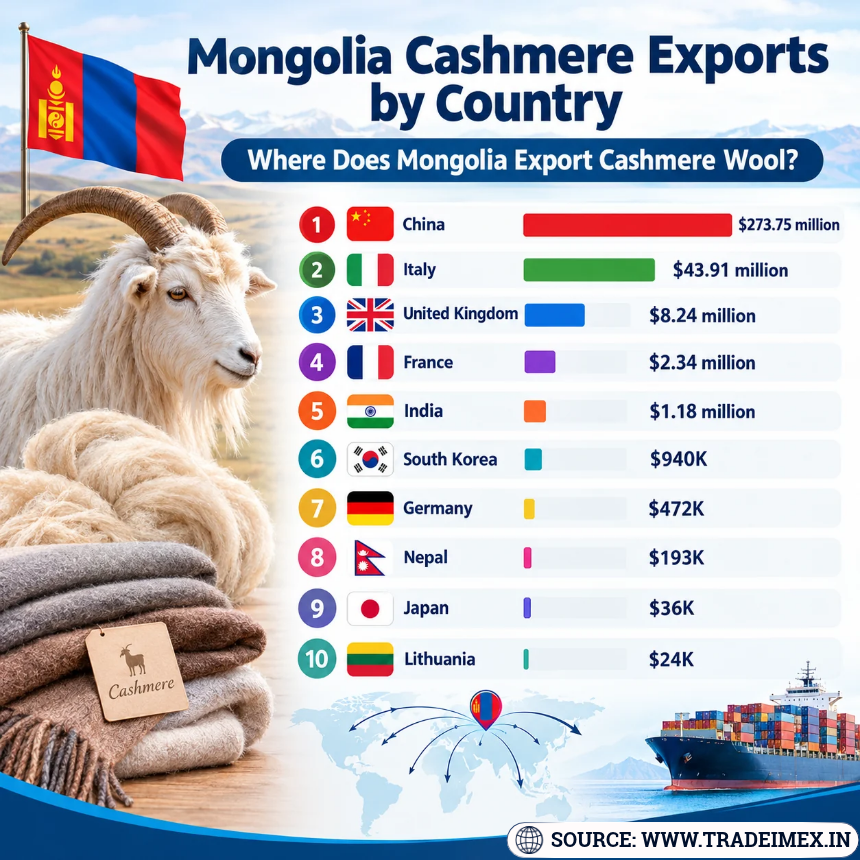
Mongolia is one of the largest producers of cashmere wool in the world. It mainly exports cashmere to countries like China, which buys a lot of it for making clothing and other products, as per Mongolia cashmere wool export data. Other important buyers include the United Kingdom and countries such as Italy & France. These countries value Mongolia's soft & high-quality cashmere. As a result, cashmere exports are an important part of Mongolia's economy, helping local farmers & businesses thrive in the global market. The top 10 destinations for Mongolian cashmere exports, as per the Mongolia shipment data for 2025-26, include:
1. China: $273.75 million (82.7%)
2. Italy: $43.91 million (13.3%)
3. United Kingdom: $8.24 million (2.5%)
4. France: $2.34 million (0.7%)
5. India: $1.18 million (0.5%)
6. South Korea: $940K (0.4%)
7. Germany: $472K (0.3%)
8. Nepal: $193K (0.2%)
9. Japan: $36K (0.1%)
10. Lithuania: $24K (0.1%)
China: A significant regional textile-processing and trading hub, with geographical proximity to Mongolia, as per the data on Mongolia exports to China under HS code 5105.
Italy: An established market for premium textiles, cashmere processing, and luxury knitwear, as per the data on Mongolia cashmere exports to Italy.
Other European markets: Opportunities among textile manufacturers and apparel brands seeking fine natural fibres.
Asian manufacturing markets: Potential demand from processors that use cashmere in yarn, fabrics, and finished textile products.
Mongolia Cashmere Wool Exports: Last 10 Years Export Data
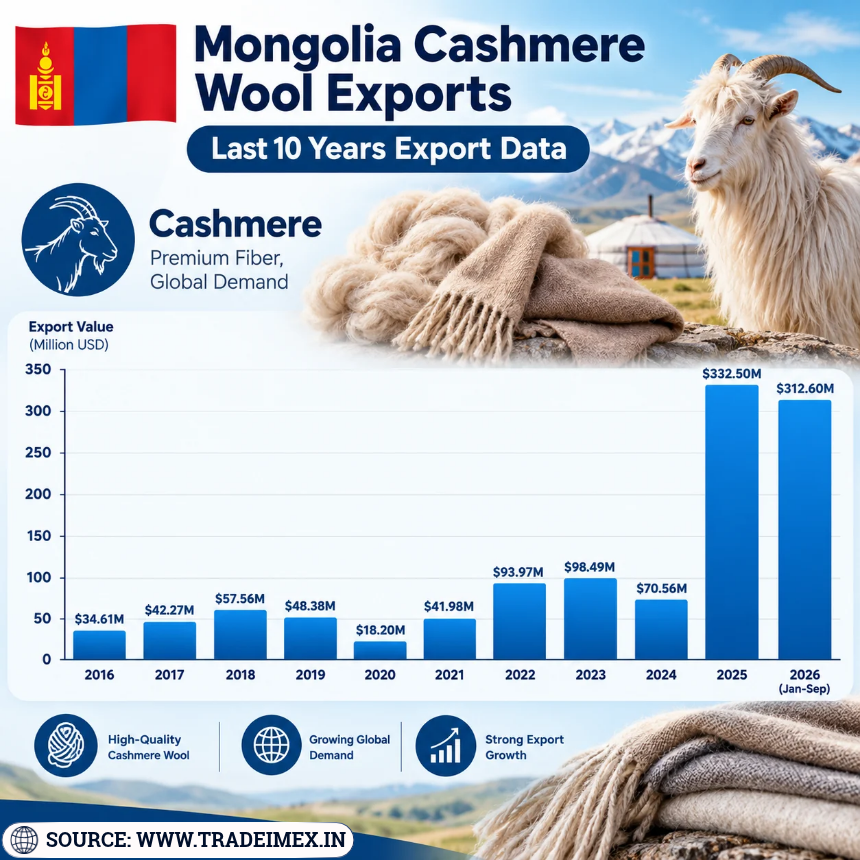
Year of Exports | Total Mongolian Cashmere Exports ($) |
2016 | $34.61 million |
2017 | $42.27 million |
2018 | $57.56 million |
2019 | $48.38 million |
2020 | $18.20 million |
2021 | $41.98 million |
2022 | $93.97 million |
2023 | $98.49 million |
2024 | $70.56 million |
2025 | $332.50 million |
2026 (January-September) | $312.60 million |
Mongolia Cashmere Wool Export 2026: Nine-Month Performance
Mongolia’s combed cashmere exports continued to increase during the first nine months of 2026. The available figures show growth in both export value and shipment volume compared with the same period of the previous year.
Period | Export value | Export volume |
January–September 2025 | $188.4 million | 2,305 tons |
January–September 2026 | $312.6 million | 3,158 tons |
Based on these figures, export value increased by around 65.9%, while volume rose by around 37%. The average recorded export value per ton also increased, from around $81,700 in January–September 2025 to around $99,000 in January–September 2026. This difference may reflect changes in product quality, processing levels, destination mix, or export prices. The nine-month results indicate a stronger performance in the recorded combed cashmere category. Nevertheless, these figures should not be presented as full-year 2026 export results.
Mongolia’s Cashmere Production and Export Supply Chain
Mongolia’s cashmere industry begins with herding households that raise goats across the country’s grasslands. The fibre is collected seasonally and passes through several stages before reaching international customers.
The main stages of the cashmere supply chain are:
Cashmere collection: Herders collect the fine undercoat from goats during the seasonal combing period.
Sorting and grading: Fibres are separated according to characteristics such as fineness, length, colour, and quality.
Cleaning and washing: Raw cashmere is processed to remove dirt, grease, and other impurities.
Dehairing & combing: Coarser guard hairs are separated from the fine undercoat to prepare cashmere for processing.
Spinning and manufacturing: Processors convert suitable fibres into yarn, knitwear, fabrics, and garments.
International distribution: Exporters supply raw materials, processed fibres, yarn, and finished products to global buyers.
Mongolia’s cashmere industry has opportunities to retain more value domestically by expanding its processing capacity. Greater investment in machinery, quality control, & manufacturing can help local businesses move beyond raw-material exports. Government plans reported in 2026 included investment of around $57.5 million to expand cashmere processing capacity. The stated targets include achieving full primary processing and increasing deep processing to 40% by 2028.
Mongolian cashmere supplies a global industry that includes textile mills, yarn producers, luxury apparel manufacturers, and fashion brands. International buyers value cashmere for its softness, warmth, and suitability for premium clothing and accessories.
Key Drivers of Mongolian Cashmere Export Growth in 2026
Several factors may support the continued development of Mongolia’s cashmere export industry.
1. International demand for premium fibres
Cashmere remains an important natural fibre in premium knitwear, sweaters, scarves, and other apparel. Demand from high-end manufacturers creates opportunities for exporters with reliable quality and supply.
2. Expansion of domestic processing
Investments in washing, dehairing, combing, spinning, and garment manufacturing can help Mongolia capture additional value from its cashmere resources.
3. Better fibre quality and grading
Consistent sorting, grading, and testing help exporters meet the technical specifications of international textile mills and improve the reliability of shipments.
4. Product diversification
Businesses can expand beyond raw cashmere into combed fibre, yarn, knitwear, and finished garments. Each product category offers different commercial opportunities and requires the correct tariff classification.
5. Traceability and responsible sourcing
International buyers increasingly seek transparency regarding fibre origin, animal welfare, and environmental practices. Better traceability and responsible sourcing systems can help suppliers respond to these requirements.
Challenges Facing Mongolia’s Cashmere Export Industry
Despite the growth in processed cashmere exports, Mongolia’s industry faces several challenges that could affect its future performance.
Climate risks: Severe winters, droughts, and changing weather conditions can affect livestock health and fibre supply.
Raw-material price fluctuations: Changes in supply, procurement competition, and international demand can affect exporters’ margins.
Processing investment: Modern machinery, infrastructure, and technical expertise require substantial investment.
Quality consistency: Textile manufacturers need dependable fibre specifications and reliable delivery schedules.
International competition: Mongolia competes with other cashmere-producing countries and alternative natural and synthetic fibres.
Environmental sustainability: Responsible pasture management is important for protecting the grasslands that support livestock production.
Market concentration: Dependence on a limited number of buyers can expose exporters to changes in purchasing patterns and trade conditions.
To address these challenges, the industry will need to strengthen processing capabilities, improve quality control, diversify markets, and maintain a reliable supply of high-quality fibre.
How Mongolia Cashmere Export Data Helps Businesses
Trade data can help cashmere exporters, importers, textile mills, and sourcing professionals assess international demand and identify potential commercial opportunities.
Businesses can use HS-code-based trade statistics to:
Track monthly and annual export performance.
Identify importing countries and analyse destination-market demand.
Compare export values and shipment volumes.
Calculate average recorded export values per ton.
Research potential buyers & textile manufacturers.
Compare suppliers and competing export markets.
Evaluate sourcing opportunities for combed cashmere & other textile materials.
Monitor changes in international trade flows and product classifications.
Get AI-powered market research on Mongolia cashmere exports.
Conclusion: Mongolian Cashmere Export Outlook 2026
Mongolia remains an important source of premium cashmere, and the country’s processed-fibre exports recorded strong growth during 2026. Combed goat down exports reached around $332.5 million in 2025, while exports from January–September 2026 reached around $312.6 million, compared with $188.4 million in the corresponding period of 2025. The industry’s future development will depend on raw-fibre availability, processing investment, product quality, international demand, & the ability of exporters to meet increasingly detailed buyer requirements. Expanding domestic processing could allow Mongolia to capture more value from its cashmere resources and strengthen its position in premium textile supply chains & cashmere wool exporters, impacting the Mongolia cashmere exporters database.
Note For Our Readers
For businesses involved in global textile trade, monitoring Mongolian cashmere export data by country or HS code can help identify market opportunities & understand changes in processed-fibre trade. Accurate analysis requires separating combed cashmere from raw fibre, yarn, and finished garments and verifying the applicable HS classification. For the latest Mongolia import-export data, AI-powered search, or customized trade reports, contact TradeImeX at info@tradeimex.in today.
Frequently Asked Questions
What is HS Code 5105 in cashmere trade?
HS Code 5105 covers wool and fine or coarse animal hair that has been carded or combed. The precise classification of cashmere depends on its processing stage and the applicable tariff schedule.
How much combed cashmere did Mongolia export in 2025?
Mongolia exported about 4,023 tons of combed goat down, worth around $332.5 million, in 2025, according to Mongolia customs data.
What was Mongolia’s combed cashmere export value in the first nine months of 2026?
The recorded value was around $312.6 million during January–September 2026, compared with $188.4 million during the same period in 2025.
Which countries are important markets for Mongolian cashmere?
China and Italy are relevant markets in the broader cashmere supply chain. A definitive top-destination list for HS Code 5105 requires verified country-level trade records.
Why is Mongolian cashmere export data important?
It helps businesses monitor export trends, compare values and volumes, research destination markets, identify potential buyers, and evaluate opportunities in processed cashmere and related textile products.
Explore the latest global trade trends, market insights, import-export analysis, and industry updates with TradeImeX blogs.
Request a Data Sample →
Tradeimex
TradeImeX’s content team brings together expertise in global trade data, import-export trends, market intelligence, and international business. Our writers turn complex trade data into clear, actionable insights to help businesses understand markets, identify opportunities, and make informed decisions. From emerging trade trends to country and product-level analysis, we focus on delivering timely insights backed by reliable data.