

The Philippines is one of the world's leading banana-exporting countries, supplying fresh bananas to major markets across Asia and other international destinations. Its tropical climate, established plantations, commercial farming operations, and export infrastructure make bananas an important part of the country's agricultural trade. According to the latest Philippines export data and Philippines customs export data for bananas, the total value of Philippines banana exports reached $1.68 billion in 2025, a 36% increase from the previous year. The Philippines exported 3.04 million tons of bananas in 2025. The Philippines exported bananas worth $978.8 million in the first half of 2026 (January-June), according to the Philippines banana export data under HS code 0803.
The Philippines is the 2nd largest exporter of bananas worldwide, according to global trade data. In 2025, Philippine banana exports rebounded, supported by improving supply conditions & demand from major overseas buyers. Japan, China, & South Korea remained important destinations, while the industry continued to face challenges related to plant disease, weather conditions, farm productivity, & global competition. This article examines the Philippines banana export data for 2025-26, including production trends, export values, major destination countries, leading banana exporting companies in the Philippines, and opportunities under HS Code 0803.
Key Highlights: Philippines Banana Export Data 2025
Export value: around $1.68 billion.
Export quantity: around 3.04 million metric tons.
Leading export destination: Japan.
Other major markets: China and South Korea.
Main commercial export variety: Cavendish banana.
International HS classification: HS 0803, with HS 080300 used for the 6-digit trade-data category covering bananas, including plantains.
Philippines Banana Export Data 2025: Market Overview
The Philippines' banana industry is an important contributor to agricultural exports, rural employment, and international food supply chains. Commercial plantations, packing facilities, trading companies, and exporters connect domestic production areas with overseas retailers and distributors. The Philippines exported around $1.68 billion worth of bananas under HS 080300 in 2025, with reported quantities of around 3.04 million metric tons. Separately, the Philippine Department of Agriculture reporting indicated that banana export volumes increased by 25.6% in 2025, reflecting a significant recovery in overseas shipments.
Philippines banana export indicator | 2025 figure |
Export value | $1.68 billion |
Export quantity | 3.04 million metric tons |
Largest destination market | Japan |
Second-largest destination | China |
Third-largest destination | South Korea |
Main commercial export variety | Cavendish |
HS classification | 080300 |
The recovery was significant following earlier pressures from adverse weather and Fusarium wilt, a disease that affects banana plantations. Strong demand from Asian markets and the restoration of production capacity helped support export performance.
For businesses researching Philippines banana export statistics, the figures offer a useful starting point for evaluating the country's international competitiveness, identifying destination markets, and understanding potential sourcing opportunities.
Banana HS Code: Understanding HS Code 0803
The Harmonized System is an international classification framework used to identify products in customs declarations and international trade statistics. Selecting the correct Banana HS code helps businesses research trade values, compare export markets, and avoid mixing different categories of banana products.
HS Code 0803 — Bananas and Plantains
HS 0803: Bananas, including plantains, fresh or dried.
HS 080300: Six-digit classification.
National tariff codes: Individual countries may apply more detailed codes for customs and tariff purposes.
Businesses should distinguish fresh bananas from processed products. Banana chips, banana flour, and other preparations may fall under different HS headings depending on the product's processing and composition. Importers should verify the applicable national tariff code before shipping. Correct classification is essential when examining banana export data, especially when comparing Philippine exports with those of Ecuador, Colombia, Guatemala, or other competing suppliers.
Philippines Banana Exports by Country: Where Does the Philippines Export Bananas?
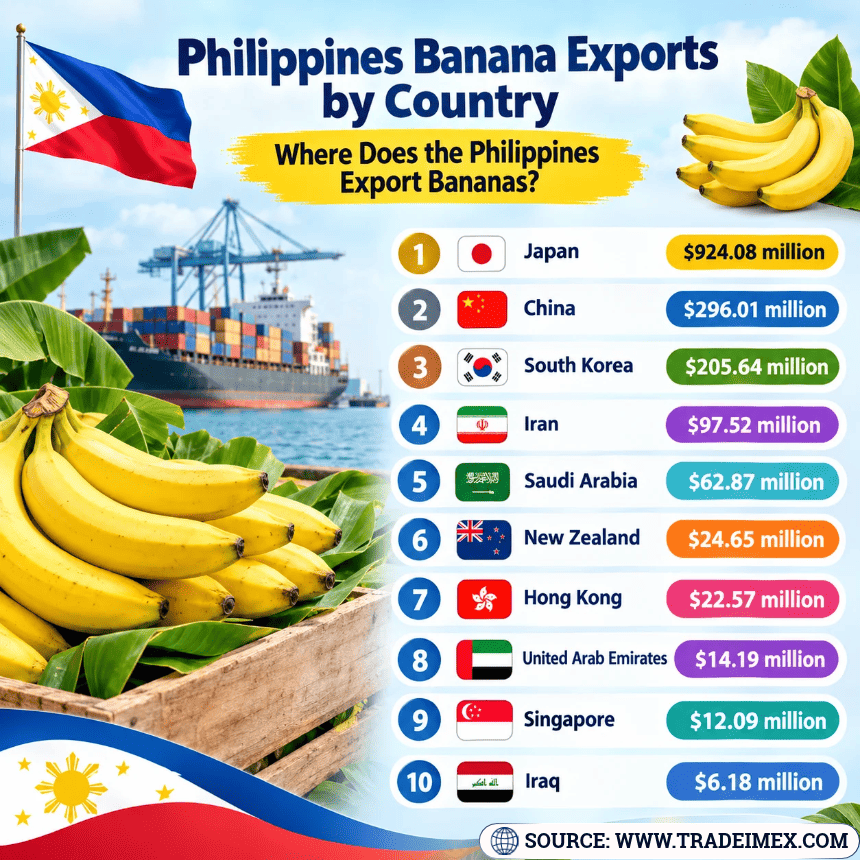
The Philippines banana exports play a significant role in the global market, with the country being one of the top exporters of bananas worldwide. The primary destinations for the Philippines banana exports include countries in Asia, Europe, & North America. Among the key countries where the Philippines exports bananas are Japan, South Korea, China, the United States, and countries in the European Union. The Philippines' reputation for producing high-quality bananas has helped establish it as a major player in the banana export industry. The top 10 destinations for Philippine banana exports, as per the Philippines shipment data for 2025, include:
1. Japan: $924.08 million (54.9%)
2. China: $296.01 million (17.6%)
3. South Korea: $205.64 million (12.2%)
4. Iran: $97.52 million (5.8%)
5. Saudi Arabia: $62.87 million (3.7%)
6. New Zealand: $24.65 million (1.5%)
7. Hong Kong: $22.57 million (1.3%)
8. United Arab Emirates: $14.19 million (0.8%)
9. Singapore: $12.09 million (0.7%)
10. Iraq: $6.18 million (0.4%)
Japan: The leading destination
Japan was the largest destination for Philippine bananas in 2025, importing around $924.09 million worth of products under HS 080300, as per the data on Philippines banana exports to Japan. Its established fruit distribution networks and consistent demand make it a key market for Philippine exporters. Companies targeting Japan should focus on consistent quality, packaging specifications, reliable shipment schedules, and compliance with applicable import requirements.
China: A major market for Philippine bananas
China ranked second, with banana imports worth around $296.01 million, as per the data on Philippines exports to China under HS code 0803. Its large consumer market creates opportunities for exporters capable of maintaining consistent quality and competitive prices. Exporters should also monitor changing demand, competitor supply, and distribution arrangements when evaluating future sales opportunities.
South Korea: An established trade partner
South Korea imported around $205.65 million worth of Philippine bananas in 2025. The market remains important for suppliers seeking to maintain a diversified customer base across East Asia.
Middle East and other destinations
Iran, Saudi Arabia, the United Arab Emirates, and Iraq were also among the leading destinations. New Zealand, Hong Kong, and Singapore added further geographic diversity.
Researching Philippines Banana Exports by country allows businesses to compare market sizes, identify existing trade relationships, and evaluate where new customers may be found. Exporters should use the latest available statistics before making decisions about market entry or expansion.
Philippines Banana Export Data: Last 10 Years Trade Performance
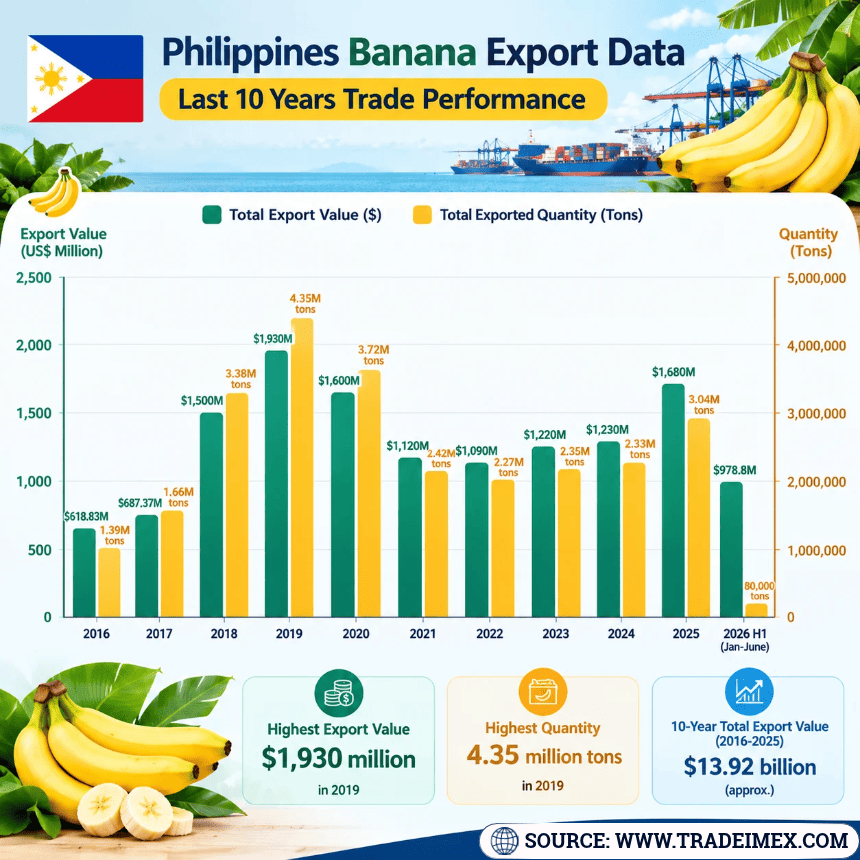
Year of Exports | Total Export Value ($) | Total Exported Quantity (Tons) |
2016 | $618.83 million | 1.39 million tons |
2017 | $687.37 million | 1.66 million tons |
2018 | $1.50 billion | 3.38 million tons |
2019 | $1.93 billion | 4.35 million tons |
2020 | $1.60 billion | 3.72 million tons |
2021 | $1.12 billion | 2.42 million tons |
2022 | $1.09 billion | 2.27 million tons |
2023 | $1.22 billion | 2.35 million tons |
2024 | $1.23 billion | 2.33 million tons |
2025 | $1.68 billion | 3.04 million tons |
2026 H1 (Jan-June) | $978.8 million | 80000 tons |
Philippines Banana Production: Main Varieties & Growing Regions
The Philippines produces several banana varieties for domestic consumption, processing, and export. Cavendish bananas dominate the country's commercial export industry because of their suitability for international fresh-fruit distribution. According to Philippine agricultural reporting cited by the Philippine Banana Council, Aquatic and Natural Resources Research and Development, national banana production in the third quarter of 2025 was estimated at around 2.31 million metric tons. Cavendish accounted for about 1.09 million metric tons, or 47.2% of production during that quarter. The Davao Region contributed around 851,430 metric tons.
Major banana varieties in the Philippines
Banana variety | Main use | Market significance |
Cavendish | Fresh consumption & export | The principal commercial export type |
Lakatan | Fresh consumption | Popular in the domestic market |
Saba/Cardava | Cooking and processing | Used in traditional & processed food |
Other local varieties | Fresh consumption & processing | Support regional & domestic markets |
Why Mindanao is important
Mindanao, particularly the Davao Region, is a major center of commercial banana production. The region benefits from established growing operations, packing facilities, and export-oriented supply chains. However, production and export volumes depend on several factors:
Weather conditions: Heavy rainfall, drought, and extreme weather can affect yield and fruit quality.
Plant disease: Fusarium wilt, including tropical race 4, can damage plantations and limit production.
Farm productivity: Crop management, planting materials, and disease control influence the quantity available for export.
Post-harvest operations: Grading, packaging, cold-chain management, and transport affect export quality.
International standards: Exporters must meet phytosanitary and quality requirements in their destination markets.
Understanding Philippines banana production helps buyers and exporters assess the sustainability of supply, anticipate seasonal constraints, and evaluate the potential for long-term contracts.
Philippines Banana Export Value Rises 7% in August 2026 Despite Lower Volumes
The Philippine banana export market recorded a notable shift in August 2026, as export value increased despite a decline in shipment volume. According to a report published by FreshPlaza on October 5, 2026, citing the Philippine Statistics Authority (PSA), banana exports rose 7% year-on-year to $146.99 million, compared with $137.33 million in August 2025. Meanwhile, reported shipment volumes declined by 1.5%, from 2.54 million metric tons to 2.50 million metric tons.
Philippines Banana Export Statistics: August 2026
Indicator | August 2026 | August 2025 | Change |
Export value | $146.99 million | $137.33 million | +7% |
Reported export volume | 2.50 million MT | 2.54 million MT | -1.5% |
Largest destination | Japan | — | — |
Why did banana export value increase despite lower volumes?
The increase was attributed to stronger international prices for fresh bananas. In other words, the Philippines generated more export revenue even though the reported shipment volume decreased. This illustrates why export value and export quantity should be examined separately when analyzing agricultural trade.
For exporters, higher prices can support revenue even when supply is tighter. However, a decline in volume may also signal production constraints, supply fluctuations, or changing shipment patterns. Businesses should therefore consider both measures before concluding industry performance.
Japan remains the leading destination
Japan continued to dominate the Philippines' banana export market in August 2026, accounting for 67.4% of reported export value.
Destination | Export value | Share of export value |
Japan | $99.01 million | 67.4% |
China | $22.31 million | 15.2% |
South Korea | $12.08 million | 8.2% |
United Arab Emirates | $7.14 million | 4.9% |
New Zealand | $4.40 million | 3.0% |
Other markets | $2.05 million | 1.4% |
Japan's dominant share highlights the importance of established Asian buyers to the Philippine banana industry. China and South Korea remained the next-largest destinations, while the UAE and New Zealand contributed smaller shares.
The report also notes that the PSA's fresh banana category covers Cavendish, Saba (plantain), Latundan, Señorita, and Morado varieties. This is useful context for companies researching Philippines banana exports, as export trends may reflect different varieties and product-market requirements.
Is the Philippines the Largest Exporter of Bananas?
The Philippines is one of the world's major banana exporters, but it was the second-largest banana exporter in 2025, behind Ecuador, according to reported export statistics.
Exporter | Position in the global market |
Ecuador | Leading global banana exporter |
Philippines | Second-largest exporter in 2025 |
Colombia | Major international banana supplier |
Guatemala | Important exporter serving overseas markets |
Ecuador's export value under HS 080300 was around $4.28 billion in 2025, compared with about $1.68 billion for the Philippines. The answer to the question “Who is the largest exporter of bananas?” depends on the reporting period and whether the ranking uses export value, export quantity, or a narrower product category. Nevertheless, the Philippines maintains a strong position in Asian markets due to its geographical proximity and established supply networks. Its future competitiveness will depend on production recovery, disease management, export quality, market diversification, and its ability to meet buyer requirements.
List of Banana Exporters in the Philippines
The Philippine banana export sector includes plantation operators, integrated agricultural companies, trading firms, packing facilities, and specialist fresh-fruit exporters. The following businesses are useful starting points for researching the list of banana exporters in the Philippines. They are examples of industry participants, not a verified ranking by export value or shipment volume. The leading banana exporters in the Philippines, according to the Philippines banana exporters database for 2026, include:
Company | Industry role |
Dole Philippines, Inc. | Agricultural producer with banana-related operations |
Sumifru (Philippines) Corporation | Banana industry participant with growing & packing operations |
Lapanday Foods Corporation | Philippine grower and exporter of fresh produce, including bananas |
Unifrutti Tropical Philippines, Inc. | Participant in the Philippine banana growing and export industry |
AVANTE Agri-Products Philippines, Inc. | Exporter associated with fresh Saba banana shipments |
Other names appearing in Philippine Bureau of Plant Industry listings include Questa Fruit Trading, Sarap Fruits Agriventure Incorporated, Highland Agri-Ventures, PSC Diversified Fruits, Vizcaya Plantation, Manupali Agri-Development Corporation, Mindanao Agritraders, and Southern Philippine Fresh Fruits Corporation.
Philippines Banana Export Outlook for 2026
The 2025 recovery provides a stronger starting point for the Philippine banana industry in 2026. However, a full-year 2026 assessment should be based on completed annual data when available, rather than treating partial-year figures as final. Key trends shaping the 2026 market include:
1. Production recovery and investment
Support for planting materials, farm inputs, and improved crop management may help strengthen supply. Sustaining production growth will be important for meeting overseas demand and maintaining export competitiveness.
2. Disease prevention and plantation management
Fusarium wilt remains a significant concern. Effective disease monitoring, biosecurity, and plantation management are important for protecting output and minimizing supply disruptions.
3. Continued demand from Asian markets
Japan, China, and South Korea represented the three leading destinations in the 2025 data. Maintaining relationships with these buyers while developing additional markets can help exporters reduce dependence on a small group of customers.
4. Opportunities for Saba bananas
Saba or Cardava bananas offer opportunities beyond the conventional Cavendish export trade. Fresh shipments and processed banana products may help suppliers reach additional customers, although product classification and market requirements must be checked separately.
5. Better trade intelligence
Exporters increasingly need information about destination demand, competitor activity, buyer companies, shipment volumes, and market prices. Reliable trade data can help businesses identify potential customers and make more informed decisions about export-market expansion.
How TradeImeX Helps with Philippines Banana Export Data
TradeImeX is an AI-powered global import-export data and trade intelligence platform that helps businesses research international trade flows & identify market opportunities. For companies interested in AI-powered search on Philippine banana exports under HS Code 0803, trade intelligence can support:
Export-market research: Compare destination countries and historical export trends.
Buyer discovery: Investigate potential importers where company-level data is available.
Supplier research: Explore available shipment records and trading relationships.
HS code research: Identify the relevant product classification and avoid mixing different product categories.
Competitor analysis: Examine available trade records to understand sourcing patterns and market participation.
Customized reports: Organize relevant trade information for business development and market planning.
By combining official statistics with trade intelligence, businesses can evaluate opportunities, screen potential suppliers, and build a more informed export strategy.
Conclusion
Philippines banana export data for 2025 highlights the country's recovery as a major global supplier, with around $1.68 billion in exports under HS 080300 & strong demand from Japan, China, and South Korea. For 2026, the industry's performance will depend on production conditions, disease management, international demand, and the ability of exporters to maintain consistent quality and reliable supply. Importers and distributors can use official statistics, verified exporter lists, and shipment-level trade intelligence to compare suppliers and identify opportunities.
Note For Our Readers
For businesses looking to understand the Philippines banana exports by country or HS code, AI-powered research, production trends, and destination-market demand provide a practical foundation for making better-informed trade decisions. For the latest Philippines import-export data or customized trade reports contact TradeImeX at info@tradeimex.in today.
Frequently Asked Questions
1. What was the value of the Philippines banana exports in 2025?
Philippines banana exports reached around $1.68 billion under HS 080300 in 2025. The reported export quantity was around 3.04 million metric tons.
2. Where does the Philippines export bananas?
The leading destinations in 2025 were Japan, China, and South Korea. Iran and Saudi Arabia were also important markets, followed by destinations including New Zealand, Hong Kong, Singapore, the United Arab Emirates, and Iraq.
3. What is the HS code for Philippine banana exports?
The international heading is HS 0803, covering bananas, including plantains, fresh or dried. The six-digit code used in the trade statistics discussed here is HS 080300. National tariff schedules may contain more detailed classifications.
4. Who are the major banana exporters in the Philippines?
Examples include Dole Philippines, Sumifru (Philippines) Corporation, Lapanday Foods Corporation, Unifrutti Tropical Philippines, and AVANTE Agri-Products Philippines. Buyers should verify current exporter registration and product coverage before placing orders.
5. Is the Philippines the world's largest banana exporter?
No. The Philippines ranked as the world's second-largest banana exporter in 2025, behind Ecuador, according to the cited trade statistics.
Explore the latest global trade trends, market insights, import-export analysis, and industry updates with TradeImeX blogs.
Request a Data Sample →
Tradeimex
TradeImeX’s content team brings together expertise in global trade data, import-export trends, market intelligence, and international business. Our writers turn complex trade data into clear, actionable insights to help businesses understand markets, identify opportunities, and make informed decisions. From emerging trade trends to country and product-level analysis, we focus on delivering timely insights backed by reliable data.