
The Philippines remains one of Southeast Asia's important electronics manufacturing, assembly, and sourcing markets. Electronics are deeply integrated into the country's industrial base, semiconductor ecosystem, telecommunications infrastructure, consumer market, and export-oriented manufacturing sector. According to the latest Philippines import data and Philippines customs import data for electronics, the total value of Philippines electronics imports reached $33.53 billion in 2025, a 21% increase from the previous year. In the first half of 2026 (January-June), the Philippines imported electronics worth $23.76 billion under HS code 85, a 29.11% year-over-year growth from the same period last year.
The Philippines is the 25th-largest importer of electronics worldwide, and electronics is its largest imported commodity, accounting for 23.9% of total Philippine imports, according to global trade data. As a result, the Philippines electronics import data shows strong demand for electronic integrated circuits, communication equipment, semiconductor devices, printed circuits, electrical components, cables, transformers, batteries, and other products covered under HS Code 85. In this article, we will delve into the Philippines Electronics Import Data for the years 2025-26, focusing on the insights gathered from the imports made under HS Code 85.
Philippines Electronics Import Data 2025: Key Highlights
Particulars | 2025 Data |
Total Philippine merchandise imports | $134.20 billion |
HS Code 85 imports | $33.53 billion |
HS 85 import growth | 20.69% YoY |
PSA electronic-product imports | $32.03 billion |
Electronics share of total imports | 23.9% |
HS 85 exports | $44.43 billion |
HS 85 trade turnover | $77.94 billion |
Largest HS 85 supplier | China |
Largest HS 85 imported product | Electronic integrated circuits (HS 8542) |
The scale of electronics imports is particularly significant because the Philippines is not simply a consumer market for electronics. Imported components and intermediate goods also support domestic semiconductor assembly, electronics manufacturing, telecommunications, industrial equipment, and re-export activity, according to the Philippine Statistics Authority (PSA).
Philippines Electronics Imports Under HS Code 85
HS Code 85 covers a wide range of electrical machinery and electronic equipment. The chapter includes electronic integrated circuits, telephones & communication apparatus, semiconductor devices, electrical wires & cables, printed circuits, switching equipment, transformers, accumulators, recording media, and several other electrical products. In 2025, the Philippines imported around $33.53 billion worth of HS 85 products.
Electronic integrated circuits represented more than half of this import value, highlighting the country's continued dependence on imported semiconductor components and other advanced electronic inputs. The composition of imports demonstrates that the Philippines' electronics import market is heavily oriented toward components and intermediate products, rather than being dominated exclusively by finished consumer electronics.
Philippines Electronics Imports by Country: Top Import Markets
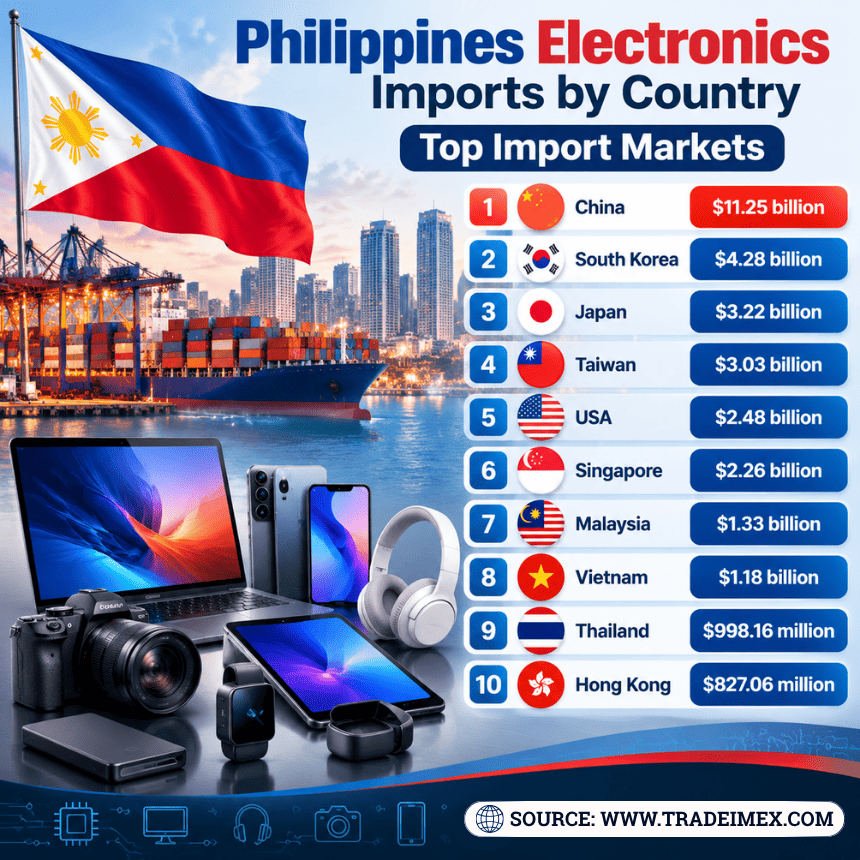
The Philippines Electronics Imports by Country data shows the top import markets from which the nation sources its electronic products. This data provides valuable insights into the countries that significantly contribute to the Philippines' electronics industry. As a key player in the electronics market, the Philippines imports electronics primarily from countries like China, South Korea, Japan, and the United States.
These nations have established themselves as leading providers of high-quality electronic products, catering to the demand and technological needs of the Philippine market. The top 10 electronics supplier countries to the Philippines, according to the Philippines shipment data for 2025, include:
1. China: $11.25 billion (33.6%)
2. South Korea: $4.28 billion (12.8%)
3. Japan: $3.22 billion (9.6%)
4. Taiwan: $3.03 billion (9.1%)
5. USA: $2.48 billion (7.4%)
6. Singapore: $2.26 billion (6.8%)
7. Malaysia: $1.33 billion (4%)
8. Vietnam: $1.18 billion (3.5%)
9. Thailand: $998.16 million (3%)
10. Hong Kong: $827.06 million (2.5%)
China alone supplied around one-third of the Philippines' HS 85 imports, making it the country's most important electronics sourcing market by value, as per the data on Philippines imports from China under HS code 85. South Korea and Japan in particular were also major sources, reflecting the importance of advanced Asian semiconductor and electronics manufacturing networks.
China Leads Philippines Electronics Import Supply
The Philippines imported around $11.26 billion in electrical & electronic equipment from China in 2025. Major products included integrated circuits, telephony equipment, insulated wires and cables, semiconductor devices, printed circuits, transformers, and electric accumulators.
The concentration of imports from China is important for companies examining the Philippines' electronics supply chain. China provides a broad product range, from semiconductor-related components and communication equipment to electrical components and finished or semi-finished products.
China's position also reflects the broader importance of East Asia in Philippine trade. PSA data shows that East Asia was the Philippines' largest geographic source of imports in the first half of 2026, accounting for $41.87 billion or 53.6% of total imports.
South Korea and Japan Remain Major Electronics Suppliers
South Korea supplied around $4.29 billion of HS 85 products to the Philippines in 2025. Electronic integrated circuits represented a substantial component of this trade, with Korean integrated-circuit exports to the Philippines valued at around $3.43 billion.
Japan was another major source, supplying around $3.22 billion of HS 85 products in 2025, as per the data on the Philippines electronics imports from Japan. Japan's role is particularly relevant for semiconductor-related parts, machinery-associated electrical equipment, automotive electronics, and other high-value industrial products. The United States and Singapore also occupied important positions in the supply chain, with HS 85 imports of around $2.48 billion and $2.27 billion, respectively.
Top Electronic Products Imported by the Philippines in 2025
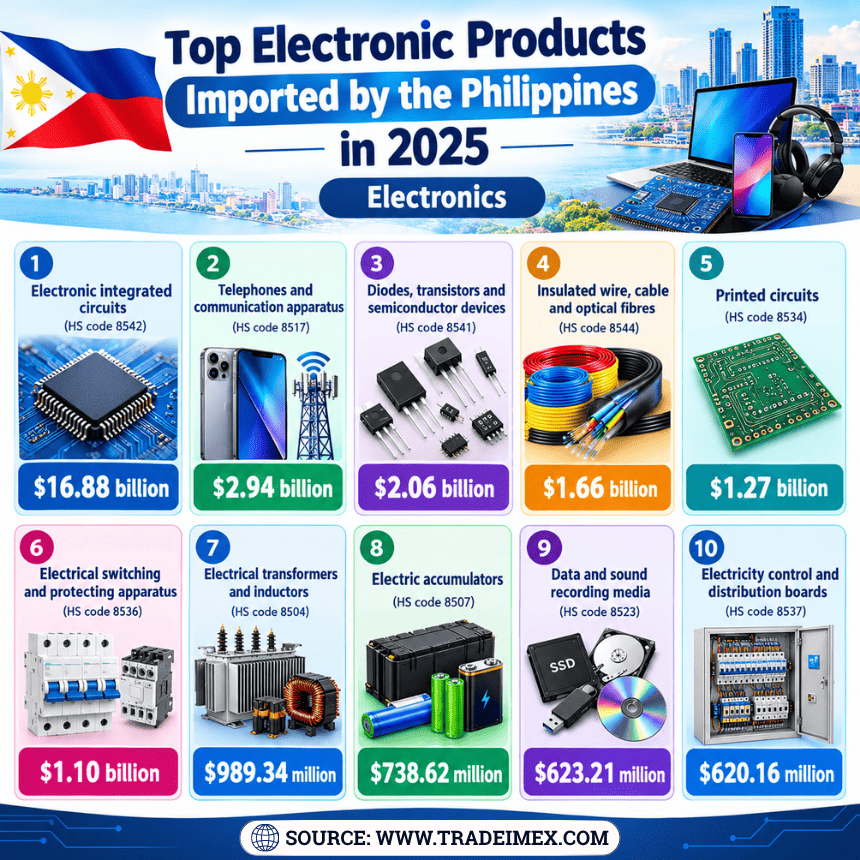
The following were among the largest HS code 85 electronics import categories of the Philippines in 2025:
Electronic integrated circuits (HS code 8542): $16.88 billion
Telephones and communication apparatus (HS code 8517): $2.94 billion
Diodes, transistors and semiconductor devices (HS code 8541): $2.06 billion
Insulated wire, cable and optical fibres (HS code 8544): $1.66 billion
Printed circuits (HS code 8534): $1.27 billion
Electrical switching and protecting apparatus (HS code 8536): $1.10 billion
Electrical transformers and inductors (HS code 8504): $989.34 million
Electric accumulators (HS code 8507): $738.62 million
Data and sound recording media (HS code 8523): $623.21 million
Electricity control and distribution boards (HS code 8537): $620.16 million
Together, these categories illustrate the importance of semiconductor components, communication equipment, electrical infrastructure, and electronic manufacturing inputs within Philippine import demand.
Electronic Integrated Circuits Dominate the Market
Electronic integrated circuits under HS 8542 were by far the largest HS 85 import category, as per the Philippines electronics import data under HS code 8542. Imports reached around $16.88 billion, representing 50.37% of total HS 85 imports in 2025. This concentration is closely connected with the Philippines' position in the global electronics and semiconductor supply chain. Integrated circuits are essential inputs for computers, telecommunications equipment, automotive electronics, industrial equipment, consumer electronics, and numerous other products. The country's large semiconductor and electronics manufacturing ecosystem therefore generates substantial demand for imported chips and related components.
Philippines Electronics Import Data: Last 10 Years Trade Performance
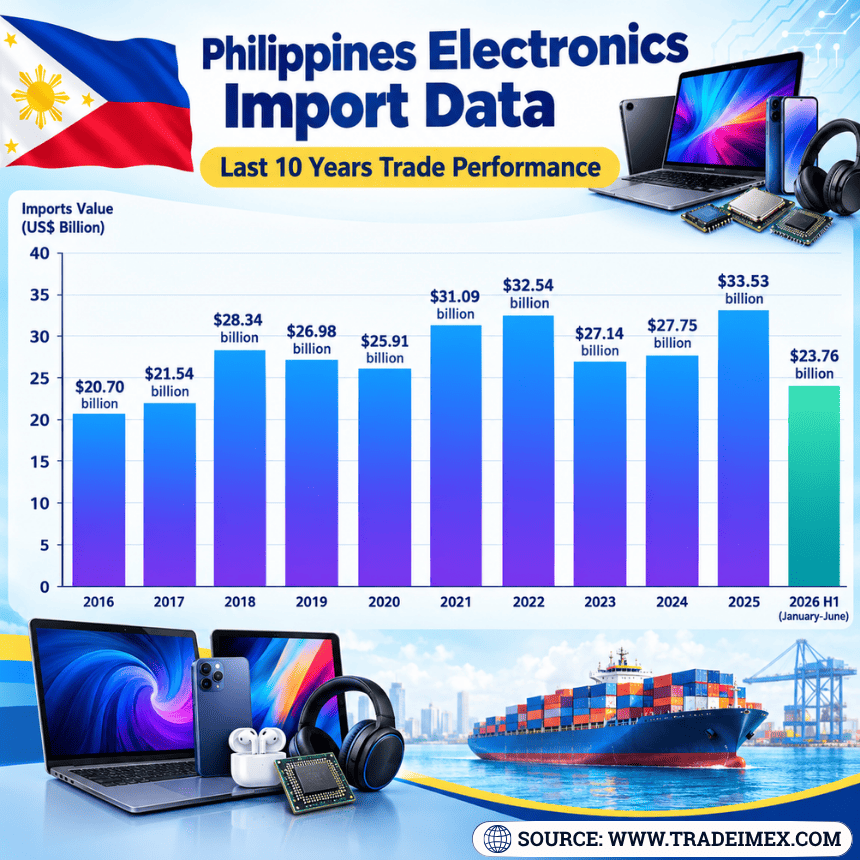
Year of Imports | Philippines Imports Under HS Code 85 ($) |
2016 | $20.70 billion |
2017 | $21.54 billion |
2018 | $28.34 billion |
2019 | $26.98 billion |
2020 | $25.91 billion |
2021 | $31.09 billion |
2022 | $32.54 billion |
2023 | $27.14 billion |
2024 | $27.75 billion |
2025 | $33.53 billion |
2026 H1 (January-June) | $23.76 billion |
Philippines Electronics Import Market in 2025
The importance of electronics extends beyond HS 85. According to the Philippine Statistics Authority, electronic products generated the highest import value among all major commodity groups in 2025, reaching $32.03 billion. This represented 23.9% of the country's total imports.
Electronic products also recorded the largest annual increase in import value among the country's commodity groups during 2025, increasing by around $4.65 billion compared with the previous year. Telecommunication equipment and electrical machinery recorded an additional annual increase of around $899.60 million. This indicates that electronics demand was not an isolated segment of Philippine trade. It was one of the principal contributors to overall import growth.
Philippines Electronics Imports & Semiconductor Demand
Semiconductors are at the heart of the Philippines' electronics import structure. The country's 2025 HS 85 imports included around:
$16.88 billion in electronic integrated circuits
$2.06 billion in diodes, transistors and semiconductor devices
$1.27 billion in printed circuits
$989.34 million in electrical transformers and inductors
$1.10 billion in electrical switching and protecting apparatus
The combined value of these categories demonstrates substantial demand for components used in electronics production and industrial applications. For international suppliers, this structure points toward opportunities across semiconductor components, circuit assemblies, electrical components, power-management equipment, connectivity products, and industrial electronics.
Philippines Electronics Import Statistics 2026: Latest Trends
The electronics import market continued to expand into 2026. During the first half of 2026, the Philippines imported $23.76 billion of electronic products, representing 30.4% of total imports during the period. Electronic products were again the country's largest imported commodity group. More importantly, the value of electronic-product imports increased by around $9.16 billion year over year during the first half of 2026, making electronics the commodity group with the largest annual increment in import value.
The growth continued into July. In July 2026, Philippine electronic-product imports reached around $4.60 billion, representing 32.6% of the country's total imports for the month. Electronic products were again the largest import commodity group. This provides a strong indication that electronics remained a central component of Philippine import demand through the first seven months of 2026.
Electronics Imports Into the Philippines by Major Sector
Industry data from the Semiconductor and Electronics Industries in the Philippines Foundation (SEIPI) provides another view of the market. SEIPI reported that cumulative Philippine electronics imports increased 16.67% from $27.38 billion in 2024 to $31.94 billion in 2025. All major electronics sectors recorded growth during the year.
Semiconductor Components Lead
Semiconductor components and devices were the largest electronics-import segment, increasing by around 20.07%, from $18.50 billion in 2024 to $22.22 billion in 2025.
Other sectors also recorded growth:
Communication/Radar: +16.62%
Control and Instrumentation: +14.53%
Electronic Data Processing: +11.30%
Medical/Industrial Instrumentation: +9.29%
Automotive Electronics: +7.65%
Consumer Electronics: +3.19%
Telecommunication: +2.70%
Office Equipment: +2.17%
The data reinforces the semiconductor-heavy nature of the Philippine electronics ecosystem.
Why Philippines Electronics Import Data Matters for Businesses
For manufacturers, distributors, sourcing companies, exporters, & market researchers, Philippines electronics import data provides more than a measurement of market size. It can reveal how the country's electronics supply chain is structured. Businesses can use import data to identify:
1. High-demand electronics products
HS-level data helps companies identify products with substantial import values, including integrated circuits, semiconductor devices, communication equipment, printed circuits, cables, transformers, and electrical components.
2. Major electronics suppliers
Import records show which countries are supplying the Philippine market and how their positions change over time.
3. Importer and buyer opportunities
Customs and shipment-level records can help businesses identify companies actively purchasing particular electronics products and components.
4. Sourcing patterns
Comparing suppliers by country, product, HS code, port, shipment frequency, and import value can reveal sourcing concentration and diversification trends.
5. Product-level market opportunities
Companies can narrow their research from the broader HS 85 chapter to specific four-digit, six-digit, or eight-digit HS codes to identify individual product markets.
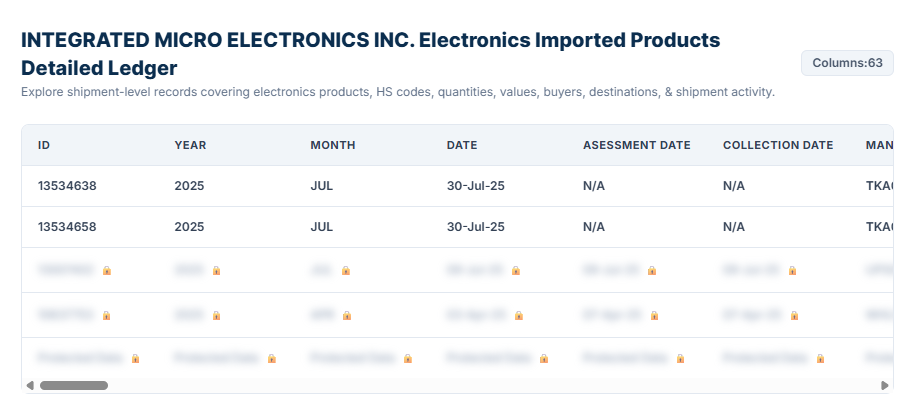
We have attached a sample shipment dataset preview of a leading electronics importer in the Philippines. To get a complete Philippines electronics importers database along with customized trade reports for your business, contact info@tradeimex.in today.
Philippines HS Code 85 Import Outlook for 2026
The available 2026 data points to continued strength in electronics imports. During January-June 2026, total Philippine merchandise imports reached $78.14 billion, up 18.8% year over year, while electronic products alone reached $23.76 billion. By July 2026, total imports had reached $92.26 billion for January-July, an increase of 18.9% from the corresponding period in 2025. Electronic products remained the largest import category in July, with $4.60 billion in monthly imports.
China also remained the Philippines' largest import supplier in July 2026, with $4.17 billion, followed by South Korea at $1.80 billion and Japan at $1.11 billion. These figures show that electronics continue to occupy a central position in the country's import structure in 2026.
Key Takeaways from Philippines Electronics Import Data
The Philippine electronics import market can be summarized through several important data points:
Philippines electronics imports reached around $33.53 billion in 2025.
HS code 85 imports increased around 20.69% year over year.
Electronic integrated circuits accounted for $16.88 billion, or 50.37% of HS 85 imports.
China supplied around $11.26 billion of HS 85 products.
South Korea supplied around $4.29 billion, while Japan supplied around $3.22 billion.
Electronic-product imports in 2025, represented 23.9% of total Philippines imports.
Smartphones remained the largest growing import category as per the Philippines smartphone import data.
Electronics imports reached $23.76 billion in the first half of 2026.
Electronic products accounted for 30.4% of Philippine imports in H1 2026.
Electronics imports reached $4.60 billion in July 2026, accounting for 32.6% of monthly imports.
Semiconductor components remained the dominant electronics import segment.
Conclusion
Overall, Philippines Electronics Import Data 2025-26 reflects a market strongly connected to global semiconductor and electronics supply chains. The dominance of integrated circuits, semiconductor devices, communication equipment, printed circuits, and other electronic components demonstrates the importance of imported inputs to the country's manufacturing and technology ecosystem.
For exporters and suppliers, HS Code 85 provides a useful starting point for evaluating the Philippine electronics market. However, companies seeking actionable market intelligence should go beyond chapter-level totals and examine individual HS codes, importer companies, suppliers, shipment frequency, product descriptions, quantities, ports, and historical sourcing patterns.
Note For Our Readers
With TradeImeX Philippines Export-Import Data, businesses can search electronics shipments under HS Code 85, identify active Philippine importers and international suppliers, study product-level demand, analyze sourcing countries, and track shipment-level trade activity. This enables companies to move from broad market statistics to specific buyer and supplier opportunities across the Philippine electronics industry. Get the latest Philippines electronics import data by country or HS code along with AI-powered trade research. Contact info@tradeimex.in to get customized trade reports & market insights for your business.
Frequently Asked Questions
1. How much electronics did the Philippines import in 2025?
The Philippines imported approximately $33.53 billion worth of products under HS Code 85 in 2025, covering electrical machinery, electronic equipment, semiconductor components, communication equipment, and related products.
2. What is the main electronics product imported by the Philippines?
Electronic integrated circuits under HS Code 8542 were the largest electronics import category in 2025, with imports valued at approximately $16.88 billion. They accounted for more than half of total HS Code 85 imports.
3. Which country exports the most electronics to the Philippines?
China was the leading supplier of HS Code 85 products to the Philippines in 2025, with imports valued at approximately $11.26 billion, followed by South Korea and Japan.
4. How much electronic products did the Philippines import in 2026?
During the first half of 2026, the Philippines imported about $23.76 billion worth of electronic products, accounting for 30.4% of the country's total imports during the period. By July 2026, monthly electronic-product imports reached around $4.60 billion.
5. Where can I find Philippines electronics importers and shipment data?
It can be found exclusively at TradeImeX. Businesses can use Philippines Import Data to research electronics imports by HS code, product, importer, supplier, country of origin, shipment, port, and import value. Searching under HS Code 85 can help identify active electronics buyers and suppliers in the Philippine market.
Explore the latest global trade trends, market insights, import-export analysis, and industry updates with TradeImeX blogs.
Request a Data Sample →
Tradeimex
TradeImeX’s content team brings together expertise in global trade data, import-export trends, market intelligence, and international business. Our writers turn complex trade data into clear, actionable insights to help businesses understand markets, identify opportunities, and make informed decisions. From emerging trade trends to country and product-level analysis, we focus on delivering timely insights backed by reliable data.