
The United States and the Philippines share a strong bilateral trade relationship, supported by growing merchandise exports, electronics manufacturing, agricultural commodities, industrial machinery, and international investment. Both countries play important roles in global supply chains, with the United States as a major destination for Philippine manufactured goods and the Philippines as a growing market for American agricultural & industrial products. According to the latest US import data & Philippines export data, total US-Philippines trade turnover reached $27.36 billion in 2025, up 10% from the previous year. Philippines-US trade accounted for $24.10 billion in the first eight months of 2026 (January-August).
The total value of US imports from the Philippines reached $18.22 billion, while US exports to the Philippines accounted for $9.14 billion in 2025, according to US export dataand Philippine import data. In 2025-26, US-Philippines trade relations continued to attract attention because of Philippine exports, rising demand for semiconductor products, changing US tariff policies, and opportunities for supply-chain diversification. Electronics, electrical equipment, machinery, coconut oil, agricultural commodities, aircraft, and consumer goods remain important components of bilateral trade.
An analysis of US-Philippines trade data for 2025-26 provides valuable insights into the leading export and import commodities, bilateral trade performance, major trading partners, and emerging opportunities for international businesses.
Top 10 Goods US Imports from Philippines: What Does the US Import From the Philippines?
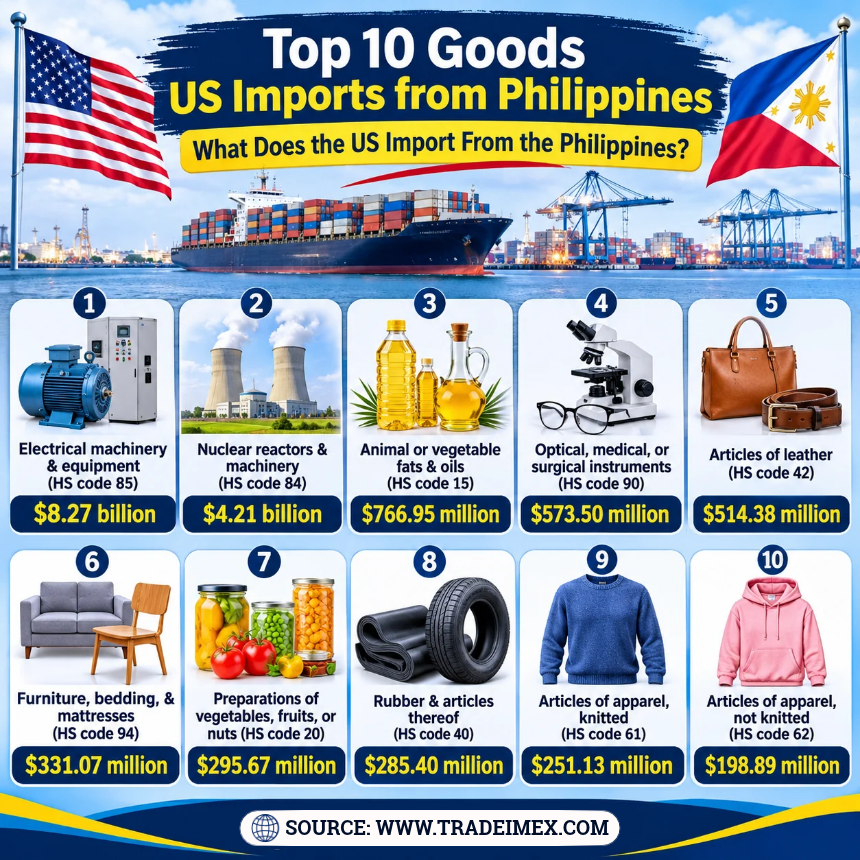
The United States imports many goods from the Philippines, making it an important trading partner. The top ten items include electronic products like computers and phones, which are very popular, as per the data on Philippines exports to the US under HS code 85. Other imports are clothing, particularly textiles, and footwear. The US also buys large amounts of coconut oil and other agricultural products, such as bananas and pineapples.
Additionally, furniture and home decorations are imported, offering unique styles. These goods help meet consumer needs and strengthen the trade relationship between the two countries. The top 10 products that the US imports from the Philippines, as per the US-Philippines trade data for 2025-26, include:
1. Electrical machinery & equipment (HS code 85): $8.27 billion
2. Nuclear reactors & machinery (HS code 84): $4.21 billion
3. Animal or vegetable fats & oils (HS code 15): $766.95 million
4. Optical, medical, or surgical instruments (HS code 90): $573.50 million
5. Articles of leather (HS code 42): $514.38 million
6. Furniture, bedding, & mattresses (HS code 94): $331.07 million
7. Preparations of vegetables, fruits, or nuts (HS code 20): $295.67 million
8. Rubber & articles thereof (HS code 40): $285.40 million
9. Articles of apparel, knitted (HS code 61): $251.13 million
10. Articles of apparel, not knitted (HS code 62): $198.89 million
Top 10 Goods US Exports to Philippines: What Does the US Export to the Philippines?
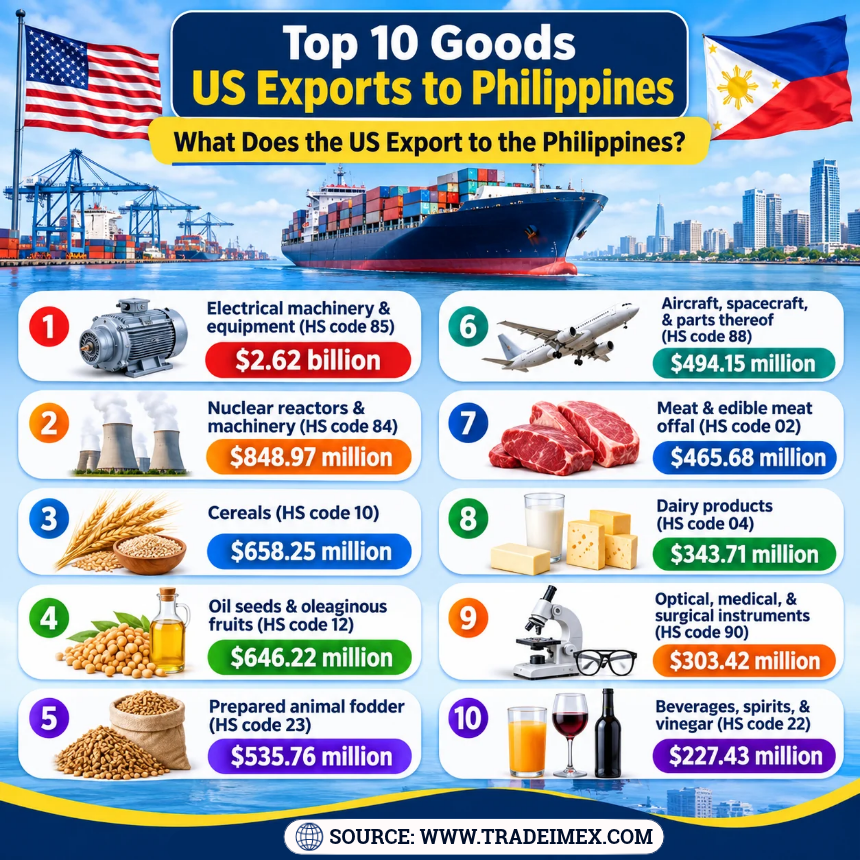
The United States exports many goods to the Philippines. Some of the top items include machinery, electronics, and cereals, as per the data on US exports to the Philippines. Other important exports are agricultural products like corn, soybeans, and meat. The U.S. also sends medical equipment and chemicals to help industries in the Philippines. Clothes and textiles are included too. These goods support economic growth and meet the needs of people in the Philippines. Overall, the trade between the two countries helps build a strong relationship & benefits both sides. The top 10 goods that the US exports to the Philippines, as per the US shipment data for 2025-26, include:
1. Electrical machinery & equipment (HS code 85): $2.62 billion
2. Nuclear reactors & machinery (HS code 84): $848.97 million
3. Cereals (HS code 10): $658.25 million
4. Oil seeds & oleaginous fruits (HS code 12): $646.22 million
5. Prepared animal fodder (HS code 23): $535.76 million
6. Aircraft, spacecraft, & parts thereof (HS code 88): $494.15 million
7. Meat & edible meat offal (HS code 02): $465.68 million
8. Dairy products (HS code 04): $343.71 million
9. Optical, medical, & surgical instruments (HS code 90): $303.42 million
10. Beverages, spirits, & vinegar (HS code 22): $227.43 million
Trade market insight: The Philippines represents an important destination for American agricultural & industrial exporters. Cereals, oilseeds, animal feed, machinery, electronic components, and aerospace products provide significant areas of bilateral commercial activity.
US-Philippines Trade: Bilateral Trade Data in the Last 10 Years
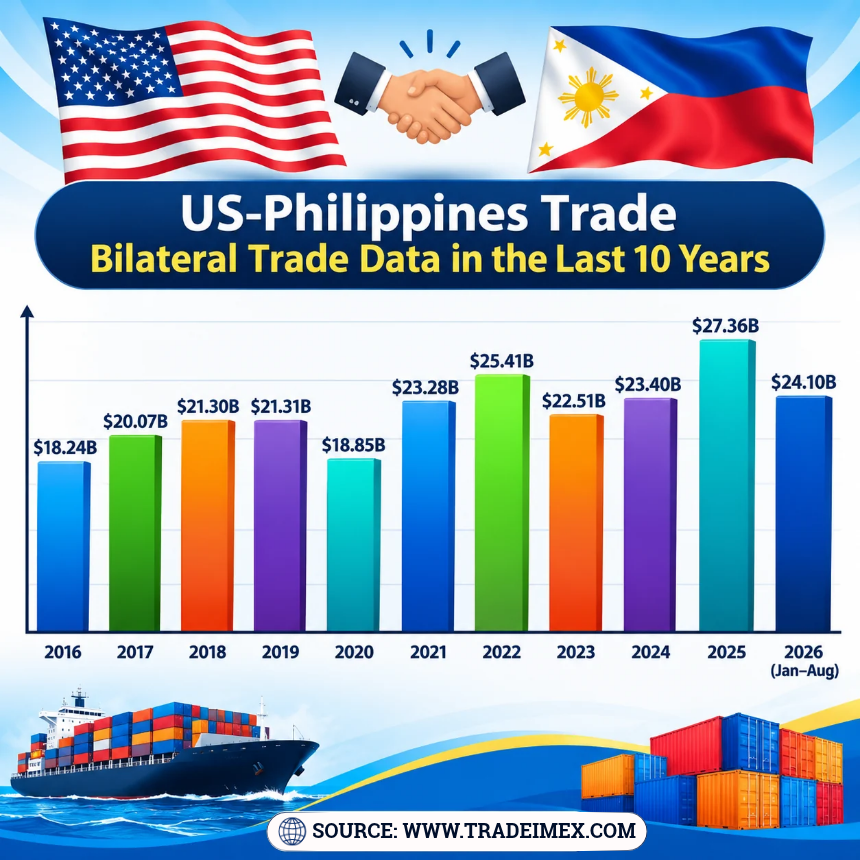
Year of Trade | Total US-Philippines Trade ($) |
2016 | $18.24 billion |
2017 | $20.07 billion |
2018 | $21.30 billion |
2019 | $21.31 billion |
2020 | $18.85 billion |
2021 | $23.28 billion |
2022 | $25.41 billion |
2023 | $22.51 billion |
2024 | $23.40 billion |
2025 | $27.36 billion |
2026 (January-August) | $24.10 billion |
Philippines-US Trade Balance and Bilateral Trade Growth
The US-Philippines trade balance reflects the difference between the value of American exports to the Philippines and Philippine exports to the United States. In 2025, the United States imported around $17.76 billion worth of merchandise from the Philippines and exported around $9.24 billion worth of goods to the country. Consequently, the US recorded a merchandise trade deficit of around $8.52 billion with the Philippines in 2025. The following comparison highlights the changing Philippines-US trade relations:
Trade indicators | 2024 | 2025 |
US exports to Philippines | $9.24B | $9.24B |
US imports from Philippines | $14.15B | $17.76B |
US trade deficit | $4.91B | $8.52B |
Total goods trade | $23.40B | $27.00B |
The figures demonstrate that US imports from the Philippines increased substantially between 2024 and 2025, while American exports remained relatively stable. This contributed to the widening US merchandise trade deficit. The growth in Philippine shipments reflects the importance of its manufacturing industries, particularly electronics, electrical components, and other manufactured products, in supplying the American market.
The United States accounted for around 15.9% of the Philippines' total merchandise exports in 2025. Its position as the largest export destination highlights the importance of American demand for Philippine electronics, machinery, manufactured goods, and agricultural products. On the import side, the United States supplied around $8.15 billion worth of merchandise to the Philippines in 2025, making it the country's fifth-largest import source.
US-Philippines Trade Relations and Economic Cooperation
The United States and the Philippines have maintained a long-standing economic partnership supported by bilateral agreements, commercial cooperation, and investment relationships. Their trade relations cover manufacturing, agriculture, technology, services, infrastructure, and international supply-chain development.
One of the most important frameworks governing bilateral economic discussions is the US-Philippines Trade and Investment Framework Agreement (TIFA), signed on November 9, 1989. The agreement provides a platform for both countries to discuss trade barriers, investment opportunities, market-access concerns, and improvements in bilateral commercial relations. Some important areas of economic cooperation include:
Agricultural Trade: The United States supplies the Philippines with cereals, meat, dairy products, oilseeds, and animal feed. Both countries continue to address agricultural market-access requirements and trade regulations.
Electronics & Semiconductor Manufacturing: The Philippines has an established electronics manufacturing industry, while American companies contribute technology, equipment, investment, and access to international markets.
Customs & Trade Facilitation: Both countries cooperate on customs administration, trade facilitation, and measures to address illegal transshipments of textile and apparel products.
Foreign Investment: Investment opportunities in manufacturing, energy, infrastructure, and technology support the broader economic partnership.
Services & Digital Trade: Financial services, telecommunications, business-process outsourcing, and technology-related activities contribute to bilateral commercial relations.
Beyond merchandise trade, US-Philippines services trade reached an estimated $13.9 billion in 2025, according to the USTR's bilateral trade summary.
Major Factors Influencing US-Philippines Trade in 2026
Several international economic developments are influencing the direction of US-Philippines trade relations in 2026. These factors are important for exporters, importers, manufacturers, and international trade businesses.
1. Rising Global Demand for Semiconductors
The Philippines is an important participant in international semiconductor manufacturing & assembly networks. Growing demand for integrated circuits, electronic components, and electrical equipment creates opportunities for Philippine exporters targeting the American market.
2. Changes in US Tariff Policies
American tariff policies & international trade regulations remain important considerations for Philippine exporters. Changes in import duties can influence product pricing, sourcing strategies, manufacturing costs, and the competitiveness of Philippine products in the United States.
3. Global Supply-Chain Diversification
International manufacturers are increasingly examining alternative sourcing and production locations. The Philippines can benefit from this trend through its electronics manufacturing capabilities, skilled workforce, and strategic position in Southeast Asia.
4. Increasing Agricultural Import Requirements
The Philippines continues to depend on international suppliers for several agricultural commodities, including cereals, oilseeds, meat, dairy products, and animal feed. This creates opportunities for American agricultural exporters and commodity suppliers.
5. Industrial and Infrastructure Development
The Philippines' infrastructure and industrial development creates demand for imported machinery, electrical equipment, aircraft, industrial components, and advanced technologies. American manufacturers can explore these opportunities through bilateral trade and investment partnerships.
Challenges Affecting US-Philippines Bilateral Trade
Despite the growing commercial relationship, several challenges could influence bilateral trade performance in 2026 and beyond.
Tariff uncertainty: Changes in US trade policies and import duties can affect the competitiveness of Philippine exports.
Regional competition: Philippine manufacturers face competition from China, Vietnam, Thailand, Malaysia, and other Asian exporters.
Supply-chain disruptions: International shipping costs, geopolitical tensions, and trade disruptions can affect trade flows.
Agricultural market-access restrictions: Differences in import regulations, tariff-rate quotas, and product standards can create challenges for American agricultural suppliers.
Trade imbalance: The growing US merchandise trade deficit with the Philippines could become an important issue in future bilateral trade discussions.
Manufacturing costs: Changes in labour, energy, and production costs can influence the competitiveness of Philippine manufacturers.
Addressing these challenges through constructive negotiations, stronger customs cooperation, improved market access, and investment partnerships will be important for sustaining bilateral trade growth.
Future Outlook for US-Philippines Trade in 2026-27
The outlook for US-Philippines trade remains closely connected to global electronics demand, semiconductor manufacturing, agricultural imports, industrial investment, and international supply-chain developments. The Philippines is expected to retain its importance as a supplier of electronic components, semiconductor products, electrical equipment, and manufactured consumer goods to the American market.
Meanwhile, US exporters can explore opportunities in agricultural goods, industrial machinery, aerospace products, medical equipment, chemicals, and advanced technologies. The growing importance of artificial intelligence, data centres, digital infrastructure, and electronics manufacturing could create additional opportunities for bilateral commercial cooperation. However, future trade performance will depend on several factors, including:
US tariff developments and bilateral trade negotiations.
International demand for Philippine electronic products.
Agricultural import requirements in the Philippines.
Foreign direct investment in Philippine manufacturing.
Global shipping costs and supply-chain conditions.
Competitiveness of Philippine exporters in the American market.
For international businesses, monitoring bilateral trade statistics, HS-code-level import-export data, and product-level shipment records will remain essential for identifying new opportunities.
Conclusion
The US-Philippines trade relationship in 2025-26 reflects an expanding economic partnership supported by electronics, semiconductors, machinery, agricultural commodities, and manufactured products. Total bilateral merchandise trade reached around $27 billion in 2025, while goods and services trade amounted to an estimated $40.9 billion.
The United States remains the Philippines' largest export destination, with American demand supporting Philippine electronics manufacturing, electrical equipment, coconut-based products, machinery, apparel, and other manufactured commodities. Meanwhile, the Philippines continues to import important agricultural and industrial products from the United States, including cereals, oilseeds, meat, machinery, electronic equipment, and aerospace products.
Note For Our Readers
For exporters, importers, manufacturers, and global trade professionals, analysing US import-export data, Philippines trade data, bilateral trade statistics, and HS-code-level shipment records can help identify high-demand products, discover potential buyers and suppliers, and develop effective global market strategies. For the latest US-Philippines trade data by country or HS code, AI-driven market research, or global trade data, contact TradeImeX at info@tradeimex.in to get customized trade reports for your business.
Frequently Asked Questions
What was the total US-Philippines trade value in 2025?
Total US-Philippines merchandise trade reached around $27.36 billion in 2025, according to bilateral Philippines-US trade data.
What are the major Philippine exports to the USA?
Major Philippine exports to the USA include electrical and electronic equipment, semiconductors, machinery, coconut oil, optical instruments, furniture, rubber products, apparel, and processed food products.
What are the major US exports to the Philippines?
Major American exports include electronic equipment, machinery, cereals, oilseeds, animal feed, aircraft, meat, dairy products, medical equipment, and chemicals.
What was the US trade deficit with the Philippines in 2025?
The United States recorded a merchandise trade deficit of around $8.52 billion with the Philippines in 2025, according to US trade data.
Which country is the largest export destination for the Philippines?
The United States was the Philippines' largest export destination in 2025, receiving around $18.2 billion worth of Philippine merchandise exports, equivalent to 15.9% of total exports.
Explore the latest global trade trends, market insights, import-export analysis, and industry updates with TradeImeX blogs.
Request a Data Sample →
Tradeimex
TradeImeX’s content team brings together expertise in global trade data, import-export trends, market intelligence, and international business. Our writers turn complex trade data into clear, actionable insights to help businesses understand markets, identify opportunities, and make informed decisions. From emerging trade trends to country and product-level analysis, we focus on delivering timely insights backed by reliable data.