

Rice is one of the most important staple foods in the Philippines, making the country a major participant in the global rice trade. Despite domestic rice production, the country relies on overseas suppliers to help meet consumer demand, stabilize food supplies, and manage seasonal production gaps. According to the latest Philippines import data and Philippines customs import data for rice, the total value of Philippines rice imports reached $1.71 billion in 2025, a 32% decline from the previous year. The Philippines imported 4.07 million metric tons of rice from January to September 2026, up 24% from the same period last year, as per the Philippines rice import data under HS code 1006.
The Philippines is the 2nd largest importer of rice in the world, only behind Vietnam, according to global trade data. In 2025, the Philippines imported around 3.40 million metric tons of semi-milled or wholly milled rice, valued at around US$1.57 billion. Vietnam remained the dominant supplier. In 2026, imports increased during the first five months, reflecting the continuing importance of overseas rice supplies to the Philippine market. This article examines Philippine rice import statistics for 2025-26, leading supplier countries, notable rice-importing businesses, market regulations, and how import-export intelligence can help companies identify trade opportunities.
Philippines Rice Imports: Key Statistics for 2025-26
The Philippines' rice trade reflects the balance between domestic agricultural production, food security, consumer demand, & government policies. Annual import volumes can change considerably depending on harvest conditions, international prices, tariff policies, and restrictions on import timing.
The following figures offer a snapshot of the market:
2025 rice imports: around 3.40 million metric tons of semi-milled or wholly milled rice.
2025 import value: around US$1.71 billion for HS Code 1006.
Leading supplier: Vietnam, with around 2.94 million metric tons of semi-milled or wholly milled rice.
January-May 2026 imports: around 2.38 million metric tons, according to Philippine Bureau of Customs data.
2026 growth: January-May import volume was 16.49% higher than the same period in 2025.
The figures above use different reporting periods and data classifications. Annual 2025 figures for HS 100630 should not automatically be treated as totals for every rice category under HS 1006. Similarly, the first five months of 2026 are a partial-year result, not a full-year forecast.
Does the Philippines Import Rice?
Yes. The Philippines imports rice because domestic production does not always meet the country's total consumption requirements at the right time, location, & price. Imports help supplement local harvests, support market availability, and respond to changes in demand. Rice consumption is deeply embedded in Filipino diets, while domestic production is affected by weather conditions, irrigation availability, production costs, farm productivity, and seasonal harvest cycles. Imports can therefore play an important role in bridging supply gaps.
The government also manages rice importation through regulatory measures intended to balance food security, consumer affordability, and the interests of local farmers. Import policies can influence when shipments arrive, which ports handle them, and how much rice enters the market. In 2025, rice imports were lower than the previous year's level. Manila Bulletin reported that the country imported around 3.39 million metric tons after revised reporting, compared with around 4.81 million metric tons in 2024. The decline was associated with the import restrictions implemented during 2025 and changes in domestic supply conditions.
The market subsequently changed again in 2026. According to the Congressional Policy and Budget Research Department, the Philippines imported 2.38 million metric tons in the first five months of 2026. These changes demonstrate why businesses should monitor current policies alongside historical import statistics.
Philippines Rice Imports by Country: Where Does the Philippines Import Rice From?
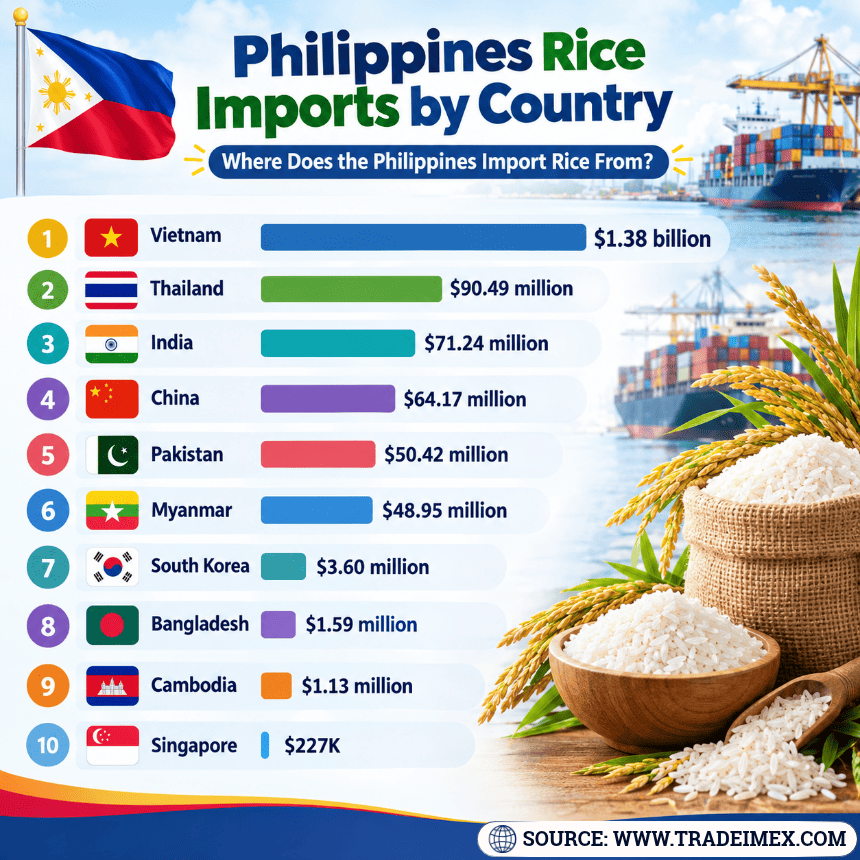
The Philippines imports rice from various countries to meet its domestic demand. Among the top countries that the Philippines imports rice from are Vietnam, Thailand, and India, with each country contributing significantly to the Philippines' rice supply. Vietnam is the largest exporter of rice to the Philippines, as per the customs data on the Philippines rice imports from Vietnam. These imports play a crucial role in supplementing the local rice production & ensuring a stable rice market in the Philippines. The top 10 destinations for Philippine rice exports, according to the Philippines shipment data for 2025, include:
1. Vietnam: $1.38 billion (80.6%)
2. Thailand: $90.49 million (5.3%)
3. India: $71.24 million (4.2%)
4. China: $64.17 million (3.7%)
5. Pakistan: $50.42 million (2.9%)
6. Myanmar: $48.95 million (2.9%)
7. South Korea: $3.60 million (0.4%)
8. Bangladesh: $1.59 million (0.2%)
9. Cambodia: $1.13 million (0.2%)
10. Singapore: $227K (0.1%)
Philippines Rice Import Data: Last 10 Years Trade Performance
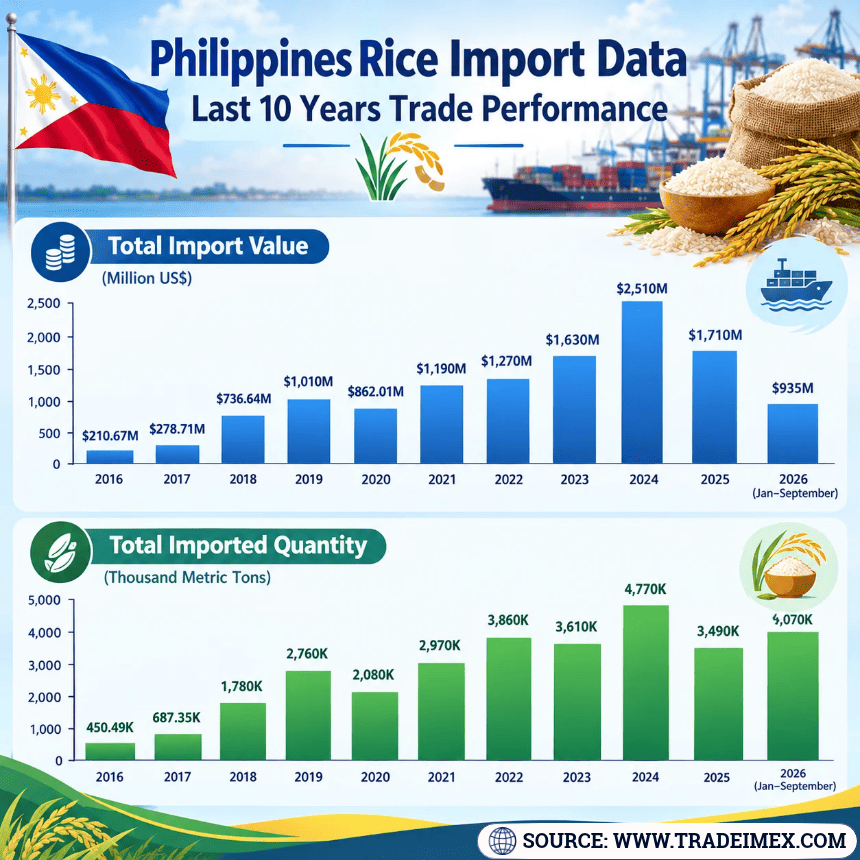
Year of Imports | Total Import Value ($) | Total Imported Quantity (Tons) |
2016 | $210.67 million | 450.49 thousand metric tons |
2017 | $278.71 million | 687.35 thousand metric tons |
2018 | $736.64 million | 1.78 million metric tons |
2019 | $1.01 billion | 2.76 million metric tons |
2020 | $862.01 million | 2.08 million metric tons |
2021 | $1.19 billion | 2.97 million metric tons |
2022 | $1.27 billion | 3.86 million metric tons |
2023 | $1.63 billion | 3.61 million metric tons |
2024 | $2.51 billion | 4.77 million metric tons |
2025 | $1.71 billion | 3.49 million metric tons |
2026 (Jan-September) | $935 million | 4.07 million metric tons |
How Much Rice Does the Philippines Import?
The answer depends on the period, rice category, and source of the statistics being examined. For 2025, rice under HS Code 100630 recorded Philippine imports of around 3.399 million metric tons, worth around US$1.573 billion. Broader national reports may show different totals because they use different reporting dates, customs classifications, or rice categories. For January through May 2026, Bureau of Customs figures summarized by CPBRD showed around 2.38 million metric tons of rice imports. This was 16.49% above the same period in 2025.
These figures suggest that rice import demand remained substantial in 2026. However, the five-month total should not be multiplied mechanically to estimate a full-year figure. Import schedules are influenced by harvest periods, government policy, international prices, inventory levels, and the timing of commercial contracts. Companies conducting rice import data research should compare:
Annual import volume and value.
Monthly shipment arrivals.
Country-of-origin breakdowns.
Rice type and applicable HS code.
Customs declarations and shipment descriptions.
Importer activity and supplier relationships.
Policy announcements that may affect future purchases.
This approach provides a more complete picture of demand than looking at a single annual figure.
Philippines Rice Importers Database: Who Are the Top Rice Importers in the Philippines?
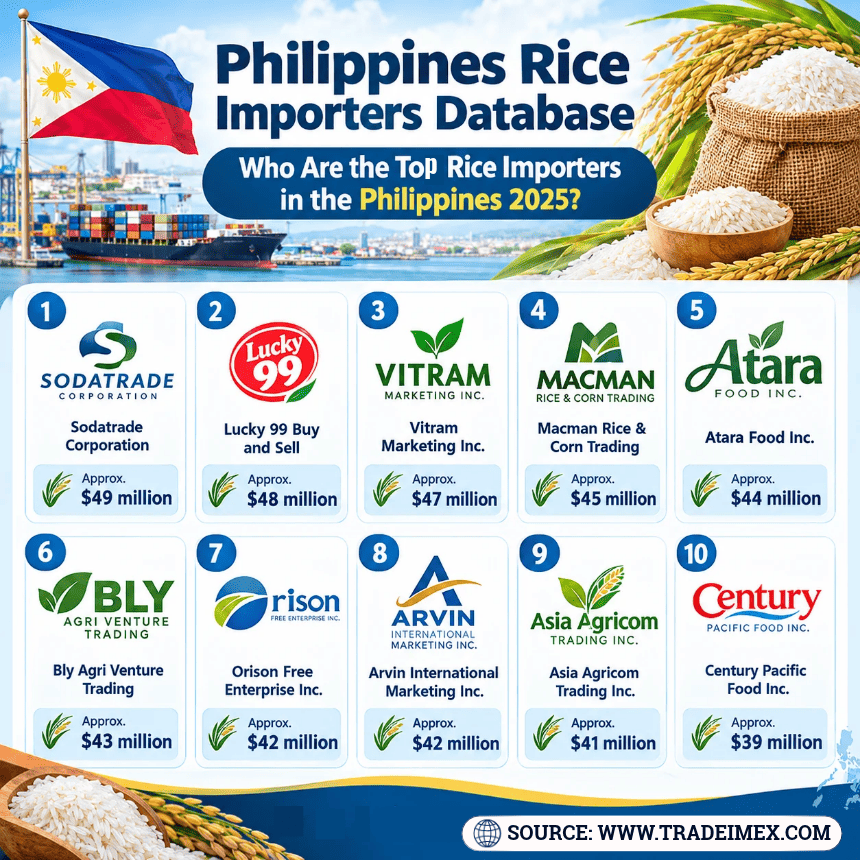
Identifying a rice importer in the Philippines requires more than knowing which country supplies the most rice. Company-level trade records can help reveal businesses that purchase rice, the suppliers they work with, the shipment descriptions they receive, & how frequently they appear in import transactions. Shipment-based trade directories identify several Philippine businesses associated with rice-import activity. The leading rice importers in the Philippines, as per the Philippines rice importers database for 2025, include:
1. Sodatrade Corporation — Approx. $49 million
2. Lucky 99 Buy and Sell — Approx. $48 million
3. Vitram Marketing Inc. — Approx. $47 million
4. Macman Rice & Corn Trading — Approx. $45 million
5. Atara Food Inc. — Approx. $44 million
6. Bly Agri Venture Trading — Approx. $43 million
7. Orison Free Enterprise Inc. — Approx. $42 million
8. Arvin International Marketing Inc. — Approx. $42 million
9. Asia Agricom Trading Inc. — Approx. $41 million
10. Century Pacific Food Inc. — Approx. $39 million
What Types of Rice Are Imported into the Philippines?
Rice imports can include different varieties, grades, and levels of processing. The product category matters because a buyer sourcing ordinary milled rice may have different requirements from a buyer purchasing fragrant, glutinous, or specialty rice. The main customs heading for rice is HS Code 1006, which is divided into more specific categories. These include:
HS 100610: Rice in the husk, or paddy rice.
HS 100620: Husked or brown rice.
HS 100630: Semi-milled or wholly milled rice, whether or not polished or glazed.
HS 100640: Broken rice.
For trade analysis, these classifications should be checked against the applicable national tariff schedule and declaration requirements. Product descriptions and the exact code used by customs may affect how a shipment appears in a dataset.
Exporters using Philippine rice import data should therefore search by both product description and HS code whenever possible. This can help distinguish relevant buyers from businesses importing other rice categories or agricultural products.
Philippine Rice Import Regulations & Market Changes in 2025-26
Government policy is an important factor in the Philippine rice market. Importers must consider licensing, sanitary & phytosanitary requirements, tariff arrangements, and the timing of permitted shipments. In December 2025, the Bureau of Plant Industry issued guidance concerning the resumption of milled rice importation from January 1, 2026, under the government's regulated import framework. The memorandum listed designated ports of entry and specified inspection requirements for certain arrivals.
These requirements illustrate why commercial planning must account for more than supplier prices. Importers need to confirm that the relevant licenses, sanitary and phytosanitary import clearances, documentation, and port arrangements are in place before shipping. The market also experienced significant changes in 2026. CPBRD's May update reported higher cumulative imports during January-May compared with the same period in 2025. This reinforces the importance of tracking monthly import data rather than assuming that the previous year's policy environment or volume trend will continue unchanged.
What Do Philippines Rice Import Statistics Mean for Exporters?
The Philippine market can offer opportunities for rice exporters, traders, and agricultural suppliers, but the best prospects depend on product fit, pricing, regulatory compliance, and buyer activity. Rice exporters have a strong established position & may focus on maintaining relationships, meeting specifications, and competing on reliable supply. Exporters from other origins may explore opportunities where buyers seek alternative varieties, different price points, or diversified sourcing. For companies evaluating the market, useful indicators include:
Import volume: Shows how much rice is entering the country and whether demand is rising or falling.
Import value: Helps assess the monetary scale of trade, while accounting for differences in grade and price.
Supplier-country shares: Reveals which origins dominate and where alternative sourcing may be possible.
Company-level shipment activity: Helps identify businesses that have imported relevant products.
Shipment frequency: Can distinguish occasional transactions from recurring purchasing activity.
Product specifications: Help match a supplier's rice varieties with buyer requirements.
Policy and port information: Helps assess compliance obligations and delivery feasibility.
Historical records are particularly valuable when used to compare multiple periods. A buyer that imported rice regularly in one period may not necessarily be active today, so recent transactions should be checked before treating a business as a qualified lead.
How TradeImeX Helps Businesses Research Philippine Rice Imports
TradeImeX is an AI-powered global trade data and trade-intelligence platform that helps businesses research import-export markets, examine shipment information, and identify potential buyers and suppliers. For companies interested in the Philippine rice trade, TradeImeX can support research workflows such as:
Import-export data research: Examine available trade records and market movements across countries and product categories.
HS-code intelligence: Narrow research by relevant rice classifications and product descriptions.
Buyer and supplier discovery: Investigate potential trading partners using available company and shipment information.
Historical trade analysis: Compare import activity across selected time periods and sourcing markets.
Customized reports: Organize relevant information for sales prospecting, market assessment, and sourcing decisions.
AI Search and Advanced Search: Explore trade questions and refine searches using available platform capabilities for AI-powered search on Philippines rice imports.
For example, a rice exporter could investigate Philippine buyers associated with HS Code 100630, compare recorded sourcing patterns, and assess which businesses warrant further qualification. The actual records and fields available will depend on the selected database, country coverage, and data product.
Rather than relying only on national import totals, businesses can combine country-level statistics with company-level trade research to develop a more targeted market-entry strategy. Explore TradeImeX to learn more about global import-export data and trade intelligence solutions.
Conclusion
The Philippines remains an important market for international rice suppliers, with imports playing a key role in meeting domestic demand and supporting food availability. The 2025 trade data highlights Vietnam's dominant position in supplying semi-milled and wholly milled rice, while Thailand, Myanmar, & India also contribute to the country's import market. Import activity during the first five months of 2026 further demonstrates the importance of monitoring changing demand, sourcing patterns, and government policies.
Note for our readers
For exporters and agricultural traders, understanding the Philippines rice import data by country & HS code is an important first step toward identifying potential buyers and evaluating market opportunities. Businesses should combine national import statistics with recent shipment records and company-level research to develop a more accurate picture of the market. Contact info@tradeimex.in to access the latest Philippines export-import data, AI search on Philippines rice imports, customized trade reports, & market insights for your business.
Frequently Asked Questions
1. Does the Philippines import rice?
Yes. The Philippines imports rice to supplement domestic supply and meet consumer demand. Import volumes change with harvest conditions, international prices, and government policy.
2. How much rice does the Philippines import?
For 2025, the Philippines recorded around 3.40 million metric tons of semi-milled or wholly milled rice imports, worth around US$1.71 billion. For January-May 2026, CPBRD reported around 2.38 million metric tons of rice imports based on Bureau of Customs data.
3. Which country supplies the most rice to the Philippines?
Vietnam was the leading supplier of semi-milled or wholly milled rice in the 2025 dataset, with around 2.94 million metric tons recorded.
4. Who are the rice importers in the Philippines?
Shipment-based trade directories identify businesses such as Lucky Buy and Sell, Atara Marketing Inc., Beatus Grain Emporium Corporation, Davao Solar Best Corp., and Nan Stu Agri Traders. Their current activity and import volumes should be verified through recent company-level trade records.
5. What HS code is used for rice import data?
Rice is generally classified under HS code 1006. Common subheadings include HS 100610 for paddy rice, HS 100620 for husked or brown rice, HS 100630 for semi-milled or wholly milled rice, and HS 100640 for broken rice.
6. Why is Philippines rice import data useful for exporters?
It helps exporters assess market demand, identify sourcing countries, understand product categories, and research potential buyers. Combining national statistics with recent shipment records can make buyer qualification & market research more effective.
Explore the latest global trade trends, market insights, import-export analysis, and industry updates with TradeImeX blogs.
Request a Data Sample →
Tradeimex
TradeImeX’s content team brings together expertise in global trade data, import-export trends, market intelligence, and international business. Our writers turn complex trade data into clear, actionable insights to help businesses understand markets, identify opportunities, and make informed decisions. From emerging trade trends to country and product-level analysis, we focus on delivering timely insights backed by reliable data.