
Asia continued to strengthen its position as the world's leading merchandise trading region in 2025, supported by strong manufacturing activity, expanding intra-regional commerce, rising demand for electronics, & growing global supply-chain integration. From China's dominance in global exports to India's expanding import-export market, Japan and South Korea's advanced manufacturing industries, and Southeast Asia's growing role in electronics, machinery, textiles, and agricultural commodities, Asian economies remained central to international trade. Asia's combined merchandise trade reached around $21.6 trillion in 2025, including exports and imports, according to Asia trade data.
According to the latest Asia import-export data, the total value of Asian imports reached $9.2 trillion, while Asian exports accounted for $10 trillion in 2025. Merchandise exports from Asia increased by 9% in 2025, making it one of the strongest-performing regions globally. Developing economies in Asia & Oceania also recorded export growth of 9% & import growth of 7.8%, highlighting the region's expanding participation in international commerce.
This performance reinforces Asia's importance as a manufacturing hub, consumer market, sourcing destination, & supplier of essential commodities & industrial products. This article explores Asia's 2025 trade data, including the largest trading nations, major import and export categories, regional trade patterns, and the economies shaping Asia's international trade landscape.
Key Highlights of Asia Trade Data 2025
Total Asian merchandise trade: $21.6 trillion in exports & imports.
Asia's export growth: 9% year-on-year in 2025.
China's total merchandise trade: around $6.36 trillion.
China's merchandise exports: around $3.77 trillion.
China's merchandise imports: around $2.58 trillion.
South Korea's exports: $709.7 billion, a record annual high.
Japan's total merchandise trade: around $1.49 trillion.
Major export categories: Electronics, machinery, semiconductors, automobiles, electrical equipment, textiles, and consumer goods.
Major import categories: Crude oil, natural gas, integrated circuits, machinery, iron ore, agricultural commodities, and industrial raw materials.
Major Trading Blocs: ASEAN, RCEP, APEC
Asia's Total Trade Value and Growth in 2025
Asia's merchandise trade performance in 2025 reflected the region's increasing importance in global manufacturing & international supply chains. The region benefited from rising demand for advanced technology products, industrial machinery, electronics, and manufactured consumer goods. According to the World Trade Organization (WTO) and UN Trade and Development (UNCTAD), Asia's merchandise exports increased by 9% in value during 2025. This growth was supported by higher exports of machinery, gold, animal and vegetable fats, and copper.
Developing Asia and Oceania also recorded a 7.8% increase in merchandise imports. This indicates that demand for industrial inputs, technology components, energy resources, and consumer products remained an important driver of regional trade. Another significant feature was the strength of intra-Asian commerce. According to trade statistics, around 59% of Asia's merchandise exports in 2025 were directed towards other Asian trading partners. This highlights the importance of regional supply chains connecting China, Japan, South Korea, India, Taiwan, Singapore, and Southeast Asian economies.
The expansion of regional trade also reflects the increasing interdependence of Asian manufacturing industries. For example, semiconductor components manufactured in South Korea and Taiwan are supplied to electronics manufacturers across China and Southeast Asia. Similarly, machinery, industrial chemicals, metals, and automotive components move between Asian economies before reaching international consumer markets.
Top 10 Asian Imports: What are the Major Imports of Asia?
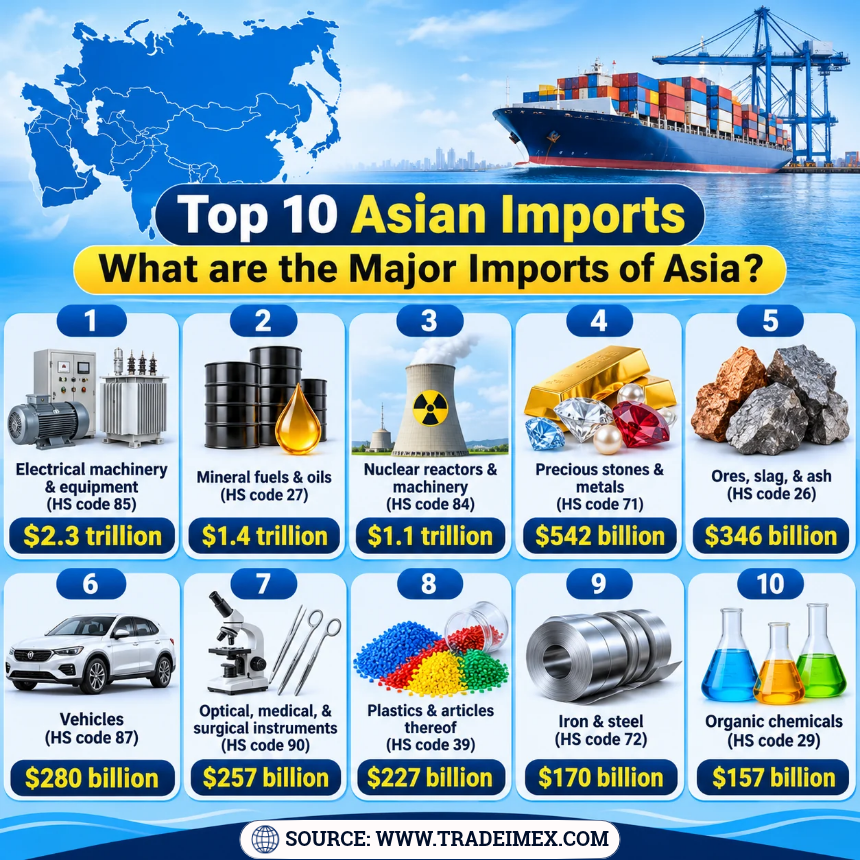
Asia’s major imports reflect the diverse needs of its fast-growing economies, with the top 10 Asian imports typically including crude oil and petroleum products, electronic components, machinery, vehicles, pharmaceuticals, chemicals, consumer electronics, industrial equipment, precious metals, & food products. These imports support manufacturing, energy demand, infrastructure, healthcare, & rising consumer markets across the Asian continent. The top 10 major imports of Asia, as per Asia import statistics for 2025, include:
1. Electrical machinery & equipment (HS code 85): $2.3 trillion
2. Mineral fuels & oils (HS code 27): $1.4 trillion
3. Nuclear reactors & machinery (HS code 84): $1.1 trillion
4. Precious stones & metals (HS code 71): $542 billion
5. Ores, slag, & ash (HS code 26): $346 billion
6. Vehicles (HS code 87): $280 billion
7. Optical, medical, & surgical instruments (HS code 90): $257 billion
8. Plastics & articles thereof (HS code 39): $227 billion
9. Iron & steel (HS code 72): $170 billion
10. Organic chemicals (HS code 29): $157 billion
Top 10 Asian Exports: What are the Major Exports of Asia?
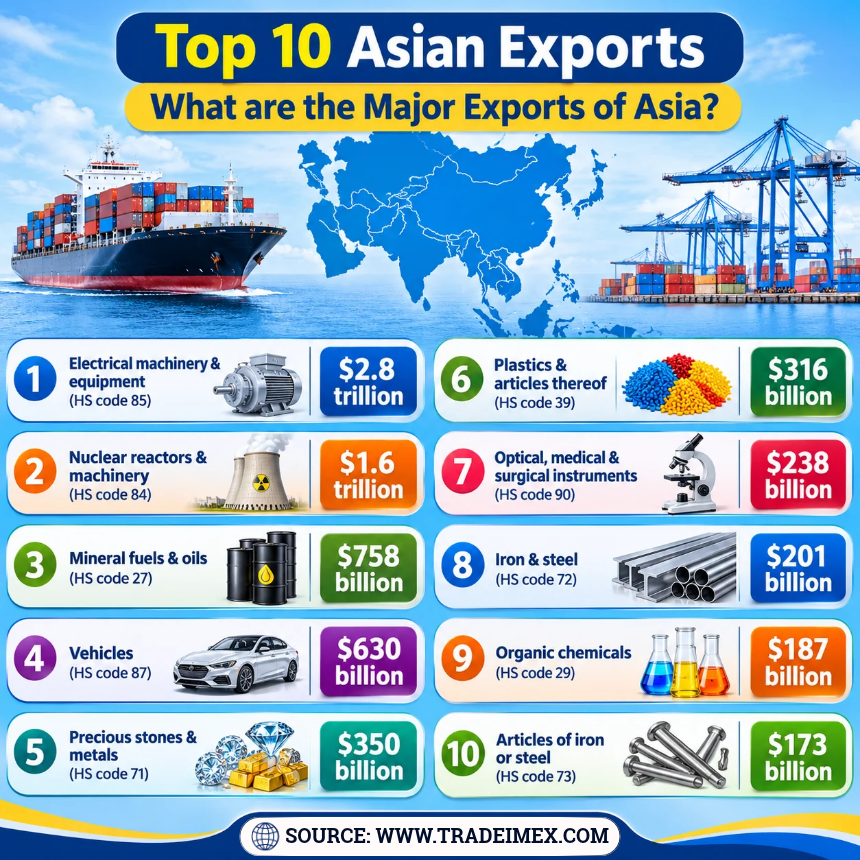
The main exports of Asia reflect its role as a global manufacturing & resource powerhouse, with the region supplying a diverse range of products to markets worldwide. Among the top 10 Asian exports are electronics, machinery, petroleum products, vehicles, textiles & apparel, chemicals, precious metals, iron and steel, agricultural goods, & computer and semiconductor components, which are significant export categories driven by advanced industrial capacity, strong supply chains, & growing technological innovation. The top 10 major exports of Asia, as per the Asia shipment data for 2025, include:
1. Electrical machinery & equipment (HS code 85): $2.8 trillion
2. Nuclear reactors & machinery (HS code 84): $1.6 trillion
3. Mineral fuels & oils (HS code 27): $758 billion
4. Vehicles (HS code 87): $630 billion
5. Precious stones & metals (HS code 71): $350 billion
6. Plastics & articles thereof (HS code 39): $316 billion
7. Optical, medical, & surgical instruments (HS code 90): $238 billion
8. Iron & steel (HS code 72): $201 billion
9. Organic chemicals (HS code 29): $187 billion
10. Articles of iron or steel (HS code 73): $173 billion
Top 10 Importers in Asia: Who Are the Largest Importing Countries in Asia?
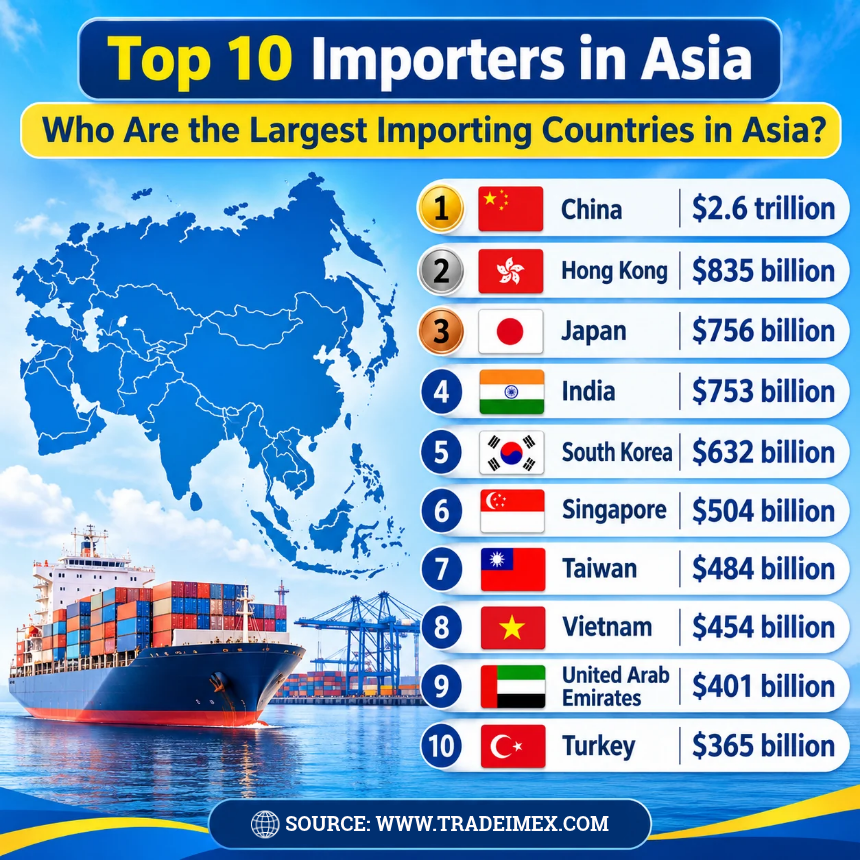
Asia is home to some of the world’s most influential importing nations, driving global trade through strong demand for energy, raw materials, machinery, consumer goods, and advanced technology. The top 10 importers in Asia typically include China, Japan, South Korea, India, Hong Kong, Singapore, Taiwan, Thailand, Malaysia, and Vietnam, each playing a major role in regional & global trade. Together, these countries reflect Asia’s growing economic power and its central position in global supply chains. The top 10 importing countries in Asia, as per the data on Asia imports by country for 2025-26, include:
1. China: $2.6 trillion (10%)
2. Hong Kong: $835 billion (3.2%)
3. Japan: $756 billion (2.9%)
4. India: $753 billion (2.9%)
5. South Korea: $632 billion (2.4%)
6. Singapore: $504 billion (2%)
7. Taiwan: $484 billion (1.9%)
8. Vietnam: $454 billion (1.8%)
9. United Arab Emirates: $401 billion (1.6%)
10. Turkey: $365 billion (1.4%)
Top 10 Exporters in Asia: Who are Asia's Largest Export Economies
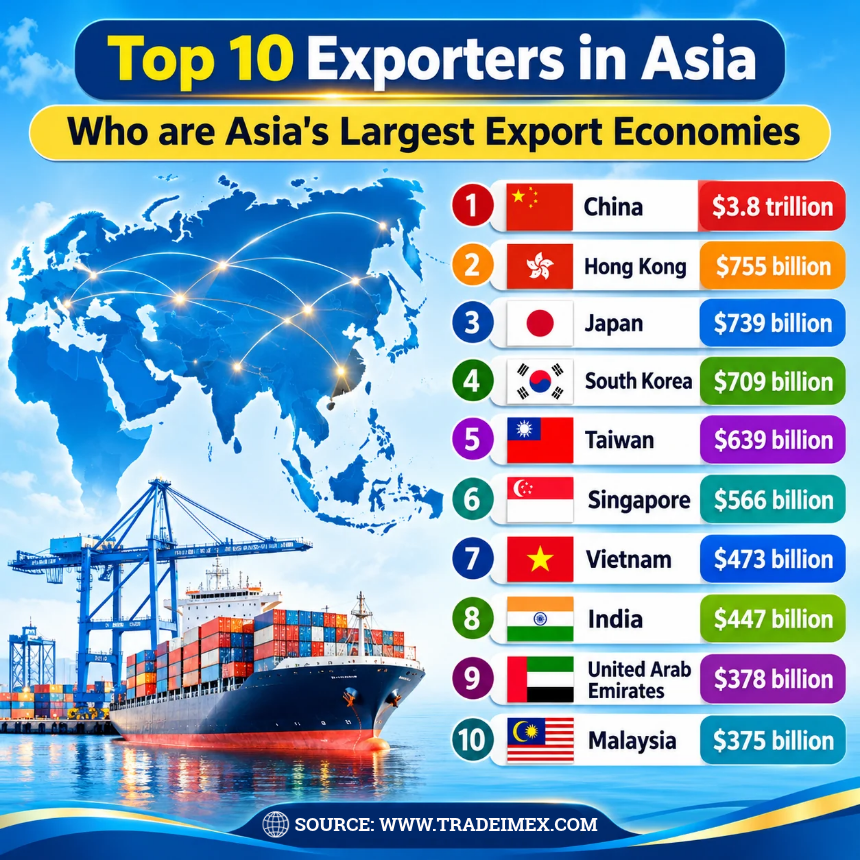
Asia has some of the the world’s most powerful export economies, with countries that play a major role in global trade through advanced manufacturing, technology, energy, and consumer goods. Among the top 10 exporters in Asia, China leads by a wide margin, followed by major export powerhouses such as Japan, South Korea, & India. Together, these economies drive a significant share of international commerce, benefiting from strategic locations, strong industrial bases, and well-developed trade networks. The top 10 exporting countries in Asia, according to the Asia export statistics for 2025-26, include:
1. China: $3.8 trillion (15%)
2. Hong Kong: $755 billion (3%)
3. Japan: $739 billion (2.9%)
4. South Korea: $709 billion (2.8%)
5. Taiwan: $639 billion (2.5%)
6. Singapore: $566 billion (2.2%)
7. Vietnam: $473 billion (1.9%)
8. India: $447 billion (1.8%)
9. United Arab Emirates: $378 billion (1.5%)
10. Malaysia: $375 billion (1.5%)
Asia Trade Data: Trade Performance in the Last 10 Years
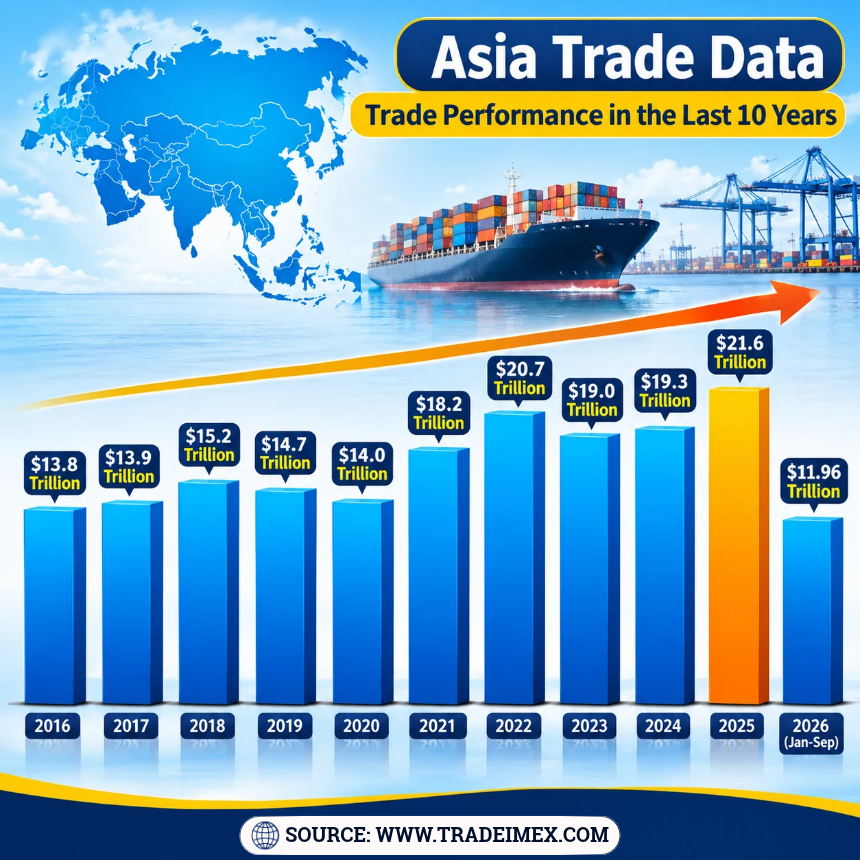
Year of Trade | Total Asian Trade Turnover ($) |
2016 | $13.8 trillion |
2017 | $13.9 trillion |
2018 | $15.2 trillion |
2019 | $14.7 trillion |
2020 | $14 trillion |
2021 | $18.2 trillion |
2022 | $20.7 trillion |
2023 | $19 trillion |
2024 | $19.3 trillion |
2025 | $21.6 trillion |
2026 (January-September) | $11.96 trillion |
Top Asian Trading Nations by Total Trade Value in 2025
Asia's largest trading economies include China, Hong Kong, Japan, South Korea, India, Taiwan, Singapore, and the United Arab Emirates. These markets have different trade structures, ranging from manufacturing-led exports to energy trading, electronics distribution, & large-scale consumer imports. According to the latest Asia import-export data, the following Asian economies recorded substantial merchandise trade values in 2025.
Asian trading economy | Total trade value in 2025 ($) |
China | $6.36 trillion |
Hong Kong | $1.59 trillion |
Japan | $1.49 trillion |
South Korea | $1.34 trillion |
UAE | $1.33 trillion |
India | $1.20 trillion |
Taiwan | $1.14 trillion |
Singapore | $1.07 trillion |
Total trade represents merchandise exports plus imports. Figures are rounded. UAE is included as a Western Asian economy. China remained Asia's largest trading economy by a considerable margin, while Hong Kong, Japan, South Korea, and the UAE also maintained important positions in international merchandise commerce.
China: Asia's Largest Exporter and Trading Economy
China continued to dominate Asian international trade in 2025, supported by its extensive manufacturing infrastructure, industrial production capacity, and global distribution networks, as per China export data.
According to China's National Bureau of Statistics, the country's total merchandise imports and exports reached RMB 45.47 trillion in 2025, increasing 3.8% year-on-year. Exports increased 6.1% to RMB 26.99 trillion, while imports reached RMB 18.48 trillion, up 0.5%. The merchandise trade surplus increased 20.4% to RMB 8.51 trillion. Major Chinese export products included:
Electrical machinery and electronic equipment.
Computers, laptops, and related components.
Smartphones and telecommunications equipment.
Industrial machinery and mechanical appliances.
Automobiles and automotive components.
Steel, plastics, furniture, and consumer products.
Major Chinese import products included:
Crude petroleum and natural gas.
Integrated circuits and semiconductor components.
Iron ore and other industrial minerals.
Soybeans and agricultural commodities.
Copper and unwrought metals.
Industrial machinery and specialized equipment.
Hong Kong: A Major Global Re-Export and Trading Hub
Hong Kong remained one of Asia's most important international trade and distribution centres in 2025. Its strategic location, financial infrastructure, and trade connectivity support extensive trade with mainland China & other Asian markets. Trade figures placed Hong Kong's total merchandise trade at around $1.585 trillion in 2025. Its merchandise exports reached $754 billion, while imports amounted to $832 billion. An important characteristic of Hong Kong's trade structure is re-export activity. Electronics, telecommunications equipment, machinery, precious metals, and consumer goods form important parts of its international merchandise flows. According to Hong Kong's Trade and Industry Department, mainland China accounted for 51.4% of Hong Kong's total trade in 2025. Taiwan, Vietnam, the United States, and Singapore were also among its major trading partners.
Japan: A Major Exporter of Automobiles and Advanced Machinery
Japan remained one of the largest Asian trading economies in 2025, with total merchandise trade of around $1.49 trillion, as per Japan import-export data. The country is internationally recognized for its automotive, semiconductor equipment, electronics, industrial machinery, precision instruments, and chemical industries. Major Japanese exports included:
Motor vehicles and automotive components.
Semiconductor manufacturing equipment.
Industrial machinery.
Electrical equipment and electronic components.
Chemicals and pharmaceutical products.
Precision instruments and optical equipment.
Major Japanese imports included:
Crude oil and petroleum products.
Liquefied natural gas.
Coal and other energy resources.
Electronic components and integrated circuits.
Food products and agricultural commodities.
Industrial raw materials.
Japan's dependence on imported energy resources makes international commodity markets particularly important to its import-export performance. At the same time, its advanced manufacturing industries continue to generate substantial export opportunities.
South Korea: Semiconductor and Automobile Exports Drive Trade
South Korea recorded its strongest-ever annual export performance in 2025. According to the country's Ministry of Trade, Industry & Resources, exports reached $709.7 billion, increasing 3.8% year-on-year and surpassing the $700 billion milestone for the first time. Imports totalled $631.7 billion, resulting in a merchandise trade surplus of $78 billion. Semiconductors, automobiles, ships, electrical equipment, & industrial products remained important export categories.
The country's semiconductor industry played a particularly important role in its international trade performance. South Korea is a major global supplier of memory chips, integrated circuits, & electronic components used in smartphones, computers, servers, & data centres. Other growing export segments included agricultural & fishery products and cosmetics, which achieved record export values in 2025.
Taiwan: A Global Semiconductor and Electronics Trade Centre
Taiwan remained an important participant in Asia's international trade network in 2025, with total merchandise trade of around $1.14 trillion. Its export industry is strongly connected to semiconductors, integrated circuits, computers, electronic components, and information technology hardware.
Major Taiwan export products:
Semiconductor chips and integrated circuits.
Computers and computer components.
Electronic machinery and equipment.
Telecommunications equipment.
Precision instruments.
Plastics and chemical products.
Major imports:
Semiconductor manufacturing equipment.
Crude petroleum and energy products.
Chemicals and industrial materials.
Machinery and electronic components.
Metals and mineral resources.
The growing international demand for AI infrastructure, high-performance computing, data centres, and advanced semiconductor chips has strengthened Taiwan's importance in global technology supply chains.
Singapore: A Strategic Asian Trade and Distribution Hub
Singapore recorded around $1.07 trillion in total merchandise trade in 2025. Its international trade activities are supported by its strategic maritime location, advanced port infrastructure, financial services, & strong connectivity with major Asian & Western markets. Major Singaporean exports include refined petroleum products, integrated circuits, electronic components, pharmaceuticals, chemicals, and machinery.
Its imports include crude oil, electronic components, industrial machinery, chemicals, and precious metals. Singapore also plays an important role in regional re-export activities, connecting manufacturers and suppliers across Southeast Asia with international buyers.
UAE: A Major Western Asian Trading Economy
The United Arab Emirates remained one of Western Asia's largest international trading economies, with total merchandise trade of around $1.33 trillion in 2025. Its trade structure is influenced by petroleum, refined fuels, gold, precious metals, machinery, electronics, and re-export activities. The UAE's position as a major trade & distribution centre connects Asian exporters with markets in Africa, Europe, and the Middle East.
Key Factors Driving Asia's Trade Growth in 2025
Several economic and industrial developments contributed to Asia's strong international trade performance in 2025.
Growing AI and Semiconductor Demand: The expansion of artificial intelligence infrastructure increased demand for processors, memory chips, semiconductor equipment, & advanced electronic components. AI-related investment was an important contributor to global merchandise trade growth in 2025, as per the electronics & semiconductor industry data.
Manufacturing and Industrial Expansion: China, India, Vietnam, Thailand, Malaysia, and Indonesia continued to strengthen their manufacturing ecosystems, supporting exports of machinery, electronics, textiles, automotive products, and industrial components.
Regional Supply Chain Integration: Asian economies increasingly depend on one another for intermediate goods, raw materials, and manufacturing components. This has strengthened cross-border trade and regional sourcing networks.
Growing Energy Requirements: Industrialization and urbanization have sustained demand for crude oil, LNG, coal, and other energy resources across major Asian importing economies.
Expanding Consumer Markets: Rising consumption and infrastructure investment have increased demand for imported food products, electronics, vehicles, machinery, chemicals, and industrial materials.
Asia Trade Outlook: Opportunities for Global Importers and Exporters
Asia's 2025 trade performance highlights several opportunities for international businesses, manufacturers, suppliers, and sourcing companies. Electronics and semiconductor supply chains remain attractive markets because of the region's manufacturing concentration and growing technology requirements. Automotive exports, particularly electric vehicles & components, also offer significant opportunities.
Similarly, agricultural exporters can explore demand for soybeans, edible oils, seafood, fruits, grains, and processed food products across major Asian importing economies. Industrial suppliers can benefit from demand for machinery, chemicals, metals, plastics, and manufacturing equipment in developing Asian markets.
However, businesses must also consider trade regulations, customs procedures, tariffs, geopolitical developments, currency movements, & changing sourcing requirements when entering these markets. Access to reliable Asia trade data, import-export statistics, shipment records, HS code information, and international buyer-supplier details can help businesses evaluate market demand, identify potential trading partners, and understand competition across different Asian economies.
Conclusion
Asia maintained its position as the world's largest merchandise trading region in 2025, with around $21.6 trillion in combined exports and imports. China's manufacturing dominance, Hong Kong's re-export activities, Japan and South Korea's advanced industrial exports, India's expanding consumer and manufacturing markets, & Southeast Asia's growing supply-chain importance collectively supported the region's international trade performance. With merchandise exports growing around 9% during the year, Asia continued to strengthen its role in global electronics, machinery, automotive, textile, agricultural, and energy markets.
Note For Our Readers
For international businesses, understanding Asia trade data for 2025 with TradeImeX provides valuable insights into the region's leading exporters, top import markets, high-demand products, & evolving global trade relations. For more insights into the latest global trade data, AI-powered trade search, import-export records by country or HS code, or customized trade records, contact info@tradeimex.in.
Frequently Asked Questions
What was the total trade value of Asia in 2025?
Asia's total merchandise trade reached around $21.6 trillion in 2025, comprising exports and imports, according to the referenced Asia trade statistics.
Which country was the largest exporter in Asia in 2025?
China was Asia's largest exporter in 2025, recording around $3.8 trillion in merchandise exports, driven by electronics, machinery, automobiles, electrical equipment, and consumer goods.
What were the top imports of Asia in 2025?
Asia's leading import categories included electrical machinery, mineral fuels and oils, industrial machinery, precious stones and metals, ores, vehicles, optical instruments, plastics, iron and steel, and organic chemicals.
Which were the largest trading economies in Asia in 2025?
China, Hong Kong, Japan, South Korea, the UAE, India, Taiwan, and Singapore were among Asia's largest trading economies by combined merchandise import and export value.
What factors drove Asia's trade growth in 2025?
Growing semiconductor and AI demand, manufacturing expansion, regional supply-chain integration, rising energy requirements, and expanding consumer markets were the major factors supporting Asia's trade growth in 2025.
Explore the latest global trade trends, market insights, import-export analysis, and industry updates with TradeImeX blogs.
Request a Data Sample →
Tradeimex
TradeImeX’s content team brings together expertise in global trade data, import-export trends, market intelligence, and international business. Our writers turn complex trade data into clear, actionable insights to help businesses understand markets, identify opportunities, and make informed decisions. From emerging trade trends to country and product-level analysis, we focus on delivering timely insights backed by reliable data.