

The United States is one of the world's leading automotive manufacturing and exporting economies, supplying passenger vehicles, SUVs, luxury cars, electric vehicles, pickup trucks, and other automobiles to international markets. With major automotive manufacturing facilities operated by domestic and international brands, the country maintains an extensive global vehicle export network connecting North America, Europe, Asia, the Middle East, and other regions. According to US export data and car export data for the USA, the total value of US car exports reached $53.49 billion in 2025, a 9.6% decline from the previous year. The US exported 1.75 million cars valued at $36 billion in the first three quarters of 2026 (January-September), as per the US car export data under HS code 8703.
The USA is the 6th largest exporter of cars worldwide, according to global trade data. Despite the reduction in US car exports, the US remained among the world's six largest passenger car-exporting countries in 2025. US car export data provides valuable insights into the country's automotive trade performance, leading overseas markets, export destinations, shipment volumes, and major vehicle manufacturers. In this article, we explore US car export data for 2025-26, the leading countries importing American cars, major automotive export trends, the US car exporters database, and the factors influencing the country's international automobile trade.
US Car Export Data 2025: Key Statistics and Market Performance
The US automotive export industry experienced a challenging year in 2025, with passenger car export values declining compared with 2024. However, the country continued to maintain a significant position in the global automobile export market. According to 2025 international trade statistics, US passenger car exports were valued at around $53.49 billion. The decline reflected changes in overseas vehicle demand, international competition, production strategies, and evolving automotive trade conditions. US car export statistics indicate:
$53.49B: Passenger car exports in 2025
$59.20B: Passenger car exports in 2024
-9.6%: Annual export value change
6th: Global passenger car exporter ranking
Another important indicator is the wider US automotive export industry. According to the latest trade data, total US exports of motor vehicles and parts reached around $165.74 billion in 2025. This included:
Passenger cars worth $53.63 billion.
Trucks, buses, and special-purpose vehicles worth $27.16 billion.
Automotive parts worth $84.96 billion.
These figures demonstrate that automotive components and parts represented a substantial share of the country's overall automotive export business.
US automotive exports: 2024 vs. 2025
Automotive category | 2024 | 2025 |
Passenger cars | $59.66B | $53.63B |
Trucks, buses & special-purpose vehicles | $30.69B | $27.16B |
Automotive parts | $87.43B | $84.96B |
Total automotive exports | $177.78B | $165.74B |
The figures indicate that the US automotive export industry faced a broad slowdown in 2025. Passenger cars experienced the largest absolute decline among the three categories, while automotive parts remained the largest export segment.
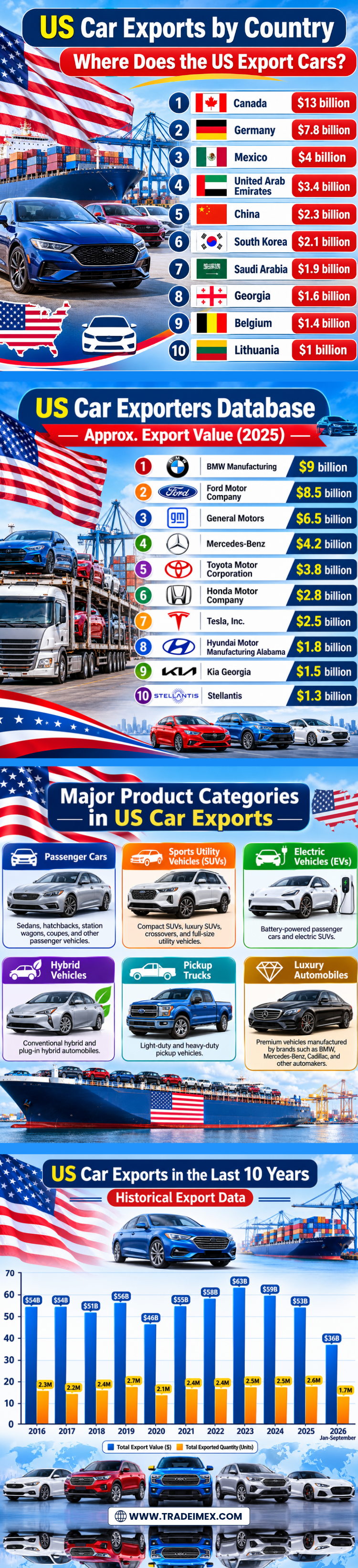
US Car Exports by Country: Where Does the US Export Cars?
The United States exports cars to many countries around the world. The largest markets for these exports include Canada and Mexico, as they are close neighbors & have strong trade connections. Other important countries include China, Germany, and Japan. US-made cars are popular in these places because of their quality and technology. The US car industry is very important for the economy, and these exports help create jobs and support local businesses by reaching customers in different countries. The top 10 export destinations for American cars, as per the US car shipment data for 2025-26, include:
1. Canada: $13 billion (24%)
2. Germany: $7.8 billion (15%)
3. Mexico: $4 billion (7.4%)
4. United Arab Emirates: $3.4 billion (6.4%)
5. China: $2.3 billion (4.2%)
6. South Korea: $2.1 billion (3.9%)
7. Saudi Arabia: $1.9 billion (3.5%)
8. Georgia: $1.6 billion (2.9%)
9. Belgium: $1.4 billion (2.7%)
10. Lithuania: $1 billion (1.9%)
Major insights from US car exports by country
1. Canada remains the largest destination
Canada was the leading destination for US passenger cars in 2025, receiving around $13.34 billion worth of vehicles, as per the data on US exports to Canada under HS code 8703. Its geographical proximity, integrated automotive manufacturing supply chains, and established cross-border trade arrangements make it a critical market for American automobile manufacturers.
2. Germany represents a significant European market
Germany imported around $7.8 billion worth of US passenger cars in 2025. As one of Europe's largest automotive markets, Germany offers opportunities for American manufacturers, particularly in premium vehicles, SUVs, and selected electric vehicle categories.
3. Mexico maintains strong automotive trade connections
US passenger car exports to Mexico reached around $4 billion in 2025, as per data on US car exports to Mexico. The two countries have closely connected automotive industries, supported by manufacturing facilities, vehicle assembly operations, and regional supply chains.
4. The UAE is an important Middle Eastern destination
The United Arab Emirates imported around $3.43 billion worth of US passenger cars in 2025. Demand for premium automobiles, luxury SUVs, and high-performance vehicles contributes to the country's importance as an automotive trading and distribution hub.
5. China and South Korea remain relevant Asian markets
China received around $2.3 billion in US passenger car exports, while South Korea imported around $2.1 billion. These markets demonstrate the continued presence of American automobile brands in Asia despite strong competition from regional manufacturers.
US Car Export Data 2026: Latest Export Trends
The US automobile export industry continued to generate substantial international trade activity during 2026. According to the latest available US car trade statistics, passenger car exports reached around $36 billion between January and September 2026. During the same nine-month period, total automotive exports, including trucks, buses, special-purpose vehicles, and automotive parts, amounted to around $120.79 billion.
Passenger car export value, January–September 2026
Category | Export value |
Passenger cars | $36B |
Trucks, buses & special-purpose vehicles | $20.90B |
Automotive parts | $65.30B |
Total automotive exports | $120.79B |
Leading destinations for US passenger cars in 2026
The January–September 2026 export figures highlight the continued importance of Canada, Germany, Mexico, the UAE, and other established automotive markets.
Rank | Destination | Passenger car exports |
1 | Canada | $8.22 billion |
2 | Germany | $4.99 billion |
3 | Mexico | $3.01 billion |
4 | United Arab Emirates | $1.12 billion |
5 | China | $1.05 billion |
6 | Belgium | $962 million |
7 | Nigeria | $826 million |
8 | Saudi Arabia | $668 million |
9 | United Kingdom | $600 million |
10 | Australia | $484 million |
11 | Japan | $426 million |
Canada remained the largest destination, accounting for around $8.22 billion in passenger car exports. Germany followed with nearly $5 billion, while Mexico received around $3.01 billion. The data also highlights the importance of the Middle Eastern and Asian markets. The UAE recorded $1.12 billion, China received around $1.05 billion, and Saudi Arabia accounted for $668 million in US passenger car exports.
These figures represent year-to-date trade rather than full-year 2026 results. They provide an indication of how the American automotive export market was performing during the first nine months of the year.
US Car Exporters Database: Leading Automobile Manufacturers in USA
The United States has a diversified automotive manufacturing ecosystem consisting of domestic automobile companies and international manufacturers operating production facilities across different states. These manufacturers produce passenger vehicles, SUVs, pickup trucks, electric cars, and luxury automobiles for domestic consumption and international markets. The following are some of the prominent automobile manufacturers with significant US manufacturing operations, as per the US car exporters & suppliers database for 2025-26:
1. BMW Manufacturing
Approx. Export Value (2025): $9 billion
Top Exported Brands: BMW X3, X5, X6, X7, and XM.
Top Export Destinations: Germany, China, South Korea, and Canada.
BMW's Spartanburg, South Carolina, facility exported nearly 200,000 vehicles to approximately 120 countries in 2025, making it the largest US automotive exporter by export value.
2. Ford Motor Company
Approx. Export Value (2025): $8.5 billion
Top Exported Brands: Ford F-150, Mustang, Bronco, and selected SUVs.
Top Export Destinations: Canada, Mexico, China, Australia, and Europe.
Ford exported approximately 311,000 US-assembled vehicles to more than 60 international markets in 2025, leading American automakers by export volume.
3. General Motors
Approx. Export Value (2025): $6.5 billion
Top Exported Brands: Chevrolet, Cadillac, and GMC.
Top Export Destinations: Canada, Mexico, South Korea, and the Middle East.
4. Mercedes-Benz
Approx. Export Value (2025): $4.2 billion
Top Exported Brands: Mercedes-Benz GLE, GLS, and other luxury SUVs.
Top Export Destinations: Germany, China, Canada, South Korea, and Europe.
5. Toyota Motor Corporation
Approx. Export Value (2025): $3.8 billion
Top Exported Brands: Toyota Camry, Corolla, RAV4, & selected Lexus models.
Top Export Destinations: Canada, Mexico, Japan, and the Middle East.
6. Honda Motor Company
Approx. Export Value (2025): $2.8 billion
Top Exported Brands: Honda Accord, Civic, CR-V, and Acura models.
Top Export Destinations: Canada, Mexico, and the Middle East.
7. Tesla, Inc.
Approx. Export Value (2025): $2.5 billion
Top Exported Brands: Tesla Model 3, Model Y, Model S, and Model X.
Top Export Destinations: Canada, Europe, and South Korea.
8. Hyundai Motor Manufacturing Alabama
Approx. Export Value (2025): $1.8 billion
Top Exported Brands: Hyundai Santa Fe, Tucson, and Genesis models.
Top Export Destinations: Canada, Mexico, and South Korea.
9. Kia Georgia
Approx. Export Value (2025): $1.5 billion
Top Exported Brands: Kia Telluride, Sorento, and Sportage.
Top Export Destinations: Canada, Mexico, and the Middle East.
10. Stellantis
Approx. Export Value (2025): $1.3 billion
Top Exported Brands: Jeep, Ram, and Dodge.
Top Export Destinations: Canada, Mexico, and Europe.
These are examples of manufacturers with US production operations, not a verified ranking of the largest individual customs exporters. Manufacturing presence alone does not establish that a company directly appears as the exporter of record on a particular shipment.
International automakers and US vehicle exports
International automobile manufacturers also contribute significantly to American vehicle exports. According to the American International Automobile Dealers Association (AIADA), international automakers exported around 751,000 US-built vehicles worth $30 billion in 2025. These vehicles were shipped to more than 130 countries and territories. The association also reported that 66% of these exports went to US free trade agreement partners. This demonstrates the important role of international automobile manufacturers in US-based production, employment, and international trade.
US Car Exports in the Last 10 Years: Historical Export Data
Year of Exports | Total Export Value ($) | Total Exported Quantity (Units) |
2016 | $54 billion | 2.3 million units |
2017 | $54 billion | 2.2 million units |
2018 | $51 billion | 2.4 million units |
2019 | $56 billion | 2.7 million units |
2020 | $46 billion | 2.1 million units |
2021 | $55 billion | 2.4 million units |
2022 | $58 billion | 2.4 million units |
2023 | $63 billion | 2.5 million units |
2024 | $59 billion | 2.5 million units |
2025 | $53 billion | 2.6 million units |
2026 Jan-September | $36 billion | 1.7 million units |
Major Product Categories in US Car Exports
US car exports cover several vehicle categories, ranging from conventional petrol-powered automobiles to hybrid and fully electric vehicles. Understanding these categories is essential for analyzing automotive trade statistics and identifying the products generating the highest export demand. The major vehicle categories include:
Passenger cars: Sedans, hatchbacks, station wagons, coupes, and other passenger vehicles.
Sports utility vehicles (SUVs): Compact SUVs, luxury SUVs, crossovers, and full-size utility vehicles.
Electric vehicles (EVs): Battery-powered passenger cars and electric SUVs.
Hybrid vehicles: Conventional hybrid and plug-in hybrid automobiles.
Pickup trucks: Light-duty and heavy-duty pickup vehicles.
Luxury automobiles: Premium vehicles manufactured by brands such as BMW, Mercedes-Benz, Cadillac, and other automakers.
Important HS Codes for US Car Export Data
HS Code | Product description |
HS 8703 | Passenger cars principally designed for passenger transportation |
HS 870310 | Snowmobiles and specially designed vehicles |
HS 870321 | Small-engine spark-ignition passenger vehicles |
HS 870322 | Spark-ignition cars with engine capacity between 1,000 cc & 1,500 cc |
HS 870323 | Spark-ignition cars with engine capacity between 1,500 cc & 3,000 cc |
HS 870324 | Spark-ignition vehicles with engine capacity exceeding 3,000 cc |
HS 870340 | Certain hybrid passenger vehicles |
HS 870350 | Certain diesel-electric hybrid passenger vehicles |
HS 870360 | Certain plug-in hybrid passenger vehicles |
HS 870370 | Certain plug-in diesel-hybrid passenger vehicles |
HS 870380 | Electric passenger vehicles |
HS 8704 | Motor vehicles for transporting goods |
HS 8708 | Motor vehicle parts and accessories |
These HS classifications help importers, exporters, and researchers identify specific automotive products in international trade databases. The applicable detailed tariff classification can vary according to vehicle specifications & the national tariff schedule.
Major Factors Driving US Car Exports in 2025-26
Several economic, industrial, and international trade factors influence the performance of American automobile exports.
1. International demand for American automobiles
American vehicles, particularly large SUVs, pickup trucks, luxury vehicles, and selected electric cars, have established demand in overseas markets. Consumer preferences, vehicle performance, brand reputation, and purchasing power influence export opportunities.
2. Automotive manufacturing investments
International automobile companies have invested heavily in US manufacturing facilities. These investments support domestic vehicle production and create opportunities to export American-manufactured vehicles to overseas markets.
3. North American trade integration
The United States, Canada, and Mexico maintain closely connected automotive manufacturing and supply chains. Cross-border trade in vehicles and components plays an important role in the regional automotive industry.
4. Electric vehicle development
The transition towards electric mobility is changing international automotive trade. American EV manufacturers and international automakers with US production facilities contribute to the development of electric vehicle exports.
5. Tariffs and international trade policies
Import duties, trade agreements, customs regulations, and changing tariff policies can influence the competitiveness of US-manufactured automobiles in overseas markets. Exporters must monitor these developments when planning international shipments.
6. Global automotive competition
The US faces competition from established automotive exporters, including Germany, Japan, South Korea, China, and Mexico. Vehicle pricing, manufacturing costs, technological innovation, and product availability influence the country's international market position.
US Car Exporters Database: How to Find Exporters & Shipment Records
US car export data is useful not only for understanding national automotive trade performance but also for identifying individual companies participating in international vehicle shipments. A comprehensive US car exporters database can help businesses identify exporters, overseas buyers, product categories, shipment volumes, & destination markets. For automotive importers, distributors, dealers, and market researchers, shipment-level trade intelligence can provide a more detailed understanding of international business opportunities.
What information can you find in a US car exporters database?
US car exporter names: Identify companies involved in exporting automobiles from the United States.
International buyer details: Discover overseas importers and buyers receiving American vehicles.
Product descriptions: Identify the types of passenger cars, SUVs, EVs, and other automobiles being shipped.
HS codes: Track vehicle exports according to their Harmonized System classifications.
Shipment quantities: Examine the number of vehicles exported in recorded shipments.
Country-wise export details: Identify the overseas destinations receiving US automobiles.
Port-wise shipment information: Research export ports and international shipping routes.
Historical trade records: Analyze changes in vehicle exports across different months and years.
Conclusion: US Car Export Market Outlook 2026
The United States remains an important participant in the global automobile export industry. Despite a decline in passenger car export values during 2025, the country continued to rank among the world's leading car exporters, with around $53.49 billion in international passenger car shipments according to global HS 8703 trade rankings. Canada, Germany, Mexico, the UAE, China, and South Korea remained important destinations for American passenger vehicles.
Meanwhile, the latest January–September 2026 statistics recorded $36 billion in US passenger car exports, demonstrating continued global trade activity. The involvement of domestic and international automobile manufacturers, expanding electric vehicle production, integrated North American supply chains, and overseas demand for American vehicles will remain important factors shaping the industry's future.
Note For Our Readers
For importers, exporters, automotive dealers, and market researchers, US car export data by country or HS code offers valuable insights into destination markets, product demand, leading exporters, & international shipment trends. Access to a reliable US car exporters database can further help businesses identify potential buyers, analyze competitors, & develop data-driven international trade strategies. Contact TradeImeX at info@tradeimex.in and get the latest US import-export data, AI-powered search, customized trade reports, & market insights for your business.
Frequently Asked Questions
What was the total value of US car exports in 2025?
The United States exported around $53.63 billion worth of passenger cars in 2025, according to US car trade statistics.
Which country imports the most cars from the USA?
Canada was the largest destination for US passenger car exports in 2025, with imports valued at around $13.34 billion.
What were the US car exports during January–September 2026?
US passenger car exports reached around $36 billion during the first nine months of 2026.
Which are the major automobile exporters in the United States?
Major manufacturers with US production operations include Ford, General Motors, Tesla, BMW, Mercedes-Benz, Toyota, Honda, and Stellantis.
What is the HS code for US car exports?
HS Code 8703 covers passenger cars and other motor vehicles primarily designed for passenger transportation. HS 870380 specifically covers electric passenger vehicles.
Explore the latest global trade trends, market insights, import-export analysis, and industry updates with TradeImeX blogs.
Request a Data Sample →
Tradeimex
TradeImeX’s content team brings together expertise in global trade data, import-export trends, market intelligence, and international business. Our writers turn complex trade data into clear, actionable insights to help businesses understand markets, identify opportunities, and make informed decisions. From emerging trade trends to country and product-level analysis, we focus on delivering timely insights backed by reliable data.