

The global pork industry remains an important segment of international agricultural and meat trade, connecting major livestock-producing economies with consumer markets across Asia, Europe, North America, and Latin America. Pork is one of the most widely traded animal protein products, with international demand driven by population growth, changing dietary preferences, food processing industries, retail consumption, and expanding meat distribution networks. According to global trade data & pork export data, the total value of global pork exports under HS code 0203 reached $37 billion in 2025, a 1% increase from the previous year. Global pork exports reached $22.1 billion in the first three quarters of 2026 (January-September).
Spain, the United States, Germany, Brazil, and Canada emerged as some of the world's leading pork-exporting countries. Pork export data under HS Code 0203 provides detailed insights into the international trade of fresh, chilled, and frozen swine meat. It helps importers, exporters, meat processing companies, distributors, and agricultural businesses identify major suppliers, understand export market opportunities, & evaluate changes in global pork trade. This article explores the latest pork export data for 2025, including the top 10 pork-exporting countries, their export values, international trade trends, major growth markets, and the importance of HS Code 0203 in global meat commerce.
Understanding Pork Export Data Under HS Code 0203
Pork export data refers to international shipments and customs records associated with the export of pork meat from one country to another. These records provide information about export values, shipment quantities, product descriptions, destination countries, trading companies, and applicable HS codes.
Under the Harmonized System (HS), 0203 represents meat of swine, fresh, chilled, or frozen. It is an important customs classification used by international trade authorities to monitor cross-border pork shipments. The HS Code 0203 category is generally divided into the following product classifications:
HS Code 020311: Meat of swine, fresh or chilled, carcasses and half-carcasses.
HS Code 020312: Meat of swine, fresh or chilled, hams, & cuts thereof, bone-in.
HS Code 020319: Other fresh or chilled swine meat.
HS Code 020321: Meat of swine, frozen, carcasses and half-carcasses.
HS Code 020322: Meat of swine, frozen, hams, & cuts thereof, bone-in.
HS Code 020329: Other frozen swine meat.
These classifications help international buyers distinguish between different pork categories and identify the specific products traded across global markets, as per the International Meat Trade Association. It is important to understand that HS 0203 covers fresh, chilled, and frozen pork meat. Processed pork products, pork offal, and live pigs are classified under different HS headings. Therefore, businesses analyzing pork export data should distinguish between these product categories to ensure accurate market comparisons.
Pork Exports by Country: Top 10 Pork Exporting Countries
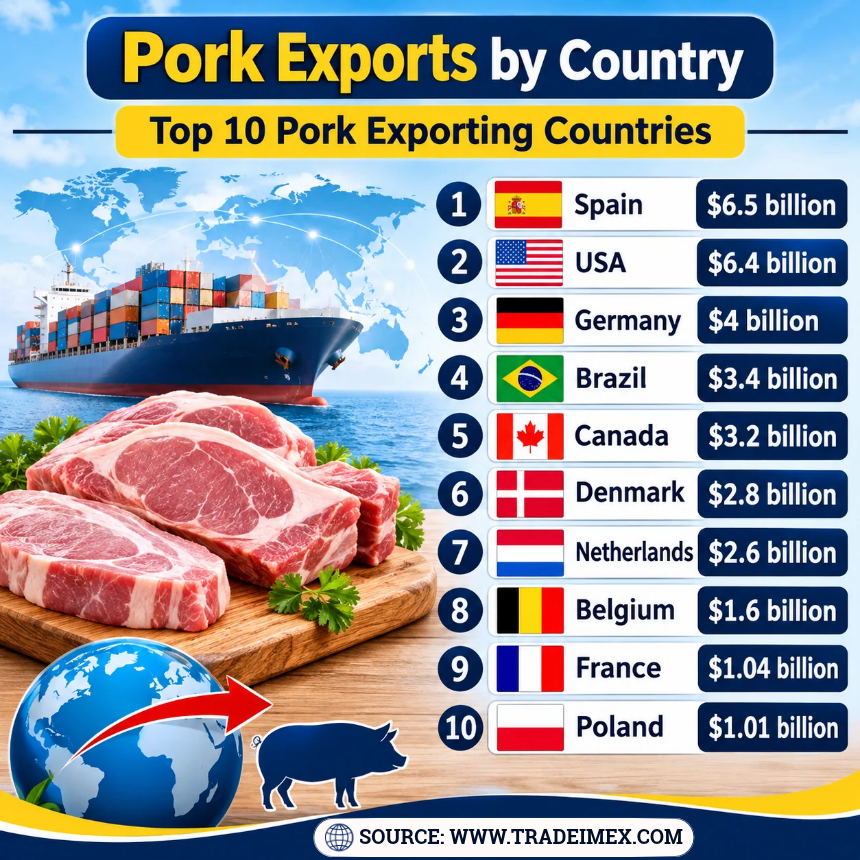
The top ten pork-exporting countries play a big role in the global meat market. The leaders in pork exports include the United States, Germany, Spain, and Canada. These countries have large pig farms and high production levels. Brazil, the Netherlands, Mexico, France, Poland, and Denmark also export a lot of pork. They sell this meat to many places around the world to meet the demand for pork. This helps their economies grow and provides jobs for many people. The top pork-exporting countries, as per the data on pork exports by country & global pork shipment data for 2025-26, include:
1. Spain: $6.5 billion (17%)
2. USA: $6.4 billion (17%)
3. Germany: $4 billion (11%)
4. Brazil: $3.4 billion (9.1%)
5. Canada: $3.2 billion (8.7%)
6. Denmark: $2.8 billion (7.7%)
7. Netherlands: $2.6 billion (7.1%)
8. Belgium: $1.6 billion (4.2%)
9. France: $1.04 billion (2.8%)
10. Poland: $1.01 billion (2.7%)
Country-Wise Analysis of the Leading Pork Exporters in 2025
1. Spain: $6.5 Billion
Spain is ranked as the largest exporter of pork worldwide in 2025, with export revenues reaching around $6.5 billion. Its share accounted for around 17.9% of global pork exports, according to Spain export data.
Spain's position reflects its well-developed pig farming industry, modern meat processing facilities, established cold-chain infrastructure, and strong international distribution networks.
The country supplies different pork cuts and frozen meat products to international buyers, particularly across European and Asian markets.
Spain also benefits from its membership in the European Union, which facilitates agricultural trade with other European economies.
Spanish pork export value increased by around 5.7% compared with 2024, demonstrating continued strength in international demand.
2. United States: $6.4 Billion
The United States ranked second in global pork exports in 2025, recording around $6.4 billion in export value and accounting for 17.1% of worldwide pork exports, according to the US pork export data.
The American pork industry benefits from large-scale commercial pig farming, advanced meat processing facilities, efficient transportation networks, & strong agricultural production capacity.
US pork exporters supply a wide range of products, including frozen pork cuts, hams, shoulders, and other meat products. Major overseas markets include Mexico, Japan, South Korea, China, and Canada.
Despite its strong international position, US pork export value declined by around 2.6% in 2025 compared with the previous year. Nevertheless, the country remained one of the two largest suppliers in the international pork trade.
3. Germany: $4 Billion
Germany occupied third position among the world's largest pork exporters in 2025, with around $4 billion in export revenues. Its global export share stood at around 11%.
Germany has traditionally been one of Europe's most important pork-producing and meat-processing economies.
Its well-established livestock industry, modern processing facilities, and access to European distribution networks support its international export activities.
German pork exporters serve several European markets, while international trade also connects the country with Asian destinations.
However, Germany's pork export value declined by around 5.5% in 2025 compared with 2024.
4. Brazil: $3.4 Billion
Brazil ranked fourth in global pork exports in 2025, with around $3.4 billion in export value and a global market share of 9.1%, according to Brazil export data.
The country has emerged as an increasingly important supplier of pork products because of its large agricultural production base, competitive livestock farming costs, and expanding international market access.
Brazilian pork exporters have strengthened their presence in Asian and Latin American markets.
The Philippines, Japan, China, Chile, and Hong Kong were among the important destinations for Brazilian pork shipments.
Brazil recorded around 19.1% year-over-year growth in pork export value in 2025, making it the fastest-growing exporter among the top 10 countries.
This performance highlights Brazil's increasing importance in global meat supply chains and its ability to expand exports to international markets.
5. Canada: $3.2 Billion
Canada secured fifth position among the world's largest pork exporters in 2025, generating around $3.24 billion in export revenues.
The Canadian pork industry is supported by commercial livestock production, advanced meat processing infrastructure, and established international trade relationships.
Canadian exporters supply pork products to the United States, Japan, China, Mexico, and other international markets.
The country's geographical proximity to the US market also provides important distribution advantages.
Canada recorded around 2.1% growth in pork export value in 2025 compared with 2024, indicating relatively stable international demand.
6. Denmark: $2.8 Billion
Denmark ranked sixth, with around $2.8 billion in pork export revenues during 2025. Its contribution represented around 7.7% of global pork exports.
Denmark has a well-developed pig farming and meat-processing industry.
The country is internationally recognized for its organized livestock production systems, meat quality standards, food safety practices, and export-oriented agricultural sector.
Danish pork exporters supply European and international markets, including the United Kingdom, Germany, Japan, and other Asian destinations.
Pork export value from Denmark increased by around 7.8% in 2025, reflecting improved export performance compared with the previous year.
7. Netherlands: $2.6 Billion
The Netherlands recorded around $2.66 billion in pork exports in 2025, securing seventh position globally with a market share of around 7.1%.
The country benefits from its strategic location in Europe, advanced agricultural infrastructure, and strong international trade networks.
Dutch pork exports are closely connected with the wider European meat distribution system.
The Netherlands serves as both a major agricultural trading economy and an important distribution center for international food products.
However, Dutch pork export value declined by around 1.7% in 2025 compared with 2024.
8. Belgium: $1.6 Billion
Belgium ranked eighth among the world's leading pork exporters, with export revenues of around $1.6 billion in 2025.
Its pork industry benefits from an established livestock production sector, modern food processing facilities, and convenient access to major European markets.
Belgian exporters supply pork products to neighboring European economies and other international destinations.
Belgium's pork export value decreased by around 2.3% in 2025 compared with the previous year.
9. France: $1.04 Billion
France occupied ninth position in the global pork export rankings in 2025, generating around $1.04 billion in export revenues.
The French pork industry is supported by domestic pig farming, meat processing, and a well-developed agricultural supply chain.
Pork remains an important component of the country's food and meat processing industries.
French exporters supply fresh, chilled, and frozen pork products to different European and international markets.
Nevertheless, France experienced an around 9% decline in pork export value in 2025 compared with 2024.
10. Poland: $1.01 Billion
Poland completed the top 10 list of global pork-exporting countries in 2025, with around $1.01 billion in export revenues.
Poland is an important agricultural and food-processing economy in Central Europe.
Its pork industry benefits from livestock production, meat processing facilities, and established trade relationships with European markets.
Polish exporters participate in regional and international pork supply chains, supplying different pork products to neighboring countries and overseas buyers.
Poland recorded around 7.7% growth in pork export value in 2025, reflecting improved performance in the global pork trade market.
Pork Export Data: Global Pork Exports in the Last 10 Years
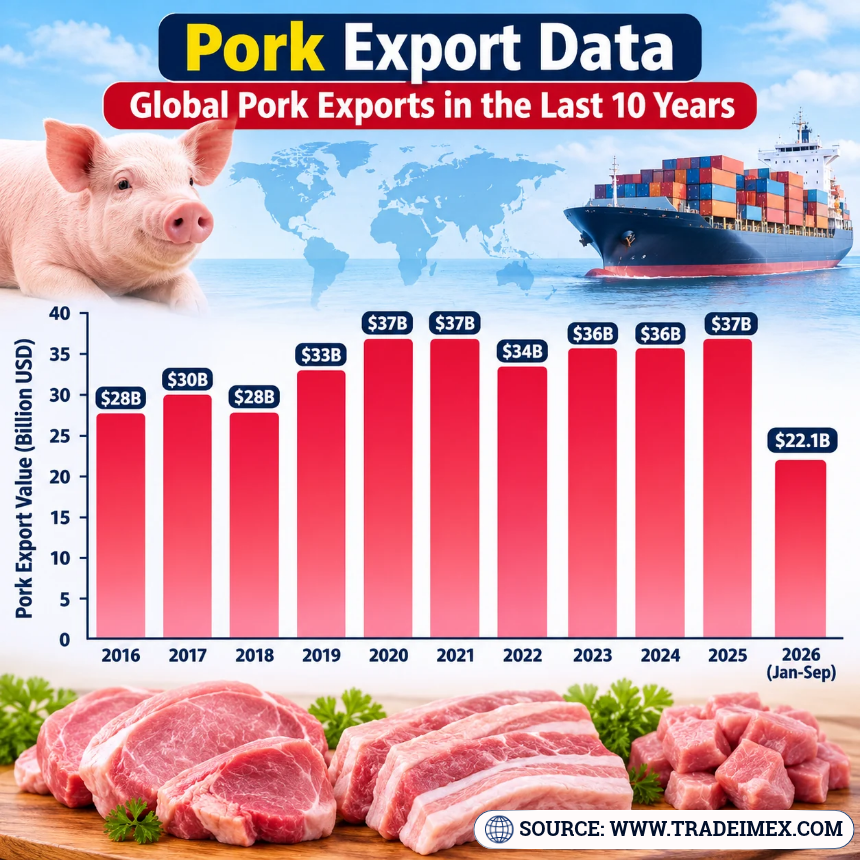
Year of Exports | Total Pork Export Value ($) |
2016 | $28 billion |
2017 | $30 billion |
2018 | $28 billion |
2019 | $33 billion |
2020 | $37 billion |
2021 | $37 billion |
2022 | $34 billion |
2023 | $36 billion |
2024 | $36 billion |
2025 | $37 billion |
2026 (January-September) | $22.1 billion |
Largest Pork Producers in the World: Pork Production by Country
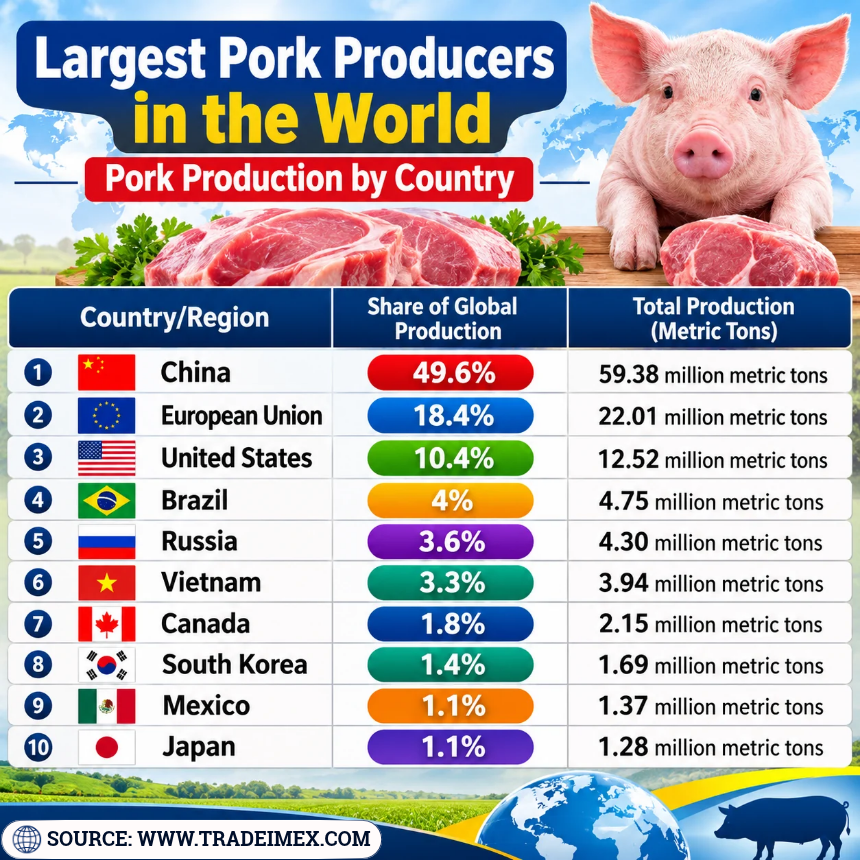
The largest pork producers in the world are countries like China, the United States, and Brazil. China is by far the biggest, making more than half of all pork sold globally. The U.S. follows as a strong second, with a focus on high-quality meat production. Brazil is also a major player, exporting a lot of pork. Other countries like Germany and Spain are important too, contributing to the global pork market. Together, these countries help meet the world's demand for pork. The top 10 pork-producing countries, as per the pork production data for 2025-26, include:
Country/Region | Share of Global Production | Total Production (Metric Tons) |
China | 49.6% | 59.38 million metric tons |
European Union | 18.4% | 22.01 million metric tons |
United States | 10.4% | 12.52 million metric tons |
Brazil | 4% | 4.75 million metric tons |
Russia | 3.6% | 4.30 million metric tons |
Vietnam | 3.3% | 3.94 million metric tons |
Canada | 1.8% | 2.15 million metric tons |
South Korea | 1.4% | 1.69 million metric tons |
Mexico | 1.1% | 1.37 million metric tons |
Japan | 1.1% | 1.28 million metric tons |
Global Pork Export Trends and Market Developments in 2025
Global pork export data for 2025 highlights several important developments in the international meat trade industry.
1. Spain and the United States dominated international pork exports
Spain and the United States remained the two largest pork-exporting economies in 2025. Their combined export value exceeded $13 billion, representing around 35% of global pork exports. The leadership of US pork exporters & Spanish pork exporters reflects established livestock industries, large-scale processing capabilities, and strong access to international buyers.
2. Brazil recorded the strongest growth among leading exporters
Brazil's pork export value increased by around 19.1% in 2025. This growth highlights the country's expanding role in international meat trade and its increasing presence in Asian markets.
3. European countries maintained a strong export presence
Germany, Spain, Denmark, the Netherlands, Belgium, France, and Poland remained among the world's major pork suppliers, according to the Europe trade data. The European pork industry benefits from integrated agricultural markets, modern processing infrastructure, established food safety systems, and extensive cross-border trade relationships.
4. Export performance differed across major suppliers
While Spain, Brazil, Denmark, and Poland recorded positive growth, Germany, France, Belgium, and the Netherlands experienced declines in export value. These differences reflect changes in international demand, production costs, market competition, trade restrictions, and destination-country purchasing requirements.
5. Asian markets remained important destinations
Asian economies continued to play an important role in international pork trade. Japan, China, South Korea, the Philippines, & Hong Kong are significant markets for global pork suppliers. Demand across these markets creates export opportunities for major producing countries, although import requirements, food safety regulations, tariffs, and animal disease restrictions can influence trade flows.
Major Factors Influencing International Pork Exports
Several economic, agricultural, and trade-related factors influence pork exports across international markets.
Livestock production capacity: Countries with large pig farming industries and consistent meat production can support higher export volumes.
International demand: Population growth, urbanization, changing dietary preferences, and food consumption patterns influence pork import requirements.
Production costs: Feed prices, animal healthcare expenses, labor costs, and energy prices directly affect pork production and export competitiveness.
Animal health regulations: Disease outbreaks and sanitary restrictions can affect export approvals and international market access.
Cold-chain infrastructure: Refrigerated transportation, storage facilities, and efficient port operations are essential for exporting fresh, chilled, and frozen pork.
Trade agreements: Bilateral and regional trade agreements can influence tariffs, market access, and international pork shipment volumes.
Currency fluctuations: Changes in exchange rates affect export pricing and the competitiveness of pork suppliers in international markets.
Understanding these factors is important for exporters, importers, and meat industry businesses looking to evaluate international pork trade opportunities.
Why Is Pork Export Data Important for International Businesses?
Pork export data offers valuable market intelligence for businesses operating in the global meat industry. By analyzing export values, shipment volumes, destination countries, and product classifications, companies can better understand international supply patterns. Some major business applications include:
Identifying leading pork suppliers: Importers can use country-wise export statistics to identify major pork-producing and exporting economies such as Spain, the United States, Brazil, Canada, and Germany.
Discovering international buyers: Exporters can study shipment records and trade databases to identify potential importers, distributors, and meat processing companies in overseas markets.
Analyzing product demand: HS Code 0203 helps businesses distinguish between fresh, chilled, and frozen pork products and understand which categories are traded internationally.
Evaluating market competition: Comparing country-wise export values and historical trade performance helps companies understand supplier competition and changing market positions.
Exploring new export destinations: Trade statistics can help businesses identify countries with growing import demand and evaluate opportunities for international market expansion.
Monitoring trade performance: Historical pork export data enables companies to track annual growth, changing shipment patterns, and emerging international trade opportunities.
Conclusion
The global pork export industry maintained a strong international trade presence in 2025, with Spain, the United States, Germany, Brazil, and Canada emerging as the leading exporting economies. Spain secured the first position with around $6.71 billion in export revenues, while the United States followed with $6.38 billion. Brazil also recorded impressive growth, highlighting its expanding role in international meat supply chains.
The growing importance of international pork trade creates opportunities for meat producers, exporters, importers, distributors, and food processing companies. Understanding HS Code 0203, country-wise export values, product classifications, and international shipment trends is essential for businesses seeking to identify reliable suppliers and explore new markets.
Note For Our Readers
Access to accurate pork export data by country or HS code and global trade intelligence can help businesses evaluate market competition, identify potential buyers, monitor international demand, & develop export strategies. Contact TradeImeX at info@tradeimex.in for customized trade reports, AI-driven search on pork exports, & market insights for your business.
Frequently Asked Questions
Which country is the largest pork exporter in the world in 2025?
Spain was the world's largest pork exporter in 2025, recording around $6.5 billion in export value and accounting for around 17.9% of global pork exports.
What is HS Code 0203 for pork exports?
HS Code 0203 represents fresh, chilled, or frozen meat of swine (pork). It includes carcasses, half-carcasses, hams, shoulders, and other pork cuts.
What was the total value of global pork exports in 2025?
Global pork exports under HS Code 0203 reached around $37 billion in 2025, representing a 1% increase compared with 2024.
Which countries are the top 5 pork exporters in 2025?
The top five pork-exporting countries in 2025 were Spain ($6.5 billion), the United States ($6.4 billion), Germany ($4 billion), Brazil ($3.4 billion), and Canada ($3.2 billion).
Which country produces the most pork in the world?
China is the world's largest pork-producing country, accounting for approximately 49.6% of global production, with an estimated output of 59.38 million metric tons in 2025/2026.
Explore the latest global trade trends, market insights, import-export analysis, and industry updates with TradeImeX blogs.
Request a Data Sample →
Tradeimex
TradeImeX’s content team brings together expertise in global trade data, import-export trends, market intelligence, and international business. Our writers turn complex trade data into clear, actionable insights to help businesses understand markets, identify opportunities, and make informed decisions. From emerging trade trends to country and product-level analysis, we focus on delivering timely insights backed by reliable data.