

The global textile industry remains one of the largest and most geographically diverse manufacturing and trading sectors. In 2025, global textile exports reached about $914 billion, underscoring the massive scale of international trade in textiles, apparel, knitted garments, woven garments, fabrics, yarns, home textiles, & other textile products. Knit and woven garments alone accounted for nearly 60% of global textile exports, with knit garment exports reaching about $289.1 billion and woven garment exports around $257.7 billion. The textile industry trade data for 2025-26 also reveals an important shift in the competitive landscape.
China remains the dominant global textile and apparel exporter, while countries such as Bangladesh, Vietnam, India, Türkiye, Italy, Germany, and several Southeast Asian economies continue to strengthen their positions in specific textile segments. For businesses involved in sourcing, manufacturing, distribution, retail, & apparel trade, understanding global trade data for textile exports by country is becoming increasingly important.
Export data can reveal which countries are expanding their overseas shipments, which markets are buying specific textile products, & where new supplier & buyer opportunities are emerging. A textile exporters database provides an additional layer of intelligence by helping businesses move beyond country-level statistics & identify exporters, suppliers, products, shipment activity, destination markets, & trading patterns.
Global Textile Industry Export Data 2025-26
The global textile trade has expanded substantially over the past two decades. According to the International Cotton Advisory Committee, world textile exports increased from around $560 billion in 2006 to $914 billion in 2025. This represents a major expansion in global textile production and cross-border supply chains. The growth has been driven by many factors, including increasing apparel consumption, expansion of organized retail, fast-fashion and e-commerce distribution networks, rising demand for home textiles, technical textiles, synthetic fibers, sportswear, & increasing diversification of global manufacturing, as per the Materials Market Report 2025.
The textile trade is also becoming more fragmented geographically. While China maintains a dominant position, Bangladesh and Vietnam have become major garment manufacturing hubs, while India remains a major supplier of cotton textiles, yarn, home textiles, garments, and other textile products. At the same time, manufacturers are increasingly evaluating alternative sourcing locations because of tariff changes, geopolitical risks, production costs, supply-chain diversification, and changing consumer preferences. This makes global textile trade data an important tool for identifying emerging sourcing markets and the biggest textile exporting countries statistics.
Textile Exports by Country in 2025: Who Are the Top 10 Textile Exporting Countries?
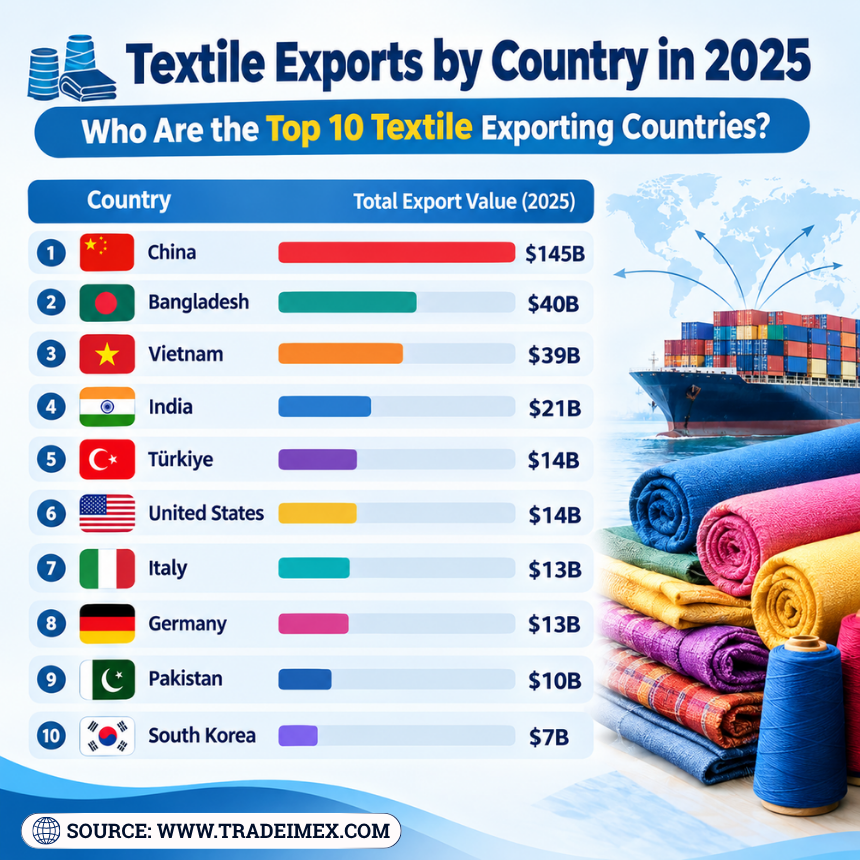
The global textile export market includes several major exporting countries, each with different areas of specialization. Textile exports by country are a vital component of the global economy, with various nations making significant contributions to the industry. The top 10 textile exporting countries play a crucial role in the international market, with China leading the pack as the largest exporter of textiles worldwide. Following closely behind are countries like India, Bangladesh, and Vietnam, showcasing their prowess in the textile industry. The top 10 leading textile exporters in the world in 2025 include:
Rank | Country | Total Export Value (2025) | Share of Textile Exports |
1 | China | $145B | 15.9% |
2 | Bangladesh | $40B | 4.4% |
3 | Vietnam | $39B | 4.3% |
4 | India | $21B | 2.3% |
5 | Türkiye | $14B | 1.5% |
6 | United States | $14B | 1.5% |
7 | Italy | $13B | 1.4% |
8 | Germany | $13B | 1.4% |
9 | Pakistan | $10B | 1.1% |
10 | South Korea | $7B | 0.8% |
1. China – Largest Global Textile Exporter
China remains the most influential country in global textile and apparel trade, as per the China export data. Its competitive advantage comes from its enormous manufacturing ecosystem, integrated supply chain, large production capacity, infrastructure, & extensive experience in international markets.
China exports a wide range of textile products, including:
Cotton and synthetic fabrics
Yarn and fibers
Knitted garments
Woven garments
Home textiles
Technical textiles
Textile machinery and related products
Trade statistics for knitted apparel demonstrate China's scale. In 2025, China exported around $85.37 billion of HS 61 knitted or crocheted apparel, substantially ahead of other exporters. China's textile industry is also increasingly moving toward higher-value products, advanced manufacturing, technical textiles, synthetic fibers, and automated production.
2. Bangladesh – Major Garment Export Hub
Bangladesh has established itself as one of the world's most important apparel manufacturing and exporting countries. The country's export strength is particularly concentrated in:
Ready-made garments
Knitwear
Woven apparel
Cotton clothing
Fashion garments
Basic and mass-market apparel
Bangladesh's competitive advantage has historically been supported by large-scale garment manufacturing, competitive labor costs, specialized production clusters, and strong relationships with international apparel brands. For businesses sourcing apparel, Bangladesh textile export data can help identify manufacturers & exporters supplying specific products to North America, Europe, and other international markets.
3. Vietnam – Rapidly Expanding Textile Exporter
Vietnam has become one of the most important textile and apparel manufacturing locations in Asia, according to Vietnam customs export data. Vietnam's textile industry benefits from strong integration into international supply chains and trade agreements with major markets. Its export portfolio includes:
Garments
Knitwear
Woven apparel
Synthetic textiles
Cotton products
Sportswear
Footwear-related textile products
Home textiles
Vietnam's increasing importance also reflects the broader China+1 supply-chain strategy, under which global companies diversify manufacturing beyond China. For importers and sourcing companies, Vietnam textile export data can help identify manufacturers serving the United States, Europe, Japan, South Korea, and other major markets.
4. India – Diverse Textile Manufacturing Base
India is one of the world's most diversified textile-producing economies, with capabilities ranging from raw materials and yarn to fabrics, garments, carpets, home textiles, and handicrafts. According to India's Ministry of Textiles, textile and apparel exports, including handicrafts, increased from $30.94 billion in FY 2023-24 to $33.89 billion in FY 2025-26, representing a CAGR of around 4.7%.
5. Türkiye – Strong European Textile Supplier
Türkiye remains an important textile and apparel exporter, particularly to European markets. Its geographical proximity to Europe gives Turkish textile manufacturers an advantage in lead times and regional supply chains. The country's industry covers fabrics, yarn, garments, home textiles, and finished apparel. In HS 61 knitted and crocheted apparel, Türkiye exported around $9.62 billion in 2025.
6. Italy – Premium Textile and Fashion Manufacturing
Italy occupies a distinctive position in global textile trade. Rather than competing primarily on low-cost mass production, Italian companies are strongly associated with premium fabrics, fashion textiles, luxury apparel, technical fabrics, & high-value manufacturing. Italian textile exporters are particularly relevant to buyers seeking:
Luxury fabrics
High-quality yarn
Fashion textiles
Premium apparel
Technical textiles
Specialized textile products
Italy exported around $11.57 billion of HS 61 products in 2025.
Top 10 Textile Exporting Companies: Textile Exporters Database
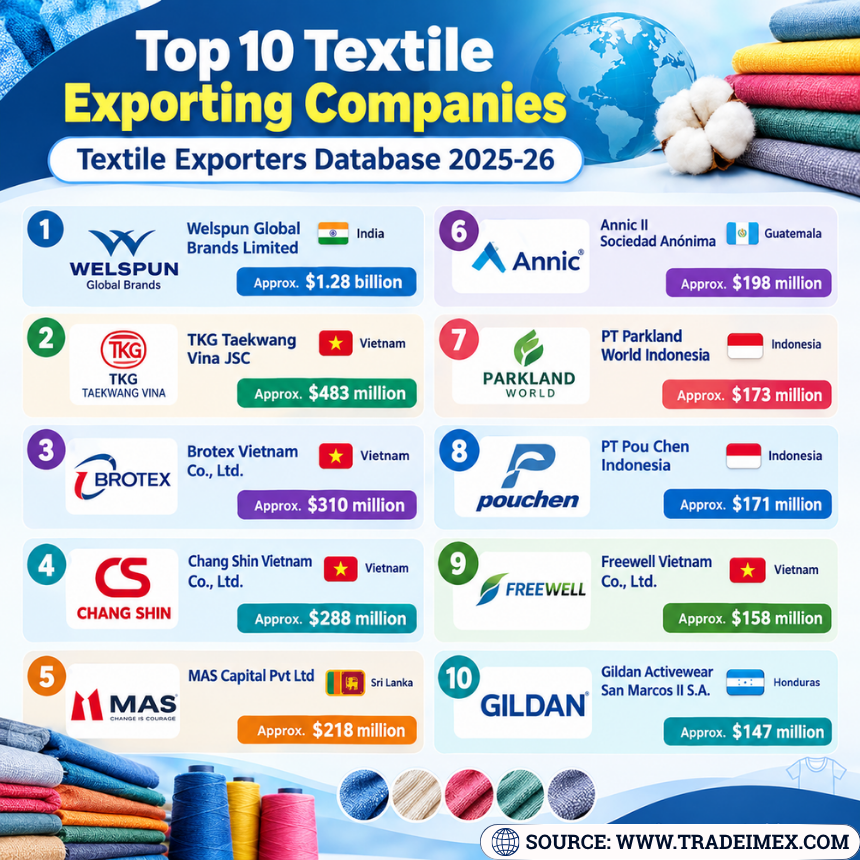
The Textile Exporters Database is a comprehensive resource showcasing the leading names in the textile industry. This database offers valuable insights into the top players in textile exports, providing vital information for businesses looking to engage in international trade for textiles and apparel. The top 10 leading textile suppliers and exporters in 2025-26, according to the latest textile exporters database, include:
1. Welspun Global Brands Limited (India): Approx. $1.28 billion
2. TKG Taekwang Vina JSC (Vietnam): Approx. $483 million
3. Brotex Vietnam Co., Ltd. (Vietnam): Approx. $310 million
4. Chang Shin Vietnam Co., Ltd. (Vietnam): Approx. $288 million
5. MAS Capital Pvt Ltd (Sri Lanka): Approx. $218 million
6. Annic II Sociedad Anónima (Guatemala): Approx. $198 million
7. PT Parkland World Indonesia (Indonesia): Approx. $173 million
8. PT Pou Chen Indonesia (Indonesia): Approx. $171 million
9. Freewell Vietnam Co., Ltd. (Vietnam): Approx. $158 million
10. Gildan Activewear San Marcos II S.A. (Honduras): Approx. $147 million
Textile Export Data by Product & HS Code (2025)
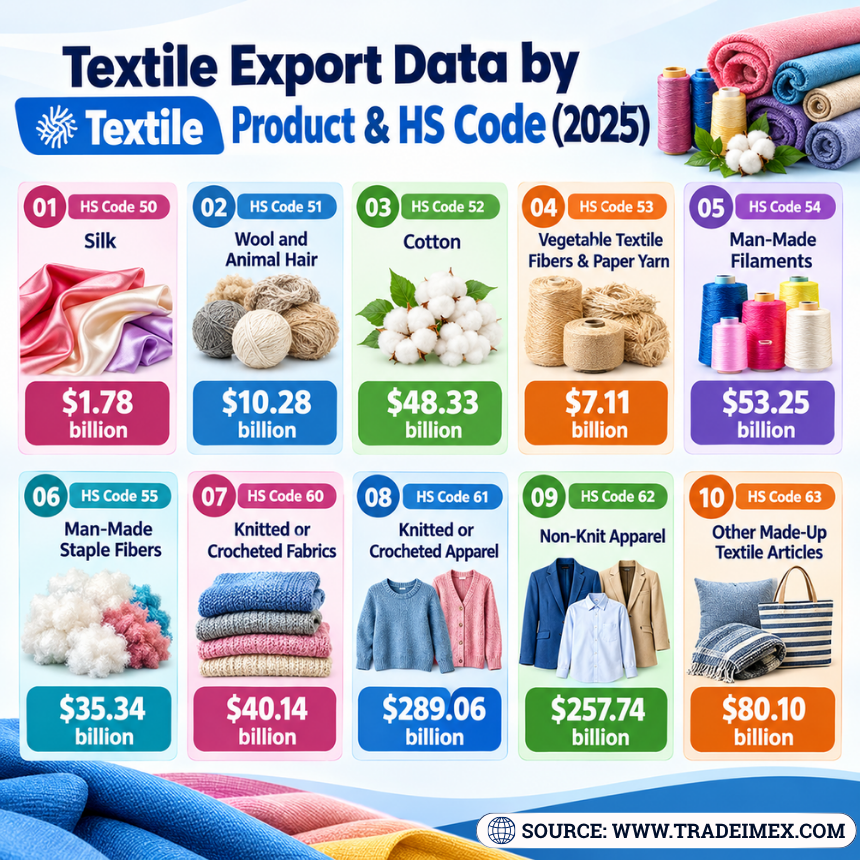
The textile industry is not a single product category. International trade data can be divided into numerous HS codes and product groups. Some of the most important categories for textile exports by HS code in 2025-26 include:
1. HS Code 50 – Silk: $1.78 billion
Silk & silk-based textile products represent a specialized segment of international trade. Major suppliers include countries with established silk production & processing industries.
2. HS Code 51 – Wool and Animal Hair: $10.28 billion
This category covers wool, animal hair, yarn, and woven fabrics. Countries such as Australia, China, Italy, and New Zealand have important roles across different stages of the wool supply chain.
3. HS Code 52 – Cotton: $48.33 billion
Cotton textiles are among the most commercially important textile categories. The product group covers cotton fibers, yarns, fabrics, and related products. India, China, Türkiye, and several other Asian countries have significant roles in cotton textile manufacturing and exports.
4. HS Code 53 – Vegetable Textile Fibers & Paper Yarn: $7.11 billion
HS Code 53 covers textile fibres of vegetable origin other than cotton, including flax, true hemp, jute, and other bast fibres, as well as paper yarn and fabrics made from paper yarn.
5. HS Code 54 – Man-Made Filaments: $53.25 billion
Synthetic fibers and filament products are becoming increasingly important as textile manufacturers respond to demand for polyester, nylon, and other performance-oriented materials.
6. HS Code 55 – Man-Made Staple Fibers: $35.34 billion
This category includes synthetic staple fibers, yarns, and fabrics and forms an important part of modern textile manufacturing.
7. HS Code 60 – Knitted or Crocheted Fabrics: $40.14 billion
Knitted fabrics are widely used in apparel, sportswear, casual clothing, and other finished products.
8. HS Code 61 – Knitted or Crocheted Apparel: $289.06 billion
HS 61 includes knitted and crocheted clothing and accessories. It is one of the most important finished-product categories in global apparel trade. Global HS 61 exports reached around $277.36 billion in 2025, with China accounting for around $85.37 billion.
9. HS Code 62 – Non-Knit Apparel: $257.74 billion
Woven apparel represents another major segment of global textile and clothing trade and includes shirts, trousers, dresses, coats, jackets, and other garments.
10. HS Code 63 – Other Made-Up Textile Articles: $80.10 billion
This category includes a broad range of products such as home textiles, household textile articles, blankets, curtains, bed linen, and other made-up textile products.
Textile Export Industry: Last 10 Years Export Data
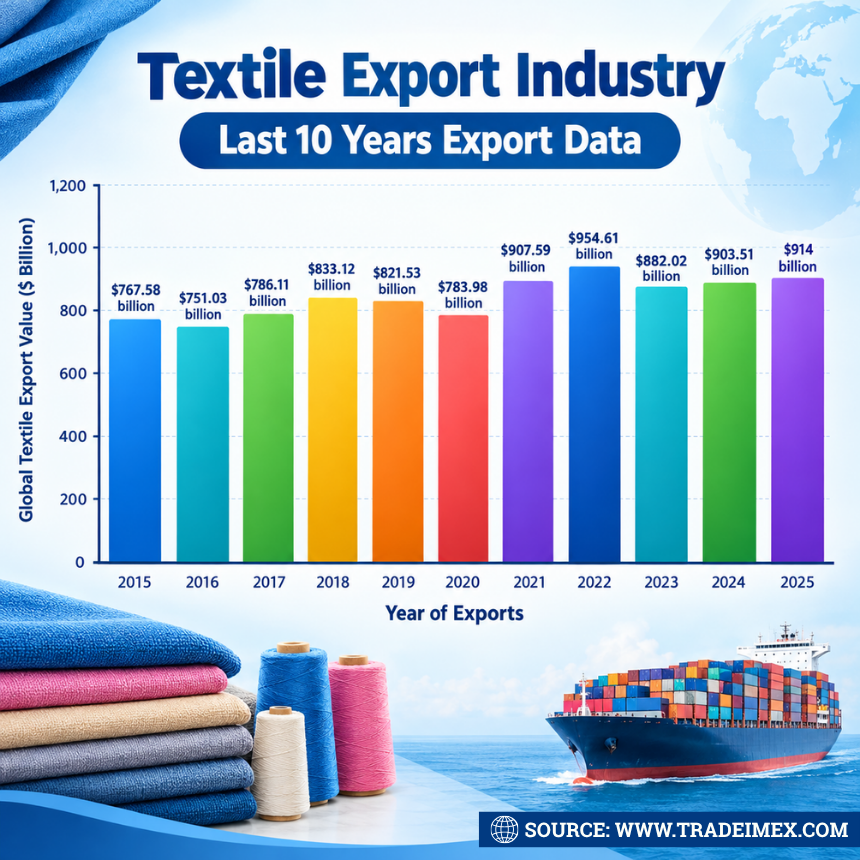
Year of Exports | Global Textile Export Value ($) |
2015 | $767.58 billion |
2016 | $751.03 billion |
2017 | $786.11 billion |
2018 | $833.12 billion |
2019 | $821.53 billion |
2020 | $783.98 billion |
2021 | $907.59 billion |
2022 | $954.61 billion |
2023 | $882.02 billion |
2024 | $903.51 billion |
2025 | $914 billion |
Major Textile Export Markets in 2025-26
Textile exporters are increasingly targeting diversified international markets. The United States remains one of the world's most important textile and apparel consumption markets, as per the US textile import data. Europe is another major demand center, with Germany, France, Italy, Spain, the Netherlands, and the United Kingdom representing important destinations, according to Europe trade data.
Asian markets are also significant. Japan, South Korea, China, and regional Southeast Asian economies support large textile supply chains. For exporters, however, simply identifying the biggest importing countries is not enough. The most useful analysis examines:
Product-specific import demand
Import growth rates
Average shipment values
Supplier concentration
Importer activity
Country-of-origin trends
Port-level movements
HS-code demand
Historical sourcing patterns
This is where detailed textile export data becomes more valuable than headline trade statistics.
Textile Exporters Database: From Market Size to Company-Level Intelligence
A country-level export figure tells businesses how much a market exports. It does not necessarily reveal which companies are responsible for those shipments. A textile exporters database addresses this gap by organizing trade information at the company & shipment level. Depending on the data type and market, a textile exporters database can help businesses research:
Exporter names
Importer and buyer names
Product descriptions
HS codes
Export destinations
Import origins
Shipment dates
Shipment quantities
Ports
Countries of origin
Countries of destination
Product specifications
Supplier activity
Historical shipment records
For example, an apparel importer looking for suppliers of cotton T-shirts can move beyond a broad search for "Vietnam textile exporters." By using product and HS-code filters, the buyer can narrow the market to companies involved in relevant product shipments. This makes trade data particularly useful for B2B sourcing and supplier discovery.
Textile Export Trends Shaping 2025-26
Several structural trends are influencing the textile export market.
1. Supply-Chain Diversification
International brands are increasingly diversifying sourcing networks. This has strengthened the position of Vietnam, Bangladesh, India, Türkiye, and other manufacturing hubs.
2. Growth of Synthetic and Technical Textiles
Demand is expanding beyond conventional cotton and wool toward synthetic, recycled, functional, and technical textile products.
3. Sustainability
Environmental regulations and consumer preferences are encouraging manufacturers to adopt recycled fibers, energy-efficient manufacturing, traceability systems, and sustainable production processes.
4. Regional Trade Agreements
Trade agreements can substantially influence textile competitiveness by changing tariff structures and market access.
5. China+1 Sourcing
The China+1 strategy continues to encourage international businesses to develop alternative manufacturing and sourcing relationships. This creates opportunities for exporters in India, Vietnam, Bangladesh, Indonesia, Türkiye, & other textile-producing economies.
How TradeImeX Supports Textile Industry Trade Research
A global trade intelligence platform such as TradeImeX can help businesses analyze textile markets using country, product, HS code, company, and trade-flow filters. The platform's global trade database can be used to research:
Textile import-export data
Textile HS codes
Textile exporters
Textile importers and buyers
Country-wise textile trade
Product-wise trade trends
Historical shipment activity
Supplier discovery
Market opportunities
Customized trade reports
Businesses can begin with a broad country-level question and progressively narrow their research to a product, HS code, company, destination, or trading relationship. For example, a textile buyer could start with AI-powered trade search:
"Who are the top textile exporters in USA?"
The research can then progress to:
"Which American companies exported knitted garments to the Philippines?"
And finally:
"Which exporters have repeatedly supplied similar products and which buyers have imported them?"
This progression from market-level intelligence to company-level discovery is one of the major advantages of structured trade data.
Future Outlook for the Global Textile Export Industry
The global textile industry is expected to remain highly competitive throughout 2025-26 and beyond. Global textile exports have already expanded to around $914 billion, while apparel trade continues to be reshaped by changing consumer demand, supply-chain diversification, sustainability requirements, & technological developments. China is likely to retain its leadership position, but the competitive landscape is becoming more diversified. Bangladesh and Vietnam remain major apparel manufacturing centers, India has significant potential across the complete textile value chain, and Türkiye continues to benefit from proximity to European markets.
For exporters, future growth will increasingly depend on product specialization, manufacturing efficiency, sustainability, market diversification, & access to global buyers. For importers, the challenge will be finding reliable suppliers while managing pricing, quality, delivery schedules, compliance, and geopolitical risks.
Consequently, textile export data 2025-26 is becoming more than a source of historical statistics. When combined with a comprehensive textile exporters database, it can serve as a strategic tool for supplier discovery, competitor analysis, market expansion, lead generation, and international sourcing.
Conclusion
The textile industry export data 2025-26 demonstrates the enormous scale and continuing transformation of global textile trade. With world textile exports reaching $914 billion in 2025, the sector remains a critical component of international manufacturing and merchandise trade. China continues to dominate global textile exports, while Bangladesh, Vietnam, India, Türkiye, Italy, and other countries maintain strong positions across specific textile and apparel categories. However, country-level statistics are only the starting point. Businesses looking for practical trade opportunities need to know which companies are exporting, what they are exporting, where they are shipping, and which buyers are purchasing their products.
Note For Our Readers
That is why a reliable textile exporters database can complement global trade statistics. By connecting country-level market intelligence with product, HS-code, company, buyer, supplier, and shipment-level information, businesses can identify opportunities more efficiently and make better-informed international trade decisions. For the latest textile export-import data by country or HS code & AI-powered trade search, contact info@tradeimex.in and get customized trade reports & market insights for your business.
Explore the latest global trade trends, market insights, import-export analysis, and industry updates with TradeImeX blogs.
Request a Data Sample →
Tradeimex
TradeImeX’s content team brings together expertise in global trade data, import-export trends, market intelligence, and international business. Our writers turn complex trade data into clear, actionable insights to help businesses understand markets, identify opportunities, and make informed decisions. From emerging trade trends to country and product-level analysis, we focus on delivering timely insights backed by reliable data.